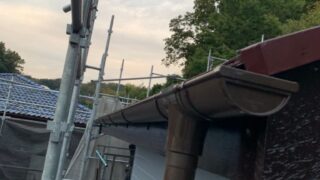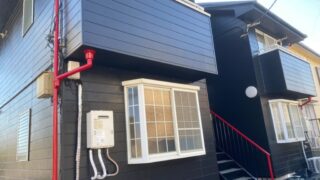
Leave the repairs and renovations of condominiums and apartments in Nakagun, Kanagawa Prefecture (Oiso Town and Ninomiya Town) to Kakeru Koumuten Co., Ltd.!
Large-Scale Renovations for Condominiums, Apartments, and Buildings in Nakagun, Kanagawa Prefecture (Oiso Town and Ninomiya Town)
To owners, management associations, and management companies considering large-scale renovations for condominiums, apartments, and buildings in Nakagun, Kanagawa Prefecture (Oiso Town and Ninomiya Town).
Kakeru Koumuten Co., Ltd. is a renovation company that handles everything from the installation of temporary scaffolding, substrate repairs, exterior painting, tile repairs, sealing, waterproofing for rooftops and balconies, to roofing work, all managed and performed by our own team. In Nakagun, we have undertaken numerous large-scale renovations and exterior reforms for apartments, condominiums, and commercial facilities.
- On-site surveys and estimates are completely free (we welcome competitive estimates)
- All management from temporary scaffolding to exterior and roofing work is handled in-house
- Our own scaffolding team will handle sites with slopes and elevation differences after confirming the location
- Consultations for partial repairs and emergency measures for leaks are also possible
- Cost Estimate / For condominiums, the cost per unit is approximately 750,000 to 1,500,000 yen (according to the Ministry of Land, Infrastructure, Transport and Tourism’s survey for the 3rd year of Reiwa, about 70% fall within this range, with the most common being 1,000,000 to 1,250,000 yen. This amount excludes consumption tax and common temporary costs). For wooden apartments, the estimate is 2,000,000 to 4,000,000 yen per building.
- Estimated Cycle / 12 to 15 years. However, the deciding factor is not the number of years but the condition of deterioration.
- Particularly Relevant in Nakagun / Considerations for sea breezes, salt damage, and tsunami/flood risks along Sagami Bay, slopes, retaining walls, and landslide risks at the foot of hills, the age of residential areas developed in the 1960s and 1970s, and the landscape plan of Oiso Town and scenic district of Ninomiya Town regarding color and procedural confirmations.
- Available Funding / There are no subsidies specifically for large-scale renovations, but if requirements are met, property tax reductions (the national system applies to projects completed by the end of March in Reiwa 9. The reduction rate varies by town), national subsidies if windows and insulation are included, and public financing may be available.
- Tips for Success / At least three competitive estimates. Compare not only the amounts but also the quantities, methods, and materials.
Large-scale repair work that can be handled in Nakagun, Kanagawa Prefecture (Oiso Town and Ninomiya Town)
Large-scale repairs are not just “exterior painting” or “waterproofing,” but a comprehensive repair of the entire building while scaffolding is in place. At Kakeru Koumuten, we can handle all the work listed below with our own team, ensuring clear responsibility and coordination of the process.
| Type of Work | Main Contents |
|---|---|
| Temporary Scaffolding Work | Installed by our own scaffolding team using our own scaffolding materials. We handle mesh sheets, protection, and fall prevention measures. |
| Substrate Repair Work | Crack repair, injection of floating mortar and tiles, explosion (exposed rebar) repair, resin mortar repair for missing parts. |
| Exterior Wall Painting Work | High-pressure washing, three coats from primer to topcoat, painting of ancillary parts (iron parts, gutters, water cuts, etc.). We accommodate radical control type, fluorine, and inorganic paints. |
| Tile Repair Work | Replacement of broken tiles, joint repair, clear waterproofing of tile surfaces (such as Seven S). |
| Sealing Work | Replacement and additional sealing around sashes and exterior wall joints. |
| Waterproofing Work | Urethane waterproofing for rooftops, roof balconies, shared corridors, and stairs, PVC sheet waterproofing, and installation of long sheets. |
| Roof Work | Roof painting, roof overlay (cover method), re-roofing, and ridge cap replacement. We have sheet metal craftsmen on staff and can handle large roofs such as factories. |
| Iron and Metal Work | Surface painting of steel staircases, handrails, and PS doors, replacement of coping and water cuts. |
| Drainage and Wastewater Work | Cleaning and renovation of roof drains (insertion of renovation drains), unclogging of gutters. Clogs in drainage can lead to puddles on rooftops and leaks, so inspection and cleaning are essential tasks. |
| Others | Replacement of rain gutters, rooftop and exterior wall inspections using drones, leak investigations using thermography, and preliminary surveys of asbestos-containing materials. |
Scope of Major Repairs Determined by Building Diagnosis
It is not always necessary to carry out all the above works. The extent of the work will be determined based on the results of the building diagnosis. At Kakeru Koumuten, we conduct a free on-site survey to confirm the following and compile a deterioration diagnosis report with photos, after which we will propose the scope of work.
| Diagnosis Area | Main Investigation Method | Scope of Work Determined by Diagnosis Results |
|---|---|---|
| Exterior Wall (Painted Surface) | Visual inspection, checking the width of cracks and the condition of the paint film | Methods and quantities for crack repair, specifications for painting (whether to repaint or paint after removing the existing paint film) |
| Exterior Wall (Tile Surface) | Sounding investigation. High areas checked with a drone | Scope and estimated quantity for injection and replacement, whether clear waterproofing is necessary |
| Sealing | Checking for cracks, shrinkage, peeling, and hardening | Whether to replace or add to the existing seal, the scope of joints to be worked on |
| Roof, Balcony, Shared Corridor | Checking for blisters or breaks in the waterproof layer, puddles, and the condition of drains | Full renovation or partial repair, method (urethane waterproofing, PVC sheet waterproofing, long sheet), whether drain renovation is necessary |
| Leak Areas | Investigation using thermal imaging cameras and drones | Identification of the cause and the priority areas for repair |
| Metal Parts, Roof, Auxiliary Parts | Checking for rust, corrosion, lifting, and cracking. For buildings near the sea, checking the progression of rust due to salt | Whether painting is sufficient or if material replacement or overlay installation is necessary |
| Site and Surroundings | Checking slopes, retaining walls, embankments, trees, delivery routes, and parking areas | Planning for scaffolding and the scope of temporary construction |
Reasons Why Kakeru Koumuten is Chosen for Large-Scale Renovations in Nakagun, Kanagawa Prefecture (Oiso Town and Ninomiya Town)

The reason why we can be entrusted with large-scale renovations in Nakagun is partly because “Kakeru Koumuten has a base in Yokohama City”, but also because of our “unique initiatives in large-scale renovation work that cannot be imitated by other companies”, which have received high praise from many customers.
1. Equipment Specialized for Exterior Renovations
At Kakeru Koumuten, we have prepared the following warehouses and material storage areas to provide low-cost, high-quality exterior wall painting and waterproofing work for large-scale renovations. We have established five bases centered around Yokohama City for material storage and showrooms.
In-house Scaffolding Materials
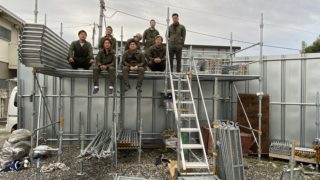
 We own the scaffolding materials necessary for temporary scaffolding required for large-scale renovations and can assemble the scaffolding ourselves.
By performing scaffolding work with our own scaffolding team instead of outsourcing, we can cut costs related to scaffolding work and provide quick and flexible responses.
We have approximately enough scaffolding materials for 100 single-family homes!
Storage of Materials in Our Large In-house Warehouse
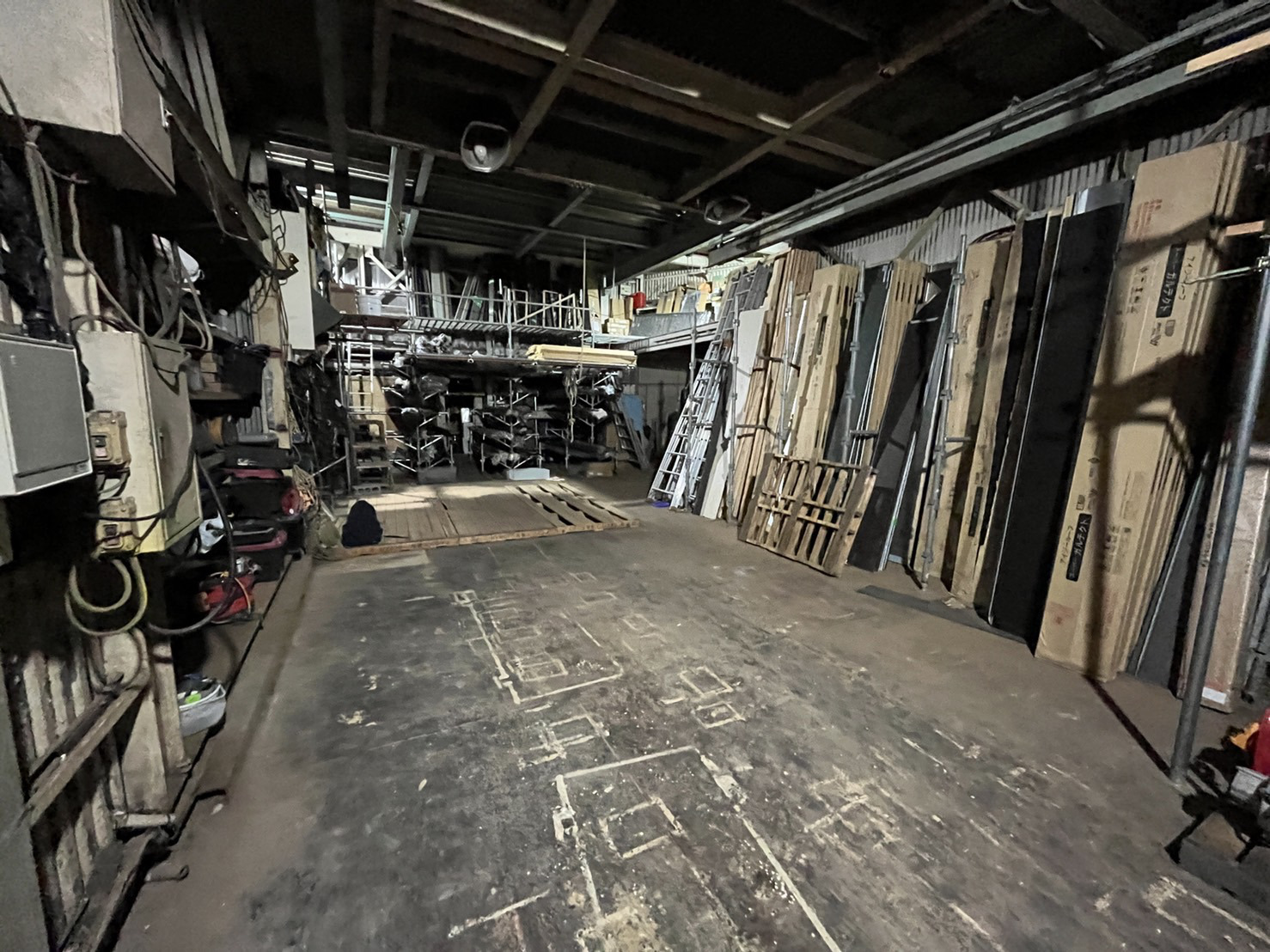 We store paints and substrate repair materials used for exterior renovations. By ordering a large quantity of materials at once, we can procure materials at a lower cost! Additionally, we always have stock available, allowing for swift responses in emergencies!
In-house Waste Separation
 Large-scale renovations generate various waste materials such as leftover paint, metal, and wood. At Kakeru Koumuten, we separate and recycle waste materials in-house, leading to cost reductions in waste disposal.
Showroom Dedicated to Exterior Renovations

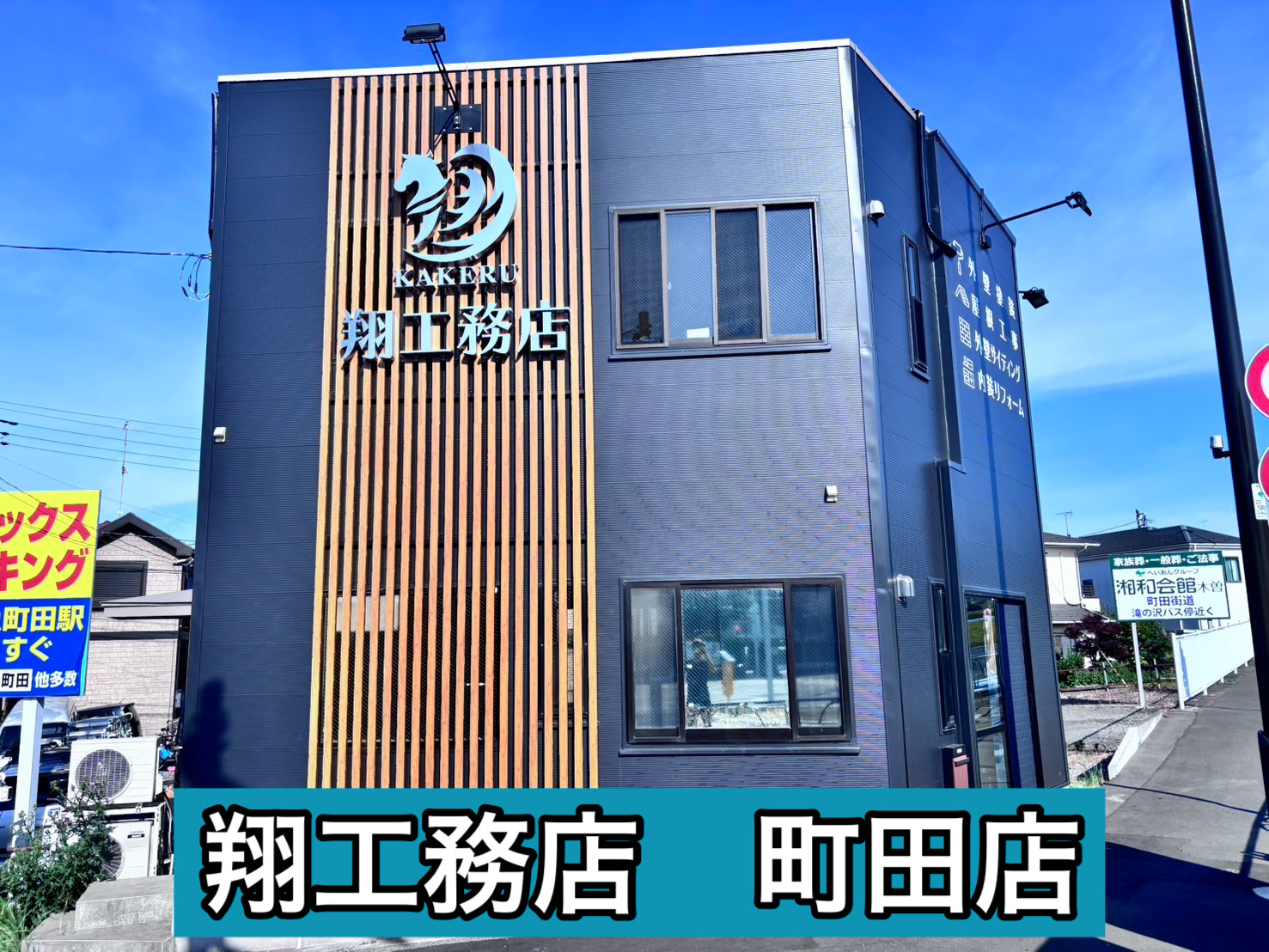
In the showroom, not only can you have meetings, but you can also check actual samples and colors of exterior materials. Color simulations for exterior wall painting and heat insulation tests using a heat insulation testing machine are also available!
2. Cost Reduction through In-House Management and Construction
 One of Kakeru Koumuten’s major strengths is in-house management and construction.
From inquiry to project completion, everything is managed by Kakeru Koumuten in a consistent system, allowing for high-quality large-scale repairs at reduced costs. Additionally, one representative will handle everything from the estimate to project completion. Since the same person is responsible for sales and construction management, smooth communication is possible.
We can handle everything from temporary scaffolding installation to exterior wall painting, substrate repairs, waterproofing work, and tile repairs with complete in-house construction! Those with specialized knowledge and experience conduct inspections and actual construction for each process!
3. Various Permits and Skilled Workers
 We have obtained construction industry permits and permits for industrial waste collection and transportation! We also have national qualified sheet metal workers and painting skilled workers, giving us confidence in our construction techniques. We can also handle large-scale roofing work for factories! We have qualified personnel for asbestos work supervisors and building material asbestos surveyors, so we can handle asbestos-containing roofing materials and preliminary surveys as well.
4. Warranty and Aftercare
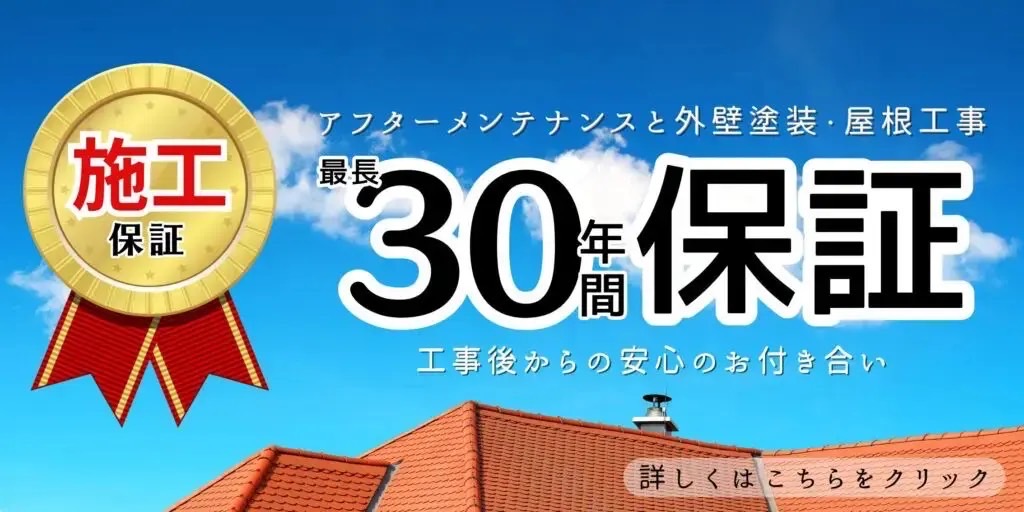
Most large-scale repair works, including “painting work,” “substrate repair work,” and “waterproofing work,” come with a warranty!
Aftercare is available every year, and we send out notification DM every year.
5. Flexible and Prompt Response

Our company is equipped to handle various troubles and situations related to apartments and condominiums.
We can address exterior walls and rooftops that cannot be inspected from high places by utilizing drones! During rain leak investigations, we can also use a thermal imaging camera, which helps in identifying the cause of leaks!
We will respond according to your wishes. We also accept emergency measures for sudden rain leaks! We will promptly respond to urgent requests!
6. Staff Development
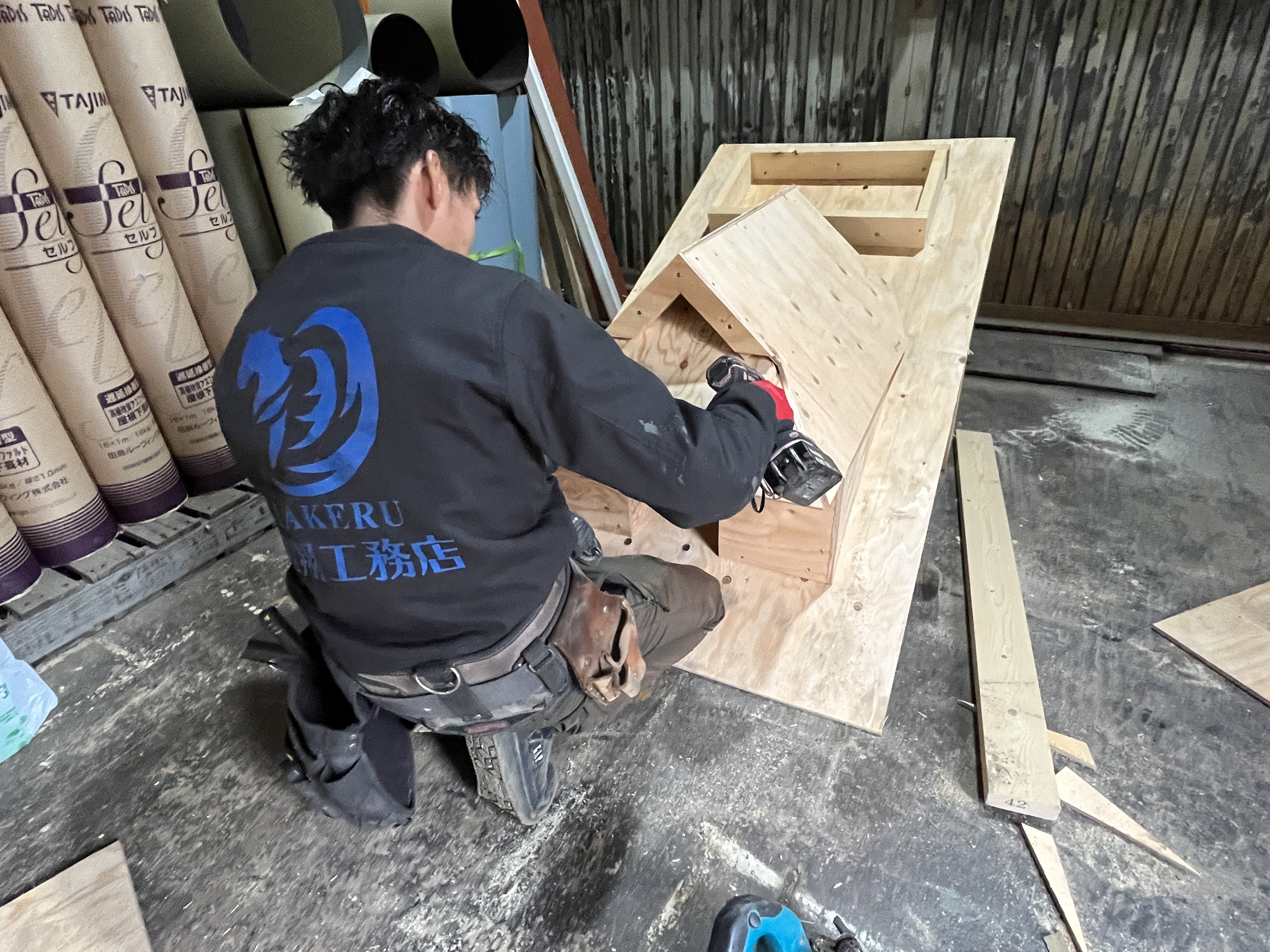
Our staff creates various models to improve their skills and conducts practical training. Since different processing and techniques are required at the site, we regularly conduct skill enhancement education to ensure each staff member can respond appropriately. We also provide education on points to be careful about and areas to check during large-scale repair work.
7. Consideration for Residents and Neighbors
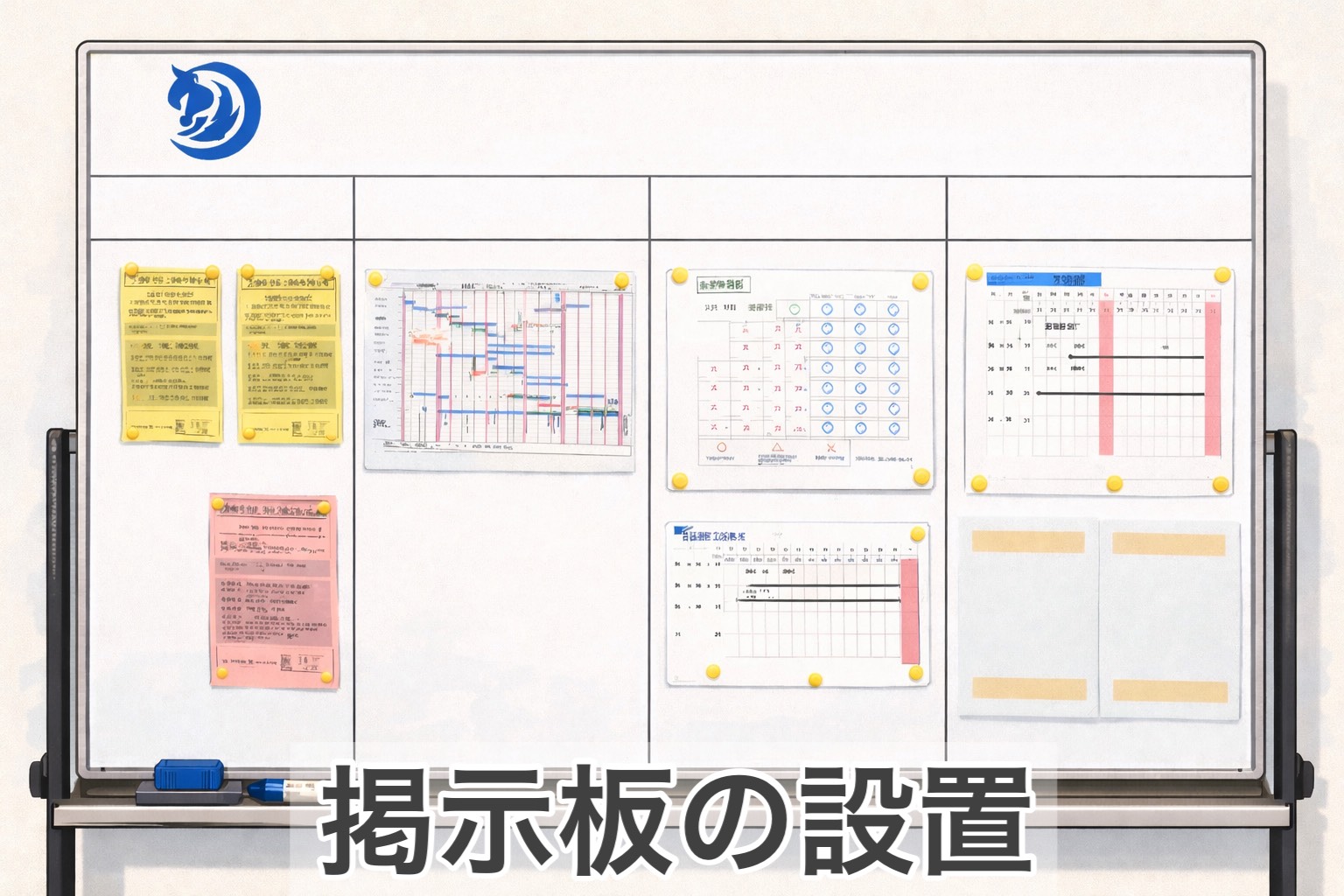
During large-scale repair work, we not only notify residents and greet neighbors, but we also install notice boards at entrances to display progress charts and announcements! Additionally, we thoroughly educate entrants on manners to minimize inconvenience to residents and neighbors.
8. Strict Quality Control
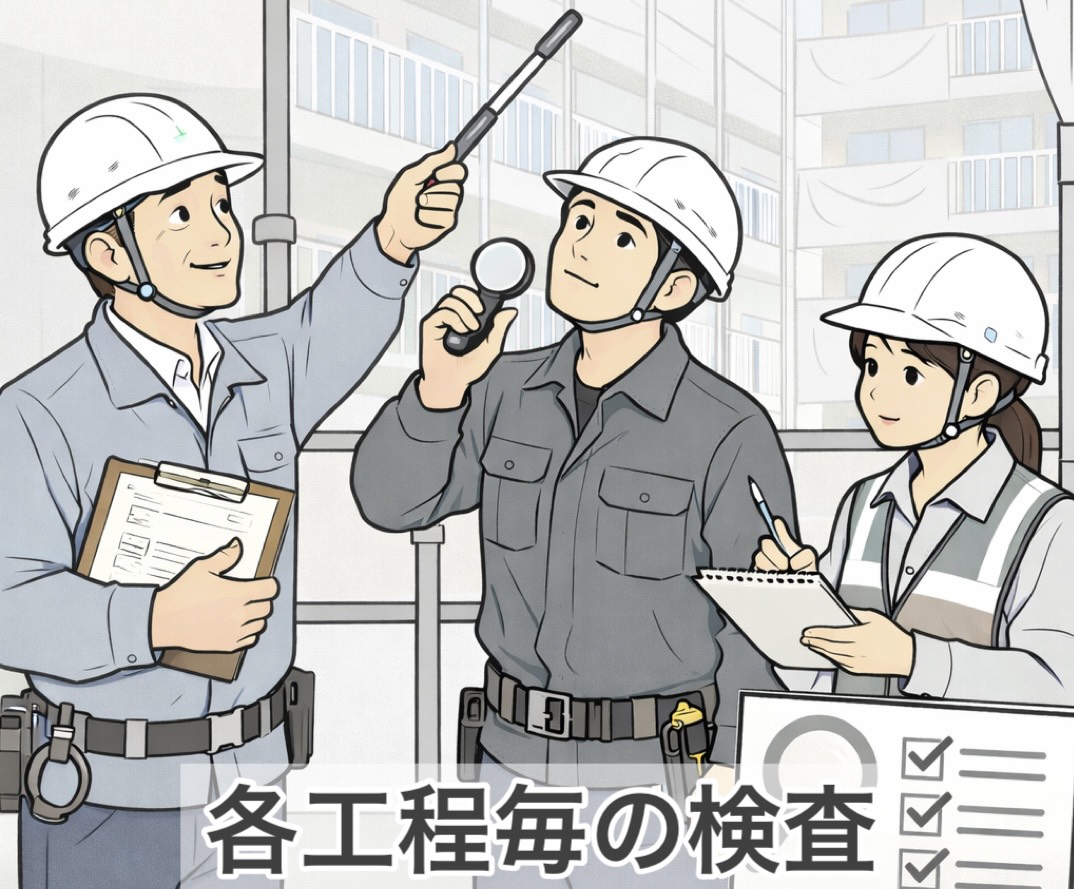
Each process is inspected by a responsible person, and detailed construction photos are taken. We use film thickness testers and check sheets to ensure there are no oversights in inspections. During exterior painting and waterproofing work, we check the quantity of used paint cans to confirm that the specified amount of paint is used, and we prevent construction defects by ordering paint in-house. Of course, we will also take photos of used paint and report them.
9. Exterior Painting Color Simulation
9-1 Self-Color Simulation
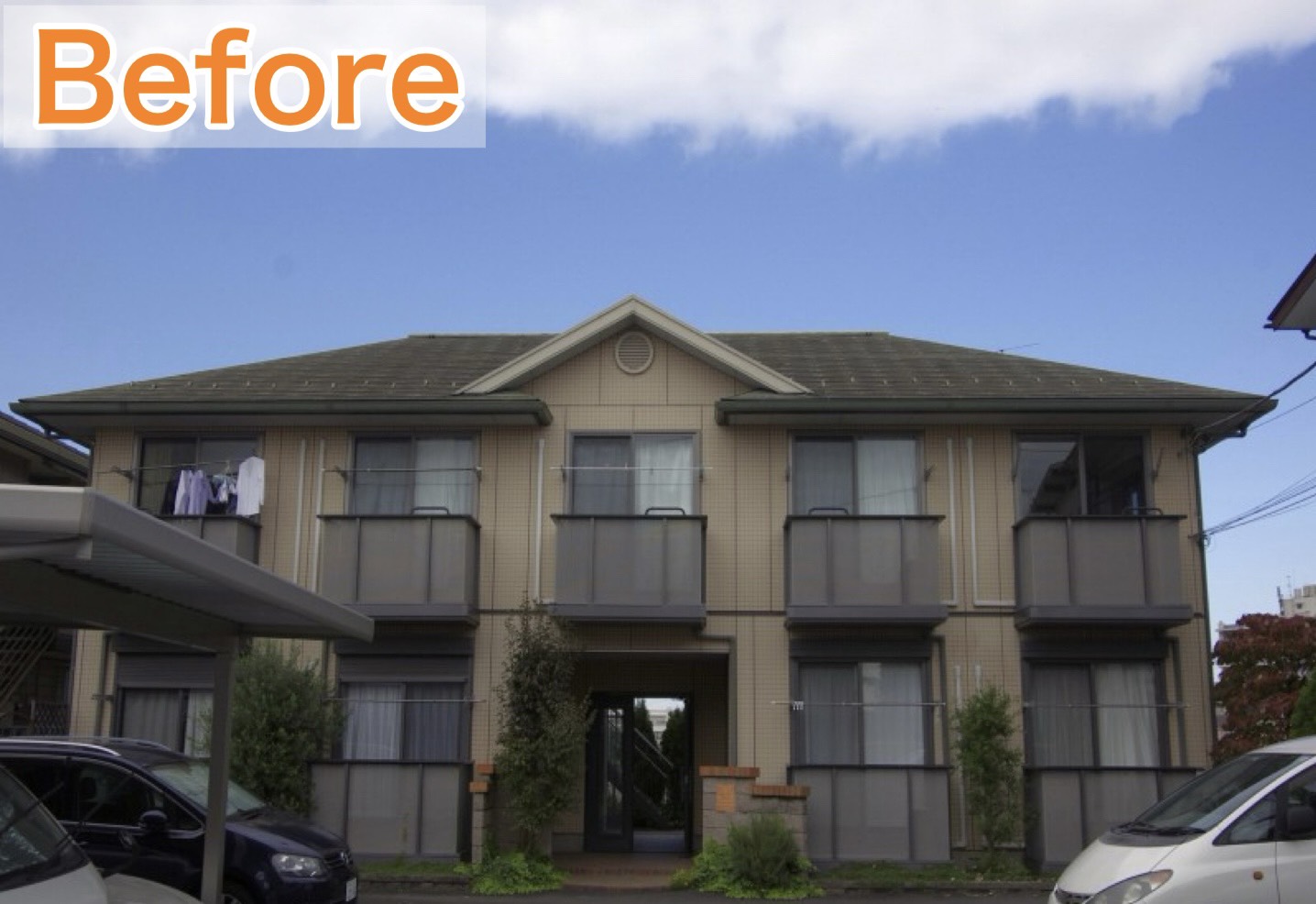
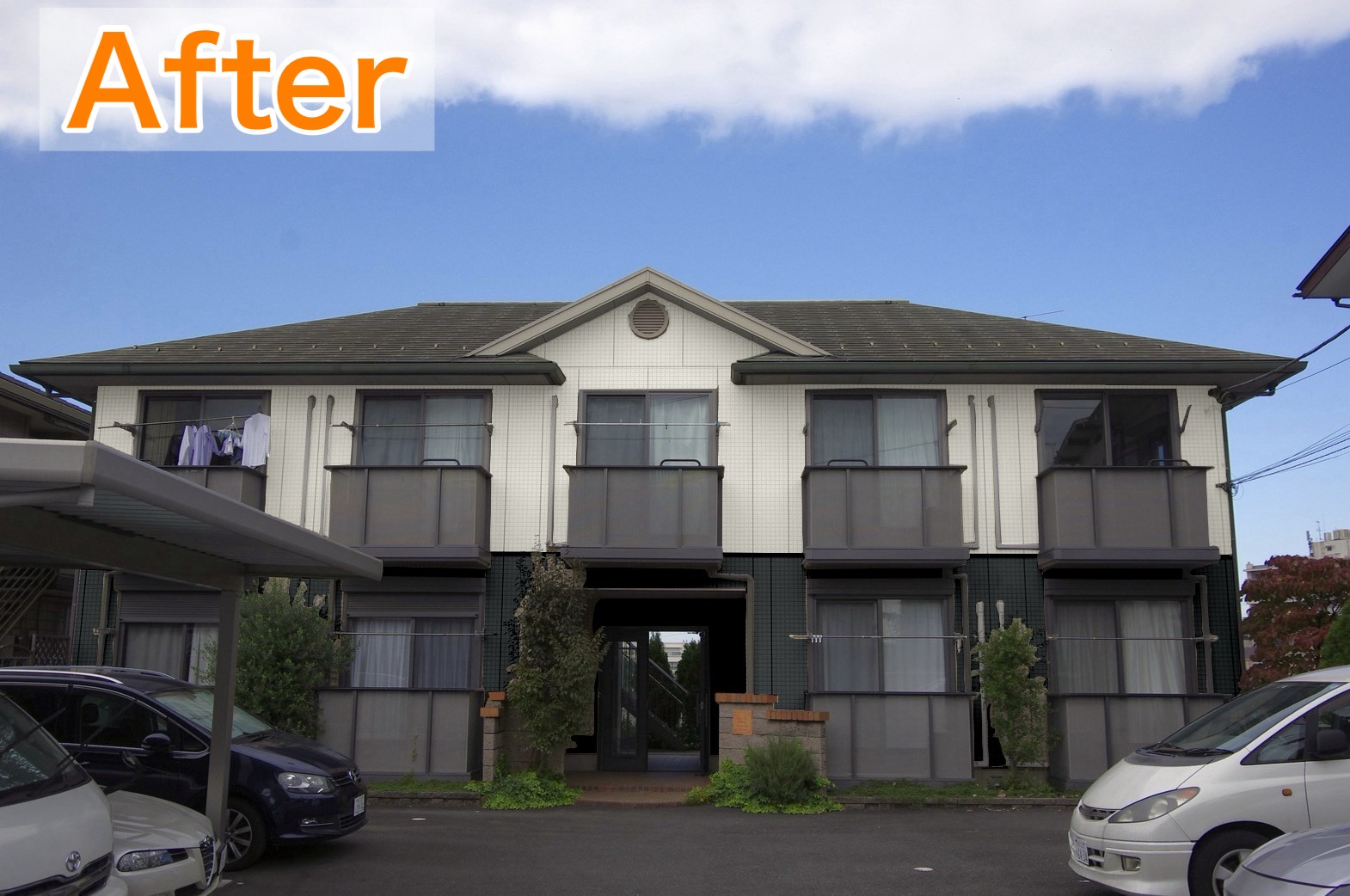
The simulations created by our company can be done using photos of your actual apartment or building!You can also perform simulations on your smartphone or computer. By simulating and then changing to a two-tone color or making an image change, we hope to help enhance the stylish appearance and increase occupancy rates! Of course, we can also arrange paint samples for actual color confirmation.
*In Oiso Town, the entire area is designated as a landscape planning zone, and in Ninomiya Town, there is the Azumayama Scenic Area, where notifications or permits may be required when changing the color of the exterior walls. There are also areas with district planning. Having a color simulation screen can help facilitate explanations at the management association’s general meetings and community meetings.
9-2 Confirm the actual color with a trial paint!
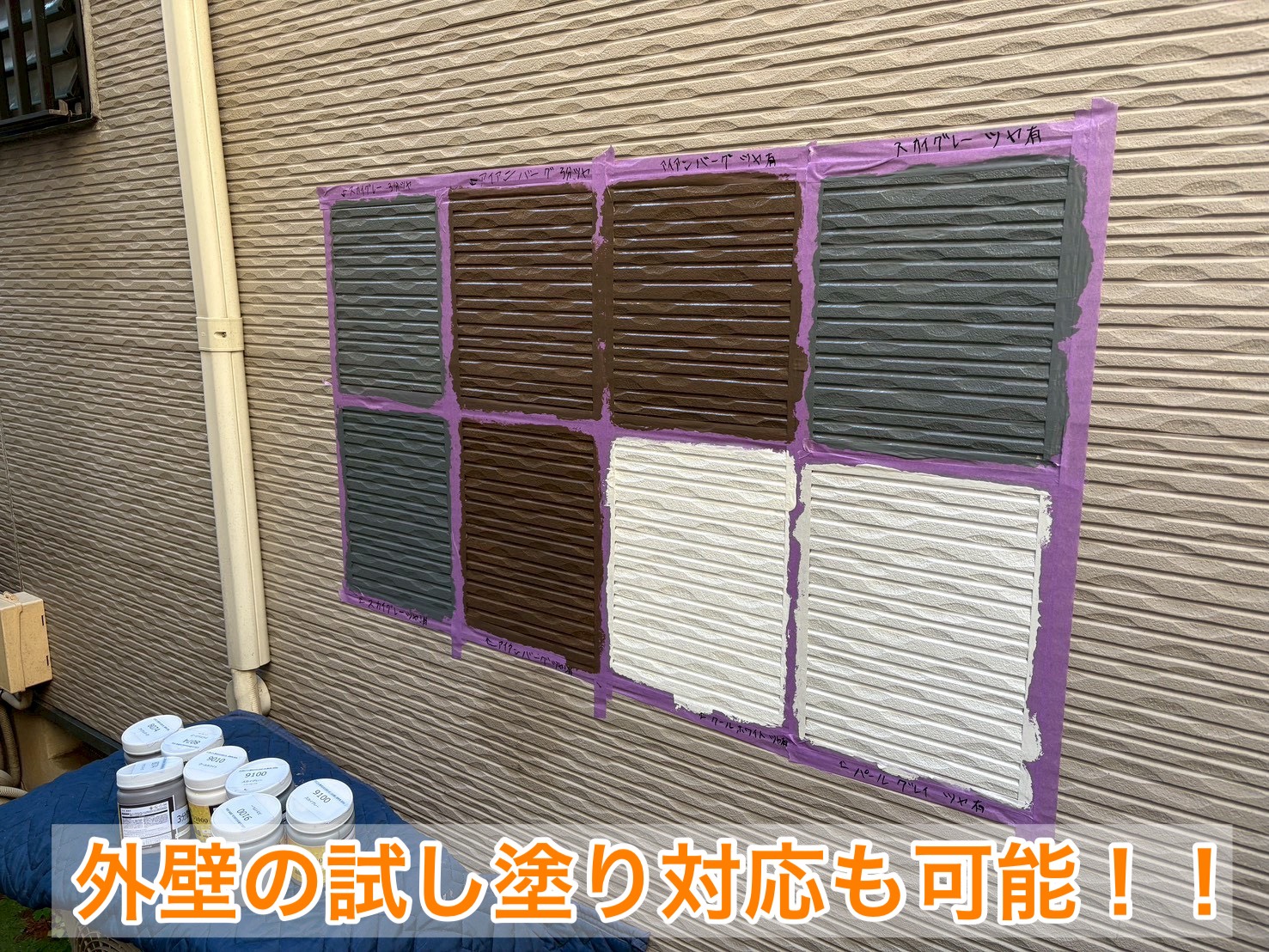 You can order samples of the paint you are considering and conduct trial painting on your exterior wall. By doing a trial paint, you can confirm the actual color and gloss!
9-3 Exterior renovation simulation
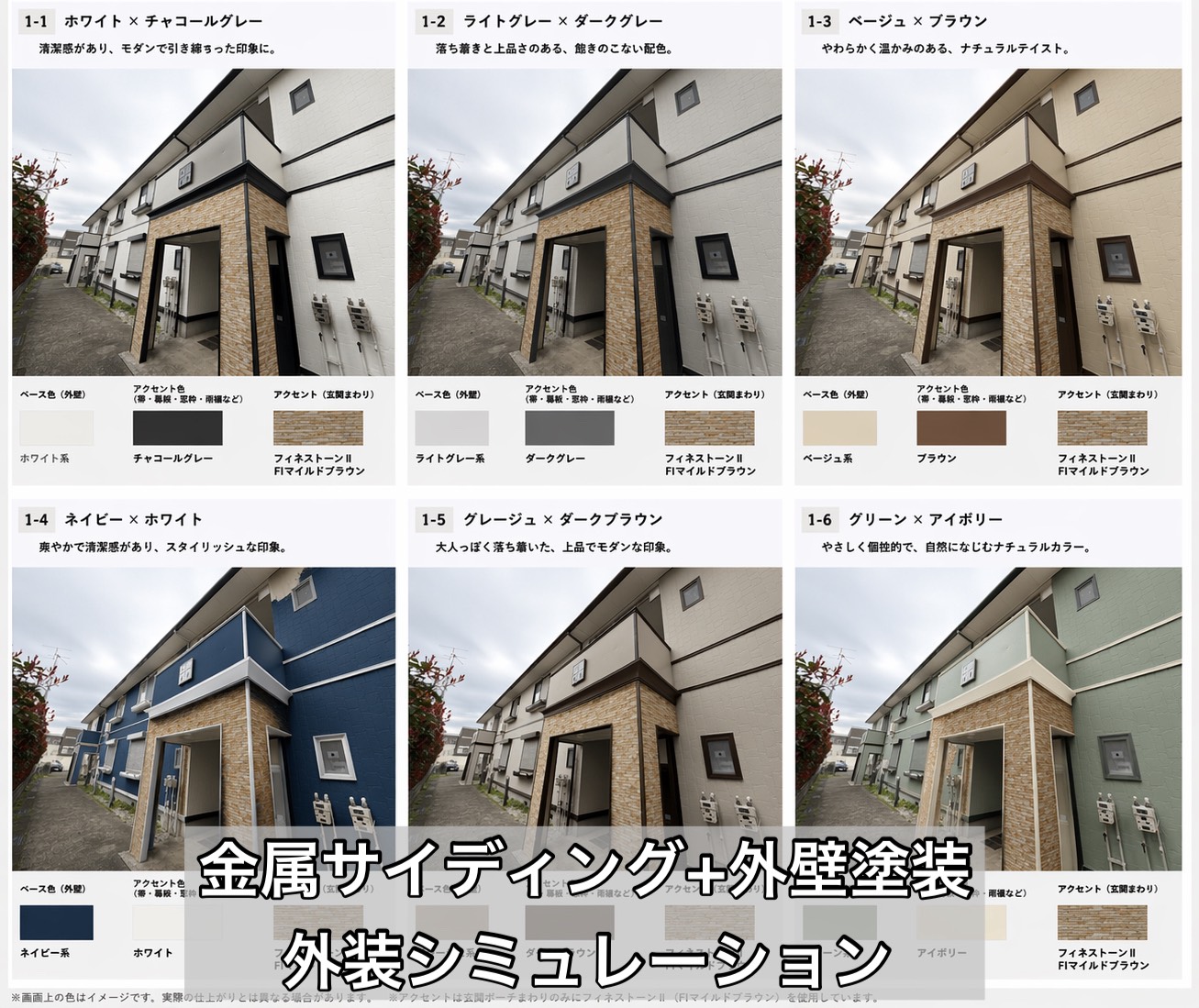
Exterior simulations for apartments and condominiums are also possible!
・Exterior wall color simulation (two-tone colors are also possible)
・Simulation for when metal siding is applied
・Simulation using accent materials such as cornices and louvers
・Simulation for roof painting or roof replacement work
With the exterior renovation simulation, you can minimize the risk of failure in image changes! We hope that renovating the appearance of your apartment or condominium will help increase occupancy rates.
Estimated Costs for Large-Scale Repairs in Nakagun, Kanagawa Prefecture (Oiso Town and Ninomiya Town)
The costs for large-scale repairs vary significantly depending on the size of the building, its condition, the scope of work, and the materials used. First, please refer to the national average based on public statistics, then to our company’s cost estimates based on past projects categorized by size, and finally to examples of unit prices for each type of work.
The national average for condominiums is 750,000 to 1,500,000 yen per unit
According to a survey conducted by the Ministry of Land, Infrastructure, Transport and Tourism, which compiled 818 construction cases (FY 2021), approximately 70% of the costs for large-scale repairs are concentrated in the range of 750,000 to 1,500,000 yen per unit, with the most common price range being 1,000,000 to 1,250,000 yen. Note that the amounts in this survey do not include consumption tax and common temporary costs, so they differ from the current total construction costs including tax.
| Construction Cost per Unit | Percentage | Construction Cost per Unit | Percentage |
|---|---|---|---|
| Up to 750,000 yen | 15.1% | 1,250,000 to 1,500,000 yen | 17.4% |
| 750,000 to 1,000,000 yen | 24.7% | 1,500,000 to 2,000,000 yen | 9.1% |
| 1,000,000 to 1,250,000 yen | 27.0% (most common) | Over 2,000,000 yen | 2.8% |
Source: Ministry of Land, Infrastructure, Transport and Tourism “FY 2021 Survey on Large-Scale Repair Work for Condominiums” (200 companies, 818 cases) *The amounts do not include consumption tax or common temporary costs. The percentages may not total 100% due to rounding and non-responses.
Breakdown of Construction Costs (What the Money is Spent On)
| Category | Composition Ratio | Main Contents |
|---|---|---|
| Construction-related Work | 60.3% | About half for exterior walls, about one-third for waterproofing. Substrate repairs, tiles, painting, waterproofing |
| Temporary Work | 22.8% | Scaffolding, mesh sheets, protective coverings, etc. (does not include common temporary costs) |
| Miscellaneous Expenses | 10.3% | Site management fees, general management fees, statutory welfare costs, etc. (9.5%), insurance premiums for large-scale repair defects (0.8%) |
Source: Ministry of Land, Infrastructure, Transport and Tourism “Fiscal Year 2021 Survey on Large-Scale Repair Work for Condominiums” (Second survey of large-scale repair work. The overall average is 59.0% for construction-related costs, 22.3% for temporary works, and 9.9% for miscellaneous expenses). *The total does not equal 100% because it includes equipment-related work, external works, and others. This is an average value and is not a criterion for judging the appropriateness of individual estimates.
Cost Estimates by Building Size (Scaffolding, Substrate Repair, Exterior Painting, Waterproofing, Sealing)
| Type and Size of Building | Cost Estimate | Estimated Construction Period |
|---|---|---|
| Wooden Apartment (2 stories, 6-10 units) | 2,000,000 – 4,000,000 JPY | 3 – 5 weeks |
| Steel Frame/RC Apartment (3 stories, 10-20 units) | 4,000,000 – 9,000,000 JPY | 1 – 2 months |
| Mixed-Use Building/Small Condominium (4-5 stories) | 5,000,000 – 15,000,000 JPY | 1.5 – 3 months |
| Medium-Sized Condominium (30-50 units) | 20,000,000 – 50,000,000 JPY | 3 – 5 months |
| Large Condominium (over 100 units) | Around 100,000,000 JPY or more | 6 months or more |
*The above estimates are based on Kakeru Koumuten’s construction performance and may vary depending on the presence of roofing work, metal work, plumbing, etc. For condominiums, please also consider the amount obtained by multiplying the above national statistics (750,000 – 1,500,000 JPY per unit) by the number of units as a reference.
Breakdown of Costs for Temporary Works, Substrate Repair, Exterior Walls, and Waterproofing
The estimate for large-scale repairs is broadly divided into “temporary works,” “substrate repair,” “sealing,” “exterior painting,” “waterproofing,” and “miscellaneous expenses.” Before comparing total amounts, please check what each item includes, how much, and at what cost.
| Item | What to Confirm in the Estimate |
|---|---|
| Building Prerequisites | Structure (wooden, steel frame, RC), number of floors, number of units, exterior wall area, waterproof area. Confirm whether the area is based on drawings or actual measurements. |
| Common Temporary Works & Scaffolding | Area and unit price of scaffolding, mesh sheets, protective measures, temporary toilets, etc. According to the Ministry of Land, Infrastructure, Transport and Tourism’s survey for Reiwa 3, temporary works such as scaffolding account for about 20% of construction costs (excluding common temporary costs). |
| Substrate Repairs | Quantities and unit prices for repair methods such as cracks, lifting, and spalling. Since these items are not finalized until scaffolding is set up, confirm whether it will be estimated quantities or actual settlement, and the settlement method if quantities increase or decrease. |
| Sealing | Whether it is a replacement or additional application, length of work (m), material name. |
| Exterior Wall Painting | Painting area (㎡), manufacturer name, product name, grade of paint, number of coats, scope of ancillary parts. |
| Waterproofing | Area by section such as rooftop, balcony, and shared corridor, method, material name, and whether drain renovations are included. |
| Inspection & Reporting | Inspections for each process, construction photos, and whether a completion report and warranty are included. |
| Miscellaneous Expenses | Contents and proportions of site management fees, general management fees, statutory welfare expenses, etc. According to the Ministry of Land, Infrastructure, Transport and Tourism’s survey for Reiwa 3, this averages about 10% of construction costs, but varies based on the size and conditions of the building, so there is no uniform standard. |
| Tax Classification | Whether the amount is tax-inclusive or tax-exclusive. Since companies display this differently, be sure to standardize before comparing total amounts. |
Unit Price Examples for Repair Works
| Repair Method | Materials Used | Cost |
|---|---|---|
| Tile Replacement | Existing Similar Tiles | per sheet / 2,000 JPY〜4,000 JPY |
| Repair of Floating Tile and Mortar Areas | Epoxy Resin Injection | per square meter / 3,000 JPY〜5,000 JPY (Varies depending on the degree) |
| Tile Joint Mortar Repair | Mortar for Tile Joints | per square meter / 1,000 JPY〜2,000 JPY (Varies depending on the degree) |
| Concrete Spalling Repair | Rust Preventive for Rebar + Resin Mortar | per location / 1,000 JPY〜2,000 JPY (Varies depending on the degree) |
| Crack Repair | Filler or Polymer Cement | per meter / 100 JPY〜2,500 JPY (Varies depending on the degree) |
| Exterior Wall Painting (3 Coats) | Radical Control Silicone Paint | per square meter / 2,500 JPY〜3,500 JPY |
| Roof Top Urethane Waterproofing (Ventilated Cushion Method) | High Strength Urethane | per square meter / 6,500 JPY〜9,500 JPY |
| Sealing Replacement | Modified Silicone | per meter / 900 JPY〜1,500 JPY |
| Temporary Scaffolding | Company-Owned Scaffolding Materials (Wedge Type) | per square meter / 700 JPY〜1,000 JPY |
*Costs and warranty periods vary based on shape, quantity, substrate condition, and type of materials. If you would like a detailed estimate, please feel free to contact us. Estimates are completely free.
Select Paint and Waterproofing Grades Based on “Years Until Next Repair”
“Good paint does not equal the right choice.” The best way to choose is to align when the next major repair will be with the lifespan of the materials to avoid waste.
| Grade | Estimated Lifespan | Suitable Cases |
|---|---|---|
| Silicone / Radical Control Type | 10-16 years | Buildings that are cycled every 12-15 years. A good choice balancing cost and performance. The lifespan varies by product, so choose specifications that match the cycle. |
| Fluorine | 16-20 years | Buildings that want to set the next repair after 15 years, high-rise or complex-shaped buildings where scaffolding costs are high. |
| Inorganic | 18-22 years | Buildings that want to suppress dirt adhesion. Effective for areas with poor sunlight and areas prone to algae and moss due to moisture around water. |
| Urethane Waterproofing (Rooftop) | 8-15 years | Rooftops with complex shapes, when wanting to renovate while utilizing the existing waterproof layer. Mid-term inspections and repairs, such as re-coating the top coat, are prerequisites. |
| Vinyl Sheet Waterproofing | 20-25 years | Rooftops with a large area and simple shapes. The construction period is short. |
| Asphalt Waterproofing | 15-20 years | Rooftops planned for long cycles. The cost per instance will increase. |
*The estimated lifespan is a general guideline and may vary depending on sunlight, location, and substrate condition. For buildings near the sea, where salt air is present, it is advisable to choose high-weather-resistant paint and specifications that include rust prevention for metal parts after washing off salt.
Guideline for Repair Reserve Funds and Options When Insufficient
The Ministry of Land, Infrastructure, Transport and Tourism guidelines indicate the guideline for repair reserve funds on a monthly basis per exclusive area. Additional charges are necessary if there is a mechanical parking lot.
| Building Scale (Less than 20 Stories) | Monthly Guideline (Average) | Range Where Two-Thirds of Cases Fit | Conversion for 70㎡ |
|---|---|---|---|
| Building Total Floor Area Less than 5,000㎡ | 335 JPY/㎡ | 235-430 JPY/㎡ | Approximately 16,500-30,100 JPY |
| 5,000-10,000㎡ | 252 JPY/㎡ | 170-320 JPY/㎡ | Approximately 11,900-22,400 JPY |
| 10,000-20,000㎡ | 271 JPY/㎡ | 200-330 JPY/㎡ | Approximately 14,000-23,100 JPY |
| 20,000㎡ or More | 255 JPY/㎡ | 190-325 JPY/㎡ | Approximately 13,300-22,750 JPY |
Source: Ministry of Land, Infrastructure, Transport and Tourism “Guidelines for Repair Reserve Funds for Condominiums” (Reiwa 6 June Revision – PDF) / National average is 13,378 JPY per unit per month (Reiwa 5 Fiscal Year Comprehensive Survey on Condominiums)
In the comprehensive survey for the fiscal year Reiwa 5, 36.6% of management associations responded that “the repair reserve fund is insufficient compared to the plan.” If there is a shortfall, there are four main options.
| Options | Considerations and Cautions |
|---|---|
| ① Adjusting the Construction Schedule | Based on deterioration diagnosis, postpone less urgent construction to the next time. However, it is essential to distinguish between construction that can be postponed and that which cannot, as delaying waterproofing and tile falling prevention measures can ultimately be more costly. |
| ② Reviewing the Scope and Specifications of Work | Revising paint grades, changing from full renovation to partial renovation, etc. Please consider this separately from “apparent cost reductions” that skip processes. |
| ③ Utilizing Subsidies and Tax Systems | Subsidies for energy-saving renovations, etc. (to be discussed later). The reduction of fixed asset tax is a system that lowers the tax amount for each individual owner, and does not directly increase the repair funds of the management association. |
| ④ Increasing the Reserve Fund, Borrowing, or One-time Payments | In addition to considering an increase in the repair reserve fund at the general meeting, the Housing Finance Agency’s condominium common area renovation loan requires no collateral. Interest rates can be reduced by obtaining management plan certification. |
Subsidies, Tax Systems, and Loans to Check for Large-Scale Renovations in Nakagun (Oiso Town and Ninomiya Town)
According to the list of subsidies and grants on the official websites of Oiso Town and Ninomiya Town, there were no subsidies specifically for large-scale renovation work for condominiums found within the confirmed range (Kanagawa Prefecture also does not have subsidies specifically for the work itself). The available options can be broadly categorized into four types. The eligibility and application status of these systems may change even during the fiscal year, so please be sure to confirm with our company or each contact point before contracting or starting work. (As of October 8, 2026)
| Type | Details |
|---|---|
| ① Support for Consultation and Planning | Free consultations with experts, dispatch of advisors, and management plan certification. Useful for pre-construction phases of large-scale repairs, including deterioration diagnosis and review of long-term repair plans. |
| ② Construction Subsidies by Purpose | Energy conservation (windows, insulation), seismic resistance, etc. Incorporated into large-scale repairs. |
| ③ Tax Incentives | Reduction of fixed property tax under the condominium longevity promotion tax system. |
| ④ Public Financing | Renovation loans for common areas of condominiums from the Japan Housing Finance Agency. |
① Condominium Longevity Promotion Tax System (Reduction of Fixed Property Tax)
If large-scale repairs contributing to longevity are carried out on condominiums that meet certain requirements, the fixed property tax for the building will be reduced in the year following the construction. The reduction rate is determined by local governments based on the national reference standards (one-third, with municipalities able to set between one-sixth and one-half), varying by town. Oiso Town’s official website (special exception page) states that “one-third of the tax amount will be reduced.” On the other hand, the official website of Ninomiya Town (fixed property tax page) did not have information on this tax system, so please confirm with Ninomiya Town’s asset tax division instead of applying other municipalities’ figures directly.
| Main Requirements of the National System | Buildings over 20 years old with more than 10 units / Must have previously conducted longevity-related construction (such as exterior painting, floor waterproofing, roof waterproofing) and be the second or subsequent construction / One of the following: ① A certified management plan condominium that has raised the amount of repair reserve funds from below the national standard to the certification standard ② A condominium managed by a management association that has received advice and guidance from the municipality, has created or reviewed a long-term repair plan, and meets certain standards. |
|---|---|
| Deadline for the National System | According to the Ministry of Land, Infrastructure, Transport and Tourism, longevity-related construction completed between April 1, Reiwa 5 and March 31, Reiwa 9 (2027) is eligible, with applications required within three months after construction completion. Oiso Town’s page states that the reduction period is for one year following the completion of construction. Since neither town’s page provided information on application deadlines or area limits, please confirm with each town before applying. |
| Contact Information | Oiso Town Policy and General Affairs Department Tax Division Asset Tax Section (0463-61-4100, extensions 255 and 256) / Ninomiya Town General Affairs Department Tax Division Asset Tax Section (0463-71-3317). Both are the contact points for fixed property tax, but are not explicitly designated as application destinations for this tax system, so please confirm the handling of the system as well. |
Source: Oiso Town “Regional Designated Local Tax Special Measures (Wagamachi Special Measures)” (Updated April 18, 2025) / Ninomiya Town “Property Tax” (Updated March 25, 2026) / Ministry of Land, Infrastructure, Transport and Tourism “Tax System for Promoting the Longevity of Condominiums”
② Support for Condominium Management in Kanagawa Prefecture, and Earthquake Resistance and Energy Saving Subsidies in Oiso Town and Ninomiya Town (Management Associations should start here)
On the official websites of Oiso Town and Ninomiya Town, there were no unique consultation windows or large-scale repair subsidy systems for management associations, but the condominiums in both towns are subject to Kanagawa Prefecture’s policies. The dispatch of advisors from Kanagawa Prefecture is available for management associations within the prefecture, excluding Yokohama City, Kawasaki City, Sagamihara City, and Yokosuka City, and management associations in Oiso Town and Ninomiya Town can also utilize this service.
| System | Details |
|---|---|
| Condominium Advisor Dispatch (Kanagawa Prefecture, Reiwa 8) | This system allows experts to visit management associations and provide advice, and the dispatch is free of charge. Consultations are targeted at amendments to management regulations, reviews of long-term repair plans, and increases in repair reserve funds. The application period for Reiwa 8 is from June 26, 2026, to February 26, 2027, and may end early if there are many applications. |
| Existing Housing Insulation Renovation Subsidy (Oiso Town) | The subsidy covers one-third of the tax-excluded amount spent on insulation renovations, with a maximum limit of 50,000 yen. It applies to construction starting on or after April 1, 2026, and requires an application before construction begins. The application may close once the budget limit is reached. It is stated that eligible applicants are those residing in the town (or those planning to reside), and it is not mentioned whether common areas of condominiums or management associations are eligible, so please confirm with the Environmental Division, Environment and Energy Section (0463-72-4438). |
| Housing Earthquake Resistance Project Subsidy (Oiso Town) | This subsidy is for single-family and mixed-use wooden houses built before May 31, 1981 (excluding framed wall construction), and condominiums or collective housing are not included. The application period for Reiwa 8 is noted as May 7 to December 4. For the current application status, please confirm with the Urban Planning Division, Development Guidance Section (0463-61-4100, extension 242). |
| Housing-Related Subsidies (Ninomiya Town) | The list of housing-related subsidies and grants from the town includes subsidies for seismic diagnosis and seismic renovation work for residential wooden buildings (marked as closed for applications), subsidies for the removal of block walls, and subsidies related to vacant houses. There was no system found in the list targeting large-scale repairs of condominiums. For details, please confirm with the Urban Development Division, Planning Guidance Team (0463-71-5956). |
Source: Kanagawa Prefecture “Condominium Advisor Dispatch Project” / Oiso Town “Existing Housing Insulation Renovation Subsidy” (Updated September 1, 2026) / Oiso Town “About the Reiwa 8 Housing Earthquake Resistance Project Subsidy” (Updated April 28, 2026) / Ninomiya Town “Housing Related Matters (General)” (Updated July 14, 2026)
③ Management Plan Certification System (Tax and Interest Rate Benefits)
Condominiums in Oiso Town and Ninomiya Town are part of a system that requires application and certification from Kanagawa Prefecture. Once certified, you may be eligible for interest rate benefits on the “Condominium Common Area Renovation Loan” from the Japan Housing Finance Agency and Flat 35 (Maintenance and Preservation Type), which is also one of the requirements for the longevity promotion tax system (certification alone does not guarantee tax reductions).
*There is no application fee for certification in Kanagawa Prefecture (the prefecture’s page states, “It is planned to be free for the time being”). Applications can be submitted in person or by mail to the prefectural office, or through the “Management Plan Certification Procedure Support Service” at the Condominium Management Center. This service has a system usage fee of 10,000 yen per application, and there may be an additional examination fee for prior confirmation by a condominium management specialist.
④ National Energy Conservation Support | Housing Energy Conservation 2026 Campaign
Changes for FY 2026The “Child-Rearing Green Housing Support Project” for FY 2025 has been abolished and reorganized into the successor “Mirai Eco Housing 2026 Project.” Additionally, the “Long-Term Excellent Housing Renovation Promotion Project” will end in FY 2027 and will not be implemented in FY 2026. Please be careful not to base your financial plans on outdated information.
Mirai Eco Housing 2026 Project
| Target | Renovations of existing homes built before December 31, 2016, regardless of whether they are single-family or multi-family dwellings. Management associations and management association corporations can also become joint contractors (i.e., can be used for renovations of common areas). Rental housing is also eligible. |
|---|---|
| Required Work | A combination of insulation renovation of openings, insulation renovation of the structure (floor, walls, ceiling), and installation of eco-friendly housing equipment is required. |
| Subsidy Limit | Depending on the age of the building and the energy-saving performance achieved, 400,000 to 1,000,000 yen per unit (1,000,000 yen if reaching the mandatory standard for houses built before 1991). |
| Period | Grant applications are generally made by registered contractors (construction contractors) after the completion of the work (the ordering party cannot apply themselves). Reservations for grant applications must be made by November 16, 2026, at the latest, and grant applications must be submitted by December 31, 2026, at the latest (will end as soon as the budget limit is reached). |
Advanced Window Renovation 2026 Project
| Target | Installation of interior windows, replacement of exterior windows, glass replacement, etc., for existing homes (single-family and multi-family) to upgrade to high-performance windows. For multi-family housing, subsidy unit prices are set separately for “low-rise” and “mid-to-high-rise” buildings. |
|---|---|
| Bulk Application for Multi-Family Housing | From May 29, 2026, applications for “bulk subsidy applications for multi-family housing (including reservations)” have started. The application process is conducted by registered contractors (window renovation contractors), and management associations cannot apply on their own, but they can apply for all units collectively, making it a system well-suited for window and entrance door renovations in conjunction with large-scale repairs. |
| Subsidy Limit | For residential properties, 1 million yen per unit (changed from 2 million yen in the 2025 fiscal year). For non-residential properties over 240 square meters, 10 million yen per building. |
| Period | Construction must start after November 28, 2025. Applications for subsidies must be made after the completion and handover of the work, with reservations accepted until November 16, 2026, and subsidy applications accepted until December 31, 2026, at the latest (until the budget limit is reached). |
⑤ Kanagawa Prefecture Subsidies (Applications for FY 2026 have ended)
| Subsidy for Existing Housing Energy Efficiency Renovation Costs | Targeted at homes (exclusive parts of condominiums) where the applicant resides permanently in the prefecture and owns or has a share in the property. Renovation of windows (including entrance doors) that are exposed to outside air is mandatory. The subsidy covers one-third of the eligible expenses, or a maximum of 150,000 yen, whichever is lower. For FY 2026, applications were closed as of 5:30 PM on September 30, when the application amount reached the budget limit. Work started before the notification of subsidy approval is not eligible, and applications by contractors on behalf of the owner are not permitted. |
|---|---|
| Subsidy for Residential Solar Power Generation and Storage Battery Installation Costs | Management associations of condominium complexes in the prefecture are also eligible. Solar power: 70,000 yen/kW, storage systems: 150,000 yen/unit. For the second phase of FY 2026, applications were closed on September 7, the day the application amount reached the budget limit. Work started before the date of subsidy approval is not eligible. This is a system to consider when planning the installation of solar power in conjunction with rooftop waterproofing. |
*The subsidy for existing housing energy efficiency renovation costs does not cover common areas of rental apartments or units not occupied by the owner.
⑥ Financing System (Housing Finance Agency Condominium Sumairu Loan)
If the management association borrows funds for large-scale repairs, they can utilize the Housing Finance Agency’s “Condominium Common Area Renovation Loan (Condominium Sumairu Loan).”
| Eligible Construction | Large-scale repairs, seismic retrofitting, flood prevention measures, energy-saving measures, balcony repairs, safety measures for elevators and parking lots, asbestos measures, costs for diagnosis and design by specialists |
|---|---|
| Collateral | No collateral required (Joint guarantee by the condominium management center, etc.) |
| Repayment Period | Generally 1 to 10 years, 1 to 20 years for specific construction, up to 35 years for seismic, flood, and energy-saving construction after obtaining management plan certification |
| Interest Rate Reduction | ① Holding of Sumairu Bonds ② Obtaining management plan certification ③ Implementation of seismic, flood, and energy-saving construction, each reducing by 0.2% per year (up to 0.6% per year) |
| Main Requirements | Improvement of management regulations, resolution at the general meeting, the delinquency rate of repair reserve funds should be generally within 10%. Applications are accepted year-round |
Source: Housing Finance Agency “Condominium Sumairu Loan” (Official)
Cases Where Fire Insurance Can Be Used and Cases Where It Should Not Be Used
Damage caused by “accidental incidents” such as the scattering of rooftop waterproof sheets, caps, and fences due to typhoons or strong winds, hail damage, and lightning strikes may be covered by fire insurance. It is important to separate and record damage caused by accidents from normal wear and tear during deterioration diagnosis.
On the other hand, normal wear and tear itself is not covered. There have been many troubles nationwide with businesses soliciting that “repairs can be made without out-of-pocket expenses using insurance,” and the National Consumer Affairs Center has repeatedly issued warnings. False claims may be prosecuted as insurance fraud. Please confirm the eligibility of claims directly with your management association or property owner with the insurance company or agency. Kakeru Koumuten will not provide any such guidance.
Building Conditions and Repair Points in Nakagun (Oiso Town and Ninomiya Town)
Nakagun in Kanagawa Prefecture consists of Oiso Town and Ninomiya Town, facing Sagami Bay. According to the basic city planning (draft) of Oiso Town, the urban area spreads across flat land nestled between Sagami Bay and the hills of Takatoriyama and Komaoyama, with a history of thriving as a resort area. Ninomiya Town established its town system in 1935 (Showa 10) and saw the completion of the Yurigaoka housing complex in 1965 (Showa 40), developing into a residential area as a bedroom community for the metropolitan area after the war. The presence of coastal urban areas, traditional resort townscapes, residential areas developed in the 40s and 50s, and locations at the foot of the hills serves as a starting point for considering large-scale repairs in Nakagun. Additionally, since both towns face the sea, buildings close to the ocean may show signs of rust and damage to paint films due to sea breezes.
(As of October 1, Reiwa 7, estimated)
(As of October 1, Reiwa 7, estimated)
(As of August 1, Reiwa 8, preliminary)
(As of August 1, Reiwa 8, preliminary)
(From the 2015 National Census)
Source: Oiso Town “Population and Household Trends” (Reiwa 7 is an estimate, not from the census)/Ninomiya Town “Population Statistics (As of August 1, Reiwa 8)” (Monthly population statistics based on preliminary figures from the Reiwa 7 census)/Oiso Town Basic City Planning (Draft) (The percentage of elderly population is based on the census) *Different survey points are indicated for each value.
We will also check the composition of generations. In Oiso Town, according to the national census of Heisei 27 (2015), the population under 15 years old was 3,604 (11.7%), the working-age population (15 to 64 years old) was 17,300 (56.0%), and the elderly population (65 years and older) was 9,972 (32.3%). The percentage of the elderly population has continued to rise from 22.7% in Heisei 17 and 26.7% in Heisei 22. In Ninomiya Town, according to the town’s urban planning master plan, the percentage of the elderly population in Heisei 22 (2010) was 27.0%, which is 6.8 points higher than the Kanagawa Prefecture average of 20.2%. The figures for both towns cannot be directly compared as they are from different survey years, and they represent the overall numbers for the towns, not the situation of individual building residents. Even within the same town, the composition of generations varies by location.
Buildings in Nakagun are divided into “four faces”
Nakagun has different environments depending on the area: the traditional downtown around Oiso Station, residential areas in the west such as Kōfu and Kōrai, residential areas around Ninomiya Station developed in the 1960s and 1970s, and areas at the foot of hills or along the coast. The type of major repairs that will be needed next will vary depending on where your building is located. Please note that the history of rebuilding or major renovations differs for each building, so the age of the building should be viewed as a guideline.
| Town Development | Representative Locations | Since Development | Construction Work That Will Be Heavier in the Next Repair |
|---|---|---|---|
| Oiso Station Area & Old Tokaido Street Urban Area Oiso, Higashi-Oiso, Tsukikyo, part of Higashimachi, etc. |
The landscape plan of Oiso Town designates areas such as the north and south of Oiso Station, Nakamaru on the old Tokaido, Oiso Port, and the coastline as “Key Landscape Formation Areas.” The town’s basic plan (draft) notes a history of thriving as a resort area, characterized by townscapes where greenery from gardens can be seen through stone walls, hedges, and wooden fences. | While the history as a resort area is long, the construction year of current buildings varies by property. | For buildings housing stores or offices, and those close to the station, planning for scaffolding and delivery on pedestrian roads, and checking the condition of exterior wall tiles and sealing are key points. It is also essential to confirm whether landscape planning procedures are necessary. |
| Koku & Komai and Western Residential Areas Along the River Koku Shinjuku, Koku Hongō, Komai, Terasaka, etc. |
The town’s basic plan (draft) states that urban areas were formed centered around the Oiso Station area in the east and the Koku branch office area in the west. In flood inundation scenarios, areas along the Kaname River (Hanamizugawa) including parts of Komai and Higashimachi, as well as areas along the Katsuragawa and Fudōgawa rivers near the intersection with National Route 1 up to Terasaka, are mentioned. | The year is not recorded in the town’s documents and varies by property. | Waterproofing around the first floor and mechanical rooms, and protection around external piping and electrical equipment are key points. Since assumptions differ by site, necessary ranges will be clearly stated in the estimate after confirming the site on the hazard map. |
| Surroundings of Ninomiya Station and Residential Areas from the 1960s to 1970s Ninomiya, Yurigaoka, Midorigaoka, Fujimigaoka, etc. |
The history page of Ninomiya Town notes that the Yurigaoka housing complex was completed in 1965, and residential areas were developed one after another after the war. The town’s urban planning master plan states that residential areas developed through land readjustment projects in the 1960s and 1970s are experiencing aging of residents and deterioration of housing. | Completion of the Yurigaoka housing complex in 1965, among others. The years of other residential areas are not recorded in the town’s documents and vary by property. | For older buildings, the second and third repair cycles, deterioration of iron parts and waterproof layers, and checking existing repair history are key points. The town’s master plan also notes that some residential areas have narrow road widths, so delivery routes will be confirmed during the estimation phase. |
| Foot of the Hills & Coastal Areas Foot of Takatoriyama and Komayama, around Azumayama, along Oiso Port and Ninomiya Coast, etc. |
In Oiso Town, 20 areas are designated as sediment disaster warning zones for debris flows, and 82 areas for steep slopes (as of 2016), with many distributed in the hills connecting Takatoriyama and Komayama. Ninomiya Town has the Azumayama Scenic Area (Type 1: 9.4ha, Type 4: 48.5ha). Tsunami inundation scenarios in Oiso Town include areas from Hanamizugawa to Oiso Port and near the mouth of Katsuragawa. | While the history of settlements and resort areas is long, the construction year of buildings varies by property. | For buildings on hillsides or slopes, the condition of retaining walls and slopes, scaffolding foundations, and delivery routes are key points. For buildings near the sea, rust on iron parts, sealing, waterproof layers, and waterproofing around the first floor are key points. |
Source: Oiso Town Basic Town Development Plan (Draft) / Oiso Town Landscape Plan (March 2009) / Ninomiya Town “History of Ninomiya Town” / Ninomiya Town Urban Planning Master Plan (Chapter 1 Current Situation and Issues) / Ninomiya Town “Scenic District” *The names and locations of the districts correspond to those listed in the town’s materials, organized by our company, and the boundaries are not precise.
Four Factors Unique to Nakagun That Damage Buildings
The contents of large-scale repairs vary depending on the location of the building. When investigating buildings in Nakagun, the following four factors should be particularly checked. I will discuss based on the overall trends of the town, but the actual conditions differ for each building, so please be sure to confirm on-site.
① Tsunami, Flood, and Internal Water Assumptions
The basic plan for Oiso Town (draft) states that based on the tsunami inundation assumptions from 2015, flooding is expected from Hanazawa River to Oiso Port, particularly near the mouth of Katsuragawa River. For floods, inundation is expected along Kaname River (Hanazawa River), Katsuragawa, and Fudogawa. The urban planning master plan for Ninomiya Town mentions that it has revised the regional disaster prevention plan based on the maximum class tsunami assumptions for Kanagawa Prefecture, the need to prepare for flooding due to localized heavy rainfall, and the low maintenance rate of rainwater drainage systems at 0.7% (no date specified in the materials). The expected depth and range differ by site, and the premises also vary by document. We will confirm the waterproofing around the first floor and mechanical room, as well as the protection around external piping and electrical equipment, on-site and specify it in the estimate.
② Assumptions of Hills, Slopes, and Sediment Disasters
Oiso Town has forests and satoyama (traditional rural landscapes) extending from Takatoriyama to Komayama, with forests covering more than one-third of the town area at 592 hectares (2017 Urban Planning Basic Survey). The sediment disaster warning areas include 20 debris flow areas and 82 steep slope areas (2016). Buildings on sites with slopes, stairs, and retaining walls have different requirements for scaffolding foundations and material delivery routes compared to flat land. Please also check whether the condition of retaining walls and slopes is included in the long-term repair plan, and we will finalize the delivery route during the estimation phase.
③ Landscape Plans, Scenic Districts, and District Plans
Oiso Town is designated as a landscape planning area throughout the town, with nine key landscape formation districts. Ninomiya Town has the Azumayama Scenic Area, where changes to the colors of buildings and structures require the mayor’s approval. There are two district plans in Oiso Town (Nishi Koiso Yanagihara District and Mandai Koyurugi no Mori District).We will confirm the regulations affecting the site during the investigation phase and incorporate them into the process, as well as prepare the necessary materials for consensus building with the management association.
④ Damage to buildings near the sea and the aging population
Both towns face Sagami Bay, and the seaside areas are exposed to sea breezes. The condition of metal parts, paint films, sealing, and waterproof layers varies depending on the distance from the sea and orientation, so we will check each area on-site. Additionally, the proportion of elderly population is high, with Oiso Town at 32.3% in 2015 and Ninomiya Town at 27.0% in 2010 (the Kanagawa Prefecture average for the same year was 20.2%). Notifications to residents will be provided clearly and politely through both distribution and bulletin boards. This is a trend across the town, and the composition of residents and their time spent at home varies by building.
Source: Oiso Town Basic Town Development Plan (Draft) / Oiso Town “District Plan” (Updated May 31, 2024) / Oiso Town Landscape Plan / Ninomiya Town Urban Planning Master Plan (Chapter 1) / Ninomiya Town “Scenic Area” / Ninomiya Town “Tsunami” *Please check the tsunami inundation depth and arrival time on Kanagawa Prefecture’s tsunami inundation assumption map and each town’s hazard map.
Key Issues to Address in Nakagun During Construction
| Issue | Current Situation in Nakagun and Kakeru Koumuten’s Response |
|---|---|
| Landscape Planning, Scenic Districts, and District Plans | The procedures and considerations for exterior wall colors may change depending on what is applicable to the property. The landscape plan of Oiso Town (March 2009) covers the entire town, and the notification targets for general districts include buildings over 10m in height or 3 stories, and buildings with a total floor area exceeding 1,000㎡. Changes in color are specified when the visible area of the changed part exceeds half of the exterior and is over 50㎡. In key landscape formation areas, changes in appearance and color are subject to regulations if the visible area of the construction exceeds 10㎡. It is recommended to confirm with the Urban Planning Division (0463-61-4100, extensions 221, 239, 243) whether there are any revisions to the plan or if exterior wall repainting is subject to these regulations. In the Azumayama Scenic District of Ninomiya Town, permission from the mayor is required for changes in the color of buildings and structures, with inquiries directed to the Urban Development Division Planning Guidance Team (0463-71-5956). We will confirm the property during the investigation phase and incorporate necessary procedures into the project plan. |
| Material Delivery and Scaffolding | In areas with heavy foot traffic along the old Tokaido and around stations, as well as narrow roads in residential areas from the Showa 40s to 50s, there are sites where large vehicles cannot access, and where consideration for delivery times is necessary. Our in-house scaffolding team will assess the site and plan the delivery route and scaffolding layout. We will check parts that are likely to lead to cost increases after the estimate during the estimation phase. |
| Parking During Construction | Vehicles on the side where scaffolding will be erected need to be temporarily moved. For buildings with many units or those with on-site parking, it may take time to secure the number of vehicles, their arrangement, and relocation. We will arrange for nearby coin parking and monthly rental availability together starting 2 to 3 months before construction begins. |
| Assumptions of Tsunami, Flood, and Landslide Risks | In low-lying areas along the coast and rivers, assumptions regarding tsunami and flooding, as well as landslide risks at the foot of hills, vary by property. We will confirm the assumptions for the property using hazard maps and assess waterproofing and protection around the first floor, mechanical rooms, and external piping and electrical equipment, as well as the condition of retaining walls and slopes during the site investigation. Necessary areas will be clearly stated in the estimate. |
| Damage to Buildings Near the Sea | Buildings along the coast will have the rust on metal parts and the damage to sealing and waterproof layers checked by area. We will specify the rust prevention treatment and painting specifications, as well as the waterproof layer installation according to the local conditions in the estimate. |
| Consideration for Neighbors | In residential areas and around stations, the noise from material delivery, the smell of paint, and splashes from high-pressure washing may reach nearby residents. We are committed to thorough greetings, posting of project schedules, and adherence to working hours. In large apartment complexes, we also provide information through management associations and neighborhood councils. |
| Notifications to Residents | Both Oiso Town and Ninomiya Town have a high proportion of elderly residents. The composition of residents and their at-home hours vary by building, so we will provide notifications both through distribution and bulletin boards, and requests for clearing balconies and confirming residents will be conducted after checking their availability in advance. |
* Kakeru Koumuten Co., Ltd. has five locations including a showroom and material storage in Yokohama City, and we respond to consultations throughout Nakagun, including areas around Oiso Station, Kōfu, Kōrai, Ninomiya Station, Yurigaoka, and Midorigaoka.
Signs of Deterioration Requiring Major Repairs and Timing
Generally, major repairs are estimated to occur every 12 to 15 years. According to a survey by the Ministry of Land, Infrastructure, Transport and Tourism, the actual repair cycle is most commonly 13 years, with about 70% falling within the 12 to 15 year range, and the cycle tends to shorten with each occurrence. However, the actual determination should be based on the condition of deterioration rather than just the number of years, so if you observe symptoms like those listed below, we recommend an early on-site inspection.
| Location | Dangerous Signs of Deterioration if Left Unattended | Main Countermeasures |
|---|---|---|
| Exterior Wall (Painted Surface) | Chalking (white powder on hands), fading, cracks wider than 0.3mm, blistering or peeling of the paint film | Substrate repair + exterior wall painting |
| Exterior Wall (Tile Surface) | Tile lifting or falling off, chipping of joints, efflorescence, hollow sound when tapped | Injection for lifting, replacement, clear waterproofing |
| Sealing | Cracks in joints, shrinkage, peeling, hardening | Re-sealing |
| Roof and Balcony | Bubbling or breaking of the waterproof layer, puddles, clogged drains, rain leakage to lower floors | Urethane waterproofing, sheet waterproofing, drain renovation |
| Metal Parts and Steel Stairs | Rust, peeling paint, corrosion of treads | Grinding + rust prevention + painting, component replacement |
| Roof | Lifting of ridge cap, cracking or warping of slate, moss, misalignment of tiles | Roof painting, roof overlay (cover method), re-roofing |
| Concrete | Spalling (exposed rebar with rust stains), water leakage from cracks | Spalling repair + resin mortar filling |
| Common Corridor and Stair Floors | Lifting or peeling of long sheets, opening at edges, exposure of substrate | Replacement of long sheets + substrate waterproofing |
Estimated Repair Cycles by Location (Ministry of Land, Infrastructure, Transport and Tourism Guidelines)
| Location/Work | Estimated Cycle | Location/Work | Estimated Cycle |
|---|---|---|---|
| Exterior Wall Painting (Repainting) | 12 to 15 years | Re-sealing | 12 to 15 years |
| Exterior Wall Painting (Existing Removal + Painting) | 24 to 30 years | Metal Parts Painting | 5 to 7 years |
| Roof Waterproofing (Repair) | 12 to 15 years | Water Supply Pipe (Rehabilitation/Replacement) | 19 to 23 years / 30 to 40 years |
| Roof Waterproofing (Removal/New Installation) | 24 to 30 years | Drain Pipe (Rehabilitation/Replacement) | 19 to 23 years / 30 to 40 years |
* The above are reference examples from the guidelines and are not uniform construction deadlines. Actual cycles will be set according to the specifications, location conditions, and deterioration status of the building.
Source: Ministry of Land, Infrastructure, Transport and Tourism “Guidelines for Preparing Long-Term Repair Plans” (Reiwa 6 June Revision – PDF) / Ministry of Land, Infrastructure, Transport and Tourism “Survey on Large-Scale Renovation Work for Condominiums in FY2021”
Examples of Large-Scale Renovation Work
This is an example of exterior renovation work on a mixed-use building undertaken by Kakeru Koumuten. The building had leaks occurring in several places, and we combined clear waterproofing for the tile exterior walls with waterproofing for the roof for the renovation.
Exterior Renovation Work on a Mixed-Use Building (Tile Exterior Wall Waterproofing + Roof Waterproofing)
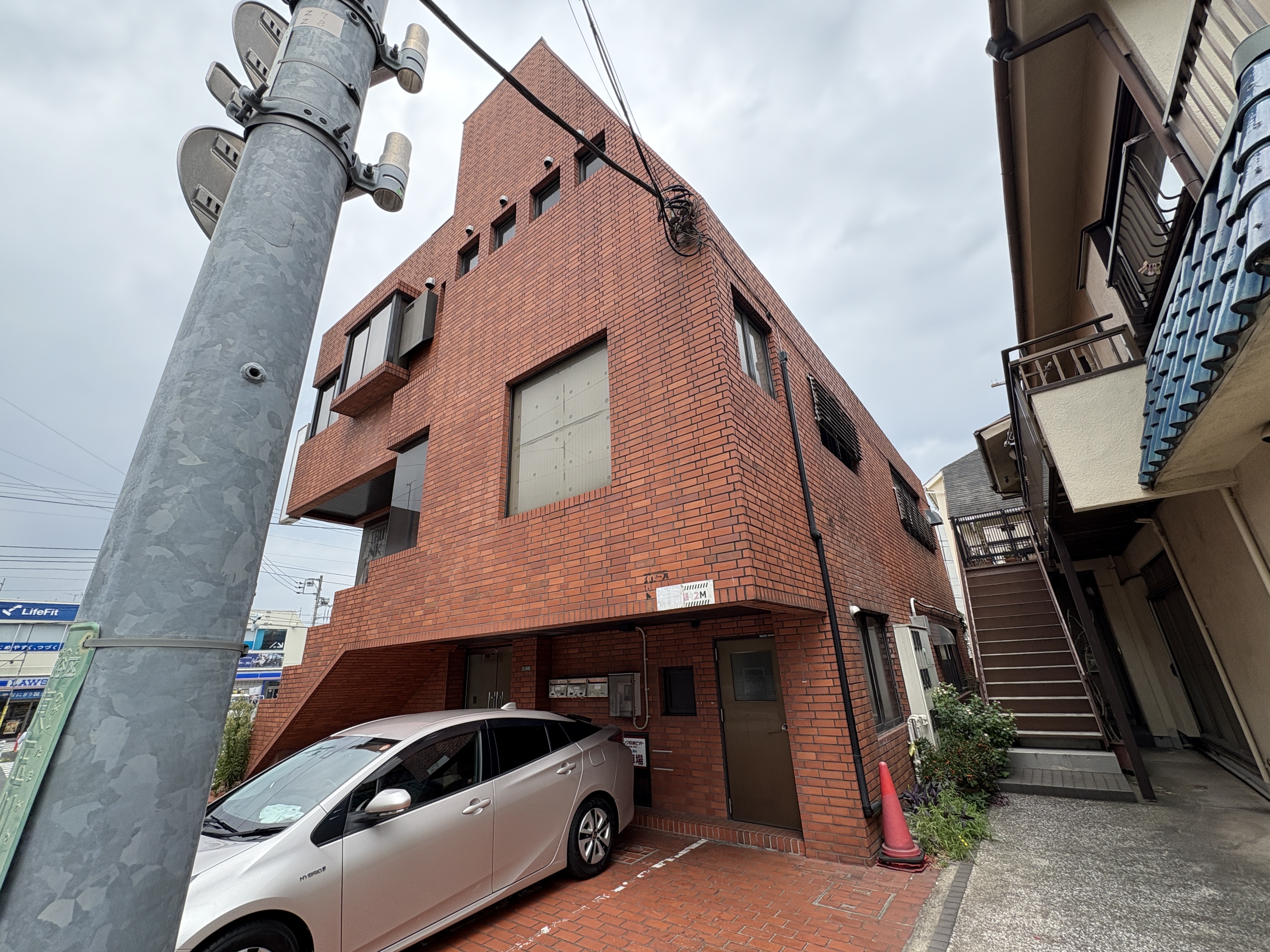
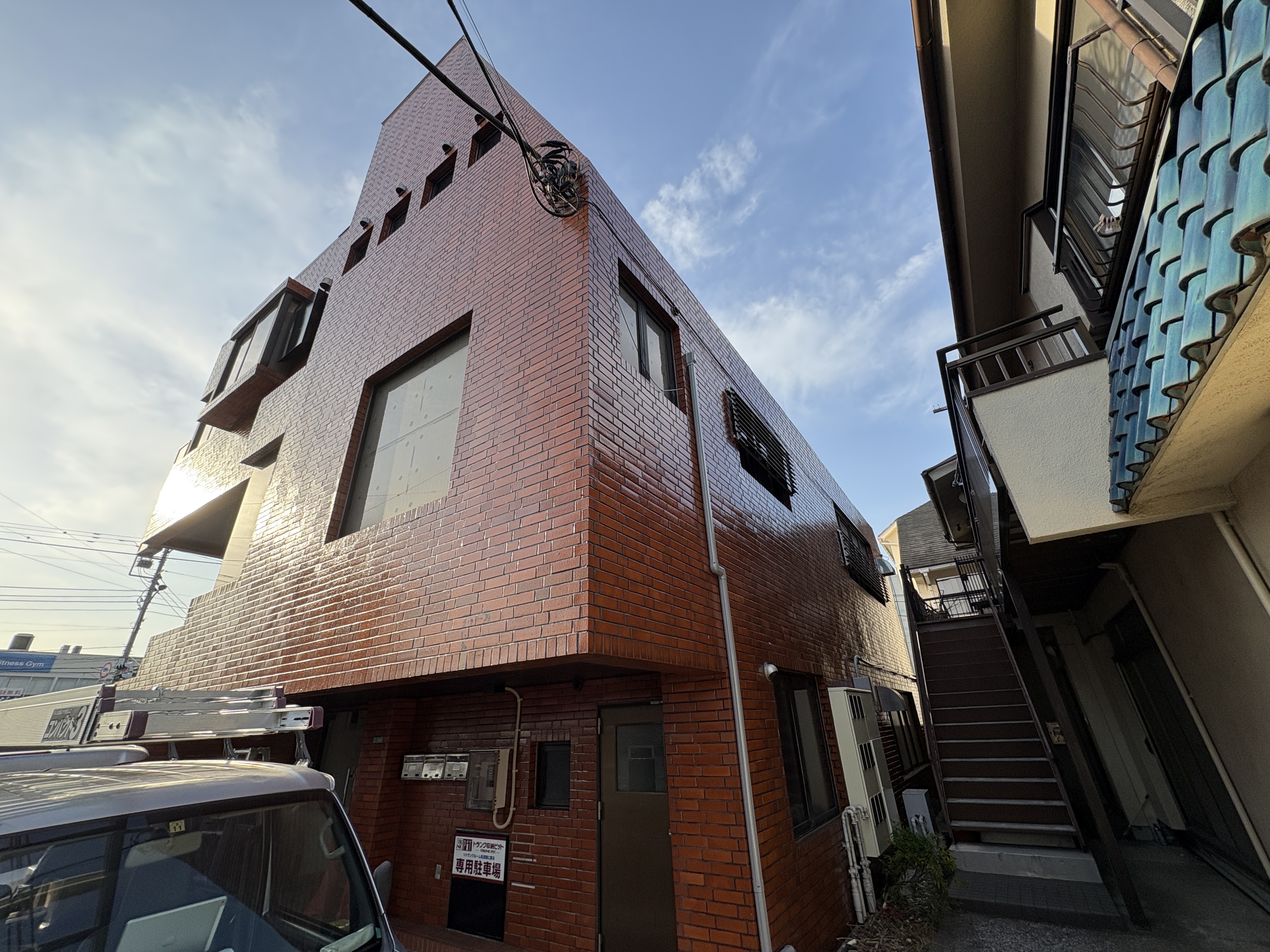
| Construction Details | Partial replacement of damaged tiles / Painting of ancillary parts (pipes, water cut-off) / Rooftop waterproofing work (urethane waterproofing) / Exterior wall tile waterproofing (Seven S) / Sealing work around sashes / Repair of exterior wall tile mortar joints / Removal of ivy |
|---|---|
| New Materials Used | Exterior wall tiles: Kunishiro Tiles / Painting of ancillary parts: Radical silicone paint / Rooftop waterproofing: High-strength urethane (Sarasene A) / Exterior wall tile waterproofing: Seven S |
| Price Range | 4,000,000 – 4,100,000 JPY |
| Construction Period | 45 days |
| Location | Not disclosed |
| Background to the Construction | Due to leaks occurring from several areas such as the exterior walls and rooftop, we proposed waterproofing for the entire exterior wall. Seven S is a clear waterproofing material for tile exterior walls; while the cost is somewhat higher, its waterproofing performance is excellent, making it recommended for cases where leaks are occurring from multiple areas of the exterior wall. |
- View detailed construction content of large-scale renovations with photos
- Exterior renovation examples and information from Oiso Town, Nakagun, Kanagawa Prefecture can be found here
- Exterior renovation examples and information from Ninomiya Town, Nakagun, Kanagawa Prefecture can be found here
- Roof renovation examples and information from Oiso Town, Nakagun, Kanagawa Prefecture can be found here
- Roof renovation examples and information from Ninomiya Town, Nakagun, Kanagawa Prefecture can be found here
Customer Feedback
Flow from On-site Survey to Completion of Construction
From the initial inquiry to the completion of construction and aftercare, one representative will consistently handle your case. In the case of management associations, a resolution at the general meeting is required, so starting the process 1 to 1.5 years before the desired start date allows for a more relaxed progression.
- Contact Us (Free) Please reach out via phone, form, or LINE. If you have estimates from other companies, it’s fine to just present those.
- On-site Investigation & Building Diagnosis (Free) We will conduct a survey of the exterior walls, check for cracks, sealing, and waterproof layers, and if necessary, investigate the rooftop, high places, and leak areas using drones or thermography. For properties in Nakagun, we will also check for rust on metal parts of buildings close to the sea, assess tsunami, flood, and landslide risks on the site, and review the conditions of slopes and retaining walls, as well as access routes and parking.
- Submission of Investigation Report & Estimate We will provide a deterioration diagnosis report with photos and an estimate detailing quantities, methods, and materials for each work item. Multiple plan proposals are also possible.
- Plan Decision & Contract Confirm colors using color simulations, paint samples, and trial painting. For management associations, we can assist in preparing materials for general meetings. In areas subject to landscape planning, scenic districts, and district plans, we will also explain the procedures and color considerations.
- Notification to Residents & Neighbors We will distribute construction notices, conduct greetings to neighbors, and install a bulletin board at the entrance (with a schedule and laundry information). If temporary relocation of parking is necessary, we will coordinate this at this stage.
- Installation of Temporary Scaffolding & Various Works Our own scaffolding team will set up the scaffolding, followed by high-pressure washing → substrate repair → sealing → exterior wall painting & tile repair → waterproofing → metal parts & ancillary work in that order. A supervisor will inspect each process and take construction photos.
- Completion Inspection, Scaffolding Dismantling & Handover We will confirm the finished work in the presence of the customer and provide construction photos, a report on the paint used, and a warranty certificate.
- Aftercare Maintenance We will send annual DM notifications, and inspections can be conducted every year. Simple repairs such as partial sealing are provided free of charge.
Resident Communication, Approval for Additional Work, Inspection Reports
Equally important as the construction itself is “when, what, and with what materials we report”. At Kakeru Koumuten, we provide materials and reports in the following four scenarios.
| Scenario | Materials Provided / Actions Taken |
|---|---|
| Before Construction Building Diagnosis |
We will provide a deterioration diagnosis report with photos. This document summarizes the deterioration areas and the basis for the proposed scope of work. |
| Before Construction to During Construction Notification to Residents & Neighbors |
We will distribute construction notices, conduct greetings to neighbors, and inform about the schedule and laundry information on the entrance bulletin board. |
| During Construction Approval for Additional Work |
Any deterioration discovered after scaffolding is set up will be addressed by presenting photos, quantities, and costs for approval before proceeding with the work. |
| During Construction to Completion Inspection Reports |
A supervisor will inspect each process and take construction photos. Upon completion, we will confirm the finished work in the presence of the customer and provide construction photos, a report on the paint used, and a warranty certificate. |
* For management associations, it is smooth to decide in advance who will approve additional work (such as the chairman or repair committee) and the estimated amount that will require approval before the contract.
What Will Life Be Like During Construction? Impact on Residents
Major repairs are principally carried out while residents remain in their homes. However, there will be some limitations on daily life while scaffolding is in place. Most troubles can be prevented by providing advance notice, so Kakeru Koumuten Co., Ltd. thoroughly explains and posts information before construction begins.
| Impacts | What Actually Happens / Our Company’s Response |
|---|---|
| Laundry | On days of high-pressure washing, painting, and waterproofing, outdoor drying will not be possible. We will inform you via bulletin boards and individual mailboxes about “which side will be worked on today” and will ensure as many days as possible for outdoor drying. |
| Window Opening and Closing | In addition to washing and painting days, there may be times when windows cannot be opened due to protective measures, drying, or waterproofing work. We will provide information for each phase, so please check the postings and notifications. We will schedule the work to avoid continuous closures. |
| Balcony | During floor waterproofing and handrail painting, we ask for temporary relocation of personal items, potted plants, and air conditioning outdoor units. The timing will be communicated in advance for each unit. |
| Noise and Odor | The period of substrate repairs (breaking and drilling) will produce the most noise. Working hours are generally from 8 AM to 5 PM, and we will accommodate requests such as refraining from work on Sundays and holidays. Low-odor paint options are also available. |
| Security and Privacy | Scaffolding can become a potential entry point. We can use mesh sheets to block visibility, and install locks on the scaffolding’s access stairs and sensor lights at night. We also ensure thorough etiquette training for visitors. |
| Parking | Vehicles on the side where scaffolding will be erected will need to be temporarily relocated. Since securing a new parking spot may take time, we will work together to secure a new location 2 to 3 months before construction starts. |
| Pets, Small Children, and Working from Home | If you have sensitivities to noise, please inform us in advance, and we may be able to adjust the work schedule accordingly. Please feel free to let us know. |
| Rental Units | We assist owners in creating notification documents for residents. If you are concerned about the impact of construction on occupancy rates, we can also suggest a color simulation for a change in image. |
How to Choose a Major Repair Contractor and Ordering Methods
There are many major repair contractors that cover Kanagawa Prefecture, Nakagun (Oiso Town and Ninomiya Town), and you may be unsure which one to choose. When requesting renovations for apartments, condominiums, or buildings, please check the following four points.
● Extensive experience in major repairs
● Check for warranties and aftercare services
● Obtain estimates from multiple contractors (at least 3 companies)
● Confirm whether they are self-managed
Extensive Experience in Major Repairs
Major repair contractors often have websites that showcase their exterior renovation achievements. If they provide detailed explanations of repair work with photos, it can offer reassurance as a reference when you actually request their services.
Using ratings from Google and review sites can be effective when comparing large-scale repair contractors! Be cautious if there are many negative reviews. If there are few reviews, also check the track record, content of explanations, and management system.
Large-scale repair work involves not only the construction itself but also potential troubles with residents and neighboring inhabitants. Therefore, it is necessary to post updates on the progress of the work and information about laundry on bulletin boards to prevent issues from arising. Kakeru Koumuten Co., Ltd. specializes in exterior work, so we receive many requests for exterior renovations of apartments and condominiums.
Check for warranties and aftercare services
When choosing a large-scale repair company, make sure to check for warranties. If any issues such as leaks occur after construction, having a leak warranty from the contractor ensures that repairs can be made at no cost, providing peace of mind! A company that offers a warranty is a sign of confidence in their work, which can serve as a criterion for selecting a contractor.
Warranty periods vary by contractor and type of work, but typically range from 1 to 10 years. Emergency repairs or partial fixes often do not come with a leak warranty. Some contractors also offer aftercare services separate from warranties, so be sure to check for warranties and aftercare services.
Kakeru Koumuten Co., Ltd. sends out annual direct mail for aftercare maintenance, allowing for yearly inspections. We also provide free responses for simple repairs such as partial sealing.
Obtain estimates from multiple contractors (at least 3 companies)
When requesting large-scale repairs, be sure to obtain estimates from multiple contractors. It is important to get estimates from at least 3 companies and compare their estimates and reports! Even for the same work, costs can vary between contractors, and warranties and aftercare services may differ. Additionally, obtaining multiple estimates makes price negotiations easier.
When comparing estimates, consider not only the cost but also the “items in the estimate,” “methods and materials for substrate repair and exterior painting,” and “confirmation of the process.” Be thorough in your comparisons! Costs can be lowered by using lower-grade materials or skipping processes, so avoid making decisions based solely on price. Especially since substrate repair work is often not visible from the outside, it is crucial to confirm whether the repair method is appropriate for the condition of the substrate!
Check these points on the estimate (checklist)
| Verification Items | Points to Check |
|---|---|
| Is there an excessive use of “lump sum” notation? | Are the quantities and unit prices clearly stated? With “Exterior Wall Repair Lump Sum,” comparisons and verifications cannot be made. |
| Do the quantities match actual measurements? | Are there quantities recorded that are far from the drawings or actual measurements? This is the area where inflation is most likely to occur. |
| Proportion of miscellaneous expenses | Details and proportions of site management costs, general management costs, statutory welfare costs, etc. According to the Ministry of Land, Infrastructure, Transport and Tourism’s survey for the fiscal year 2021, the average is about 10% of the construction costs (excluding common temporary costs), but this varies depending on the scale and conditions of the building, so there is no uniform standard. |
| Are the names of materials written down? | Are the manufacturer names, product names, grades, and number of coats for paints and waterproofing materials specified? |
| Treatment of quantities for substrate repairs | This is an item that cannot be accurately measured until scaffolding is set up. It is crucial to state whether it is “estimated quantity” or “actual quantity settlement,” and the agreements for increases or decreases. |
| Warranty and after-inspection | Warranty period for each construction, frequency of inspections, and scope of free support. |
| Company backing | Types of construction industry licenses, track record of similar scale and structure projects, presence of qualified personnel. |
Check if it is managed in-house
Large-scale repair work includes various tasks such as “substrate repair work,” “exterior wall painting,” “waterproofing work,” and “pipe replacement,” and the plan content will change based on the actual deterioration condition and customer preferences.
There are cases where contractors that completely outsource to subcontractors lack knowledge and experience, leading to proposals for repairs in irrelevant areas or unnecessary work. If you request a subcontractor after investigation, it may incur additional time and costs. By managing in-house with knowledge and experience, responsible construction can be performed at a lower cost.
Additionally, contractors that outsource to subcontractors may also have delayed responses in case of any troubles during construction. It is safer to avoid having a company that has not actually met with the customer manage the construction. Kakeru Koumuten performs everything from temporary scaffolding setup to exterior wall painting and waterproofing work in-house, managed by knowledgeable and experienced personnel!
There are three ordering methods. The choice affects the approach.
Especially for management associations, it is necessary to decide “how to request” before “which company to hire.” The main ordering methods are the following three.
| Method | Process | Advantages | Disadvantages |
|---|---|---|---|
| Responsible Construction Method | The construction company handles everything from investigation, design, construction, to management. | No additional costs for commissioning design consultants (investigation and design costs may be included in the construction costs) / A single point of contact reduces the burden on the management association / Responsibility is clear / The period until ordering can sometimes be shortened. | Specifications can easily be left to the construction company, making it difficult to compare side by side / It is hard to have third-party checks, requiring the management association to verify price, specifications, and construction status. |
| Design Supervision Method | A design office or consultant conducts the investigation and design, while a separate company handles the construction. | Allows comparison of construction companies under the same conditions / Independent supervision during construction. | Consulting fees are required separately / Attention is needed for risks of conflicts of interest and collusion / The period can easily become prolonged. |
| Management Company Prime Contract Method | The management company acts as the prime contractor, with subcontractors handling the construction. | Easy coordination with daily management / Minimal effort required from the management association. | Can easily become expensive due to intermediate margins / Competition principles may not be effective. |
Collusion and Inappropriate Consulting Issues in Large-Scale Renovations and Self-Defense Measures
Latest 2026 In the large-scale renovation industry, inappropriate orders linked between design consultants and construction companies have long been a problem. The Ministry of Land, Infrastructure, Transport and Tourism issued warnings and notifications to management associations in January 2017 and April 2023, and on September 28, 2026, the Japan Fair Trade Commission announced that it had issued exclusion orders to 38 companies and imposed a total of 1.63788 billion yen in surcharge payment orders on 37 companies regarding large-scale renovation work commissioned by condominium management associations in the Kanto region to design consulting firms (two design consulting firms were also subject to exclusion orders).
*Based on the announcement by the Japan Fair Trade Commission (September 28, 2026).
Three Typical Methods
① Dummy Estimates
By deciding in advance which company to contract, other companies only provide a formal high estimate, creating a “fixed race.” This makes it appear to the management association that they have “properly obtained competitive estimates.”
② Collusion with Design Supervisors
While consultants contract at extremely low design supervision fees, they receive kickbacks from the high construction costs of their partner construction companies. Be cautious of design supervision fees that are too low as they are a warning sign.
③ Back Margin
A certain percentage of the contract amount is given as a kickback, which is then added to the construction costs as an expense. As a result, the management association ends up paying extra.
Self-Defense Measures for Management Associations
- Obtain independent estimates from multiple companies
- Consult with neutral third parties such as condominium management professionals or architects
- Document the vendor selection process in minutes to ensure transparency
- Confirm the reasons for unusually low consulting fees
- Include a penalty clause in the contract for cases of collusion
- Avoid concentrating information with a single consultant and verify specifications by the management association itself
Frequently Asked Questions about Large-Scale Repairs in Nakagun, Kanagawa Prefecture (Oiso Town and Ninomiya Town)
- How much does large-scale repair in Nakagun, Kanagawa Prefecture (Oiso Town and Ninomiya Town) cost?
- For condominiums, according to the Ministry of Land, Infrastructure, Transport and Tourism’s fiscal year 2021 survey, about 70% fall within the range of 750,000 to 1,500,000 yen (excluding consumption tax and common temporary construction costs), with the most common range being 1,000,000 to 1,250,000 yen. Based on our company’s construction records, the cost for a two-story wooden apartment is approximately 2,000,000 to 4,000,000 yen, for a three-story steel or RC apartment it is about 4,000,000 to 9,000,000 yen, and for small-scale condominiums or mixed-use buildings, it ranges from 5,000,000 to 15,000,000 yen. The costs vary depending on the condition of the substrate and whether waterproofing or roofing work is required, so we provide free on-site estimates.
- How often should large-scale repairs be conducted?
- Generally, a cycle of 12 to 15 years is recommended, and the actual cycle is most commonly 13 years according to the Ministry of Land, Infrastructure, Transport and Tourism’s survey, with about 70% falling within the 12 to 15-year range. However, the decision should be based on the condition of deterioration rather than just the number of years. If there are signs of deterioration in sealing, tile lifting, or breaks in the waterproof layer, it is advisable to carry out repairs without waiting for the cycle, as this can ultimately reduce costs. For older buildings, the proportion of tile repairs and iron part replacements tends to increase during the second and third rounds of repairs.
- How long does the construction period take? Can residents stay during the work?
- For apartments, the duration is typically 3 weeks to 2 months, for small-scale condominiums or buildings it is about 1.5 to 3 months, and for condominiums with over 50 units, it takes approximately 4 to 6 months. Residents can remain in their homes during the construction. However, while scaffolding is in place, there may be restrictions on drying laundry outside and opening windows, so we ensure to minimize the impact on daily life by distributing notifications before construction, providing information on the bulletin board regarding the schedule and laundry, and strictly adhering to working hours.
- How long should I expect from the start of planning to the completion of construction?
- For management associations, it typically takes about 1 to 1.5 years for the establishment of the repair committee, building diagnosis, contractor selection, and general meeting resolutions, followed by 3 to 6 months for the construction itself. Overall, it is advisable to plan for around 2 years to proceed with ample time. If you are using subsidies or tax incentives, please also factor in the time required to obtain management plan certification (pre-confirmation and application to the prefecture).
- Are there any subsidies available for large-scale repairs in Nakagun, Kanagawa Prefecture (Oiso Town and Ninomiya Town)?
- According to the official websites of Oiso Town and Ninomiya Town, there were no subsidies specifically for large-scale repair work on condominiums (there are also no subsidies for the work itself from Kanagawa Prefecture). However, if it is a condominium, a reduction in fixed property tax can be applied under the “Condominium Longevity Promotion Tax System” if certain conditions are met (the reduction rate varies by town; Oiso Town’s official site states “one-third reduction of the tax amount,” while no information was found for Ninomiya Town). Additionally, there is the Kanagawa Prefecture management plan certification system and the dispatch of condominium advisors (free, accepting applications until February 26, 2027). If the work includes windows and insulation, it may be eligible for the national “Advanced Window Renovation 2026” and “Mirai Eco Housing 2026” programs. The application timing and applicants differ by program, so please check the eligibility conditions and application procedures for each program before contracting or starting construction.
- I heard that fixed property taxes can be reduced through large-scale repairs. Is that true?
- It is true if the conditions are met. Under the Condominium Longevity Promotion Tax System, if a condominium that meets the requirements (such as being over 20 years old and having more than 10 units) conducts large-scale repairs that contribute to longevity (such as exterior wall painting, floor waterproofing, and roof waterproofing), the fixed property tax amount for the following year will be reduced. The reduction rate is determined by the town’s ordinance within the range of the reference standards set by the national government; Oiso Town’s official site states “one-third reduction of the tax amount,” but this could not be confirmed on Ninomiya Town’s official site. For inquiries about where to file and deadlines, please contact Oiso Town’s Tax Division Asset Tax Section (0463-61-4100) and Ninomiya Town’s Tax Division Asset Tax Group (0463-71-3317). The national program applies to work completed between April 1, 2023, and March 31, 2027, and requires filing within 3 months after completion. For certified management plan condominiums, there are also requirements such as raising the repair reserve fund, which can take time to prepare, so it is recommended to start the process over a year before construction.
- Are there any changes to subsidies starting from the 2026 fiscal year?
- The national “Child-Rearing Green Housing Support Project” has been abolished and reorganized into the successor “Mirai Eco Housing 2026 Project.” Management associations and management corporations can also become joint contractors, allowing for the use of funds for insulation renovations in common areas. Additionally, the “Long-Term Excellent Housing Renovation Promotion Project” will end in the fiscal year 2025 and will not be implemented in fiscal year 2026. The “Advanced Window Renovation 2026 Project” has begun accepting bulk applications for apartment buildings starting May 29, 2026 (the application process is handled by registered contractors). Please be careful not to establish financial plans based on outdated information.
- What should I do if the repair reserve fund is insufficient?
- There are mainly four options. ① Postpone low-urgency repairs based on deterioration diagnosis to the next time, ② Review the scope and specifications of the work, ③ Check for support systems such as subsidies, ④ Consider increasing the repair reserve fund or financing from the Japan Housing Finance Agency. The agency’s financing for common area renovations in condominiums does not require collateral, and interest rates can be reduced by up to 0.6% per year through obtaining management plan certification and implementing energy-saving and seismic work. Please note that postponing waterproofing and tile peeling measures often ends up being more expensive, so please consult us for judgment on separation.
- Can scaffolding be set up on sloped or uneven terrain?
- Yes, it can. Nakaguni has urban areas spread across flat land nestled between Sagami Bay and the hills of Takatoriyama and Koma-yama, with buildings on sloped and terraced sites at the foot of the hills. Kakeru Koumuten owns its own scaffolding materials and has its own scaffolding team, allowing us to plan support and layout for the boards after confirming the site. This is a part where additional costs are likely to arise after seeing the site, so it is important to confirm the delivery route during the estimation phase. We also check the deterioration of retaining walls and slopes and consult on whether they are included in the long-term repair plan.
- What happens to the residents’ parking during construction?
- Vehicles on the side where scaffolding will be erected will need to be temporarily moved. In buildings with many units or those with on-site parking, securing a relocation spot may take time depending on the number and arrangement of vehicles. Kakeru Koumuten will coordinate with you about the availability of nearby coin parking and monthly parking spaces starting 2 to 3 months before construction begins.
- Can I freely decide the color of the exterior walls?
- This depends on the regulations applicable to the property. Oiso Town is entirely within a landscape planning area, and changes to the appearance and color of buildings that meet certain conditions are subject to notification (whether exterior wall repainting is subject to this depends on the size of the building and the nature of the changes). Ninomiya Town has the Azumayama Scenic Area, where changes to the color of buildings and structures require the mayor’s permission. Additionally, Oiso Town has two district plans, and the contents differ by district. You can check what regulations apply to your property by contacting Oiso Town’s Urban Planning Division (0463-61-4100) or Ninomiya Town’s Urban Development Division Planning Guidance Team (0463-71-5956). Our company will also investigate this during the survey and share a color simulation to help facilitate agreement with the management association and neighbors.
- Do buildings near the sea need salt damage measures?
- Both Oiso Town and Ninomiya Town face Sagami Bay, and buildings close to the sea may have salt carried by sea breezes adhering to exterior walls, metal parts, and fittings, accelerating rust progression. However, the extent of the impact varies depending on the distance from the sea, direction, and height of the building, so a uniform judgment cannot be made. We will check the progression of rust on metal parts, the condition of sealing and waterproof layers, and the areas around drains during the on-site survey, and specify in the estimate the necessary range for salt removal through washing, rust prevention surface treatment, and selection of highly weather-resistant paints. We will also look at the waterproofing around the first floor and the condition of retaining walls and slopes.
- Which should I choose, the responsibility construction method or the design supervision method?
- In buildings with fewer units, the burden of consulting fees becomes heavier, so we believe that the responsibility construction method is often more suitable for small to medium-sized buildings. The design supervision method allows for comparison of construction companies under the same conditions since a third party creates the specifications; however, additional consulting fees apply, and there are risks of conflicts of interest and collusion that need to be considered. Even with the responsibility construction method, verification of price, specifications, and construction status is essential. Kakeru Koumuten provides estimates that clearly state quantities, methods, and materials for each construction item, allowing you to compare with other companies on the same level.
- How can I detect collusion in large-scale repairs?
- There are three typical methods. ① Pre-selecting a contractor and having other companies submit only formal high estimates, known as “dummy estimates.” ② Consultants contract at extremely low design management fees and receive kickbacks from partner companies, creating collusion. ③ Adding a portion of the contract amount as a back margin to the construction costs. The countermeasures include obtaining independent estimates, consulting a neutral third party, documenting the selection process in minutes, and including a penalty clause in the contract.
- How many estimates should I obtain?
- We recommend at least three companies. If there are too many, it becomes difficult to compare; if there are too few, competition does not occur. What is important is not the number of companies but to “create the same playing field before comparing.” By creating a common specification sheet and quantity table, requesting under the same conditions, and requiring detailed breakdowns instead of “one set” notation, the differences in amounts can be clearly identified as differences in range or unit price.
- What is the difference if you have your own scaffolding?
- In large-scale repair construction, temporary construction accounts for about 20% of the costs (according to the Ministry of Land, Infrastructure, Transport and Tourism’s FY2021 survey). By not outsourcing scaffolding work, it is easier to control costs in this area, and our own scaffolding team can flexibly respond to sudden changes in the schedule or additional work. Kakeru Koumuten Co., Ltd. owns scaffolding materials for approximately 100 single-family homes and plans according to the site, even in sloped or uneven areas.
- Can I just have the estimate reviewed while in the middle of obtaining estimates?
- Of course, that’s possible. If you bring estimates from other companies, we will check for free whether the items, quantities, construction methods, and materials are appropriate and provide you with an estimate under the same conditions. We welcome competitive estimates.
- Can I request just emergency measures for a leak?
- Yes. As a preliminary step before large-scale repairs, we also accept requests for emergency measures or partial repairs for leaks. We will identify the cause using thermal imaging and drones and propose the minimum necessary repairs.
- Can you handle roofing materials or exterior wall materials that contain asbestos?
- Yes, we can. We have qualified personnel such as asbestos work supervisors and building material asbestos surveyors, and we handle everything from the legally required preliminary surveys to the cover method and removal of asbestos-containing roofing materials. If there is sprayed asbestos, we will also guide you on the investigation of contents, removal procedures, and legal processes.
- What happens if large-scale repairs are not done?
- There are risks such as personal injury from falling exterior wall tiles, structural deterioration due to corrosion of rebar, leaks, and decreased asset value. Furthermore, for buildings subject to regular reporting under Article 12 of the Building Standards Act, investigations such as full probing are required under certain conditions, such as when more than 10 years have passed since completion or exterior wall renovations for tiles or mortar finishes. Oiso Town and Ninomiya Town are under the jurisdiction of Kanagawa Prefecture, and it is necessary to confirm with the prefecture (Hiratsuka Civil Engineering Office, Building Guidance Division) whether general apartments and buildings are included in the applicable uses and scales. Even if not subject to statutory investigations, regular inspections and maintenance are essential, so please consult us if you are unsure about your judgment.
- How much does large-scale repair for an apartment (about 10 units) cost?
- For a wooden two-story building with 6 to 10 units, the estimate is around 2 million to 4 million yen, and for a three-story steel or RC building with 10 to 20 units, it is around 4 million to 9 million yen based on our company’s track record (including scaffolding, substrate repairs, exterior wall painting, sealing, and waterproofing). It is common for apartments to undergo repairs every 10 to 15 years. For owners, there is an increasing trend to change the appearance with color simulations during repairs to improve occupancy rates.
If you are looking for a large-scale repair contractor in Nakagun, Kanagawa Prefecture (Oiso Town and Ninomiya Town), contact Kakeru Koumuten Co., Ltd.
Our company handles many exterior wall renovations and large-scale repairs for condominiums and apartments in Nakagun, Kanagawa Prefecture (Oiso Town and Ninomiya Town). We are happy to assist not only with large-scale repair work but also with partial repairs and leak repairs. “I want it to last long with one renovation” “I want to keep costs down as much as possible” “I want to improve insulation performance because the indoors are hot” We will propose the best solutions for your specific requests and future repair plans.
From temporary scaffolding work to roofing and exterior painting, all work is performed by our company’s own team. We are confident that we will not be outdone in terms of cost, quality, and efficiency compared to other companies, so we welcome competitive quotes!
On-site inspections, estimates, and color simulations are all free of charge
Please feel free to consult us via the inquiry form, phone, or LINE.
It’s perfectly fine to just present estimates from other companies.
Large-scale repair work service area
Kakeru Koumuten Co., Ltd. accepts requests throughout Kanagawa Prefecture and Tokyo.
【Oiso Town】Ikisawa / Shishikami-dai / Oiso / Gekkyou / Kuroiwa / Koufu Shinjuku / Koufu Hongou / Komai / Terasaka / Nishikubo / Nishikoiso / Higashi Koiso / Higashi-machi / Mushikubo
【Ninomiya Town】Isshiki / Kawakawa / Nakazato / Ninomiya / Fujimigaoka / Matsune / Midorigaoka / Yamanishi / Yurigaoka
・When should large-scale renovations be carried out? An explanation of the optimal timing and risks of postponement!
・Estimates are essential when carrying out large-scale renovations! Key comparison points and precautions!
・5 common troubles in large-scale renovations of condominiums! Thorough explanation of causes and prevention measures!
・What is waterproofing work in large-scale renovations? Thorough explanation of roles, signs of deterioration, and precautions!
・Not enough funds for large-scale renovations… Solutions for funding shortages and preparations you can do right now!
・What is substrate repair, which is important in large-scale renovations? Thorough explanation of necessary reasons, signs of deterioration, and types of work!
・What is sealing work in large-scale renovations? Introduction to roles, methods, and tips for avoiding failures!
・What is tile repair, which is important in large-scale renovations? Explanation of signs of deterioration, types of work, and cost estimates!
・What is exterior wall painting, which is important in large-scale renovations? Thorough explanation of necessity, signs of deterioration, and cost estimates!
・For exterior renovations in Oiso Town, Nakagun, Kanagawa Prefecture, trust Kakeru Koumuten!
・For exterior renovations in Ninomiya Town, Nakagun, Kanagawa Prefecture, trust Kakeru Koumuten!
・For roof renovations in Oiso Town, Nakagun, Kanagawa Prefecture, trust Kakeru Koumuten!
・Trust Kakeru Koumuten for roof renovations in Yamakita Town, Ashigarakami District, Kanagawa!
・Trust Kakeru Koumuten for exterior painting in Oiso Town, Ashigarakami District, Kanagawa!
・Trust Kakeru Koumuten for exterior painting in Yamakita Town, Ashigarakami District, Kanagawa!
We welcome consultations via LINE◎

We are also updating our Instagram regularly◎ Please follow us!

contact Kakeru Koumuten Co., Ltd.
Kakeru Koumuten is a young company whose team is, on average, in their late twenties, but our skills are second to none.
Our greatest strength is that we handle scaffolding, roofing and painting entirely in-house. In an industry where these tasks are usually divided among contractors, our complete service simplifies project management and helps keep costs down. Above all, if a problem arises, we respond promptly.
We proudly describe ourselves as the youngest and most helpful renovation company in Kanagawa!