Leave the repairs and renovations of condominiums and apartments in Tachikawa City, Tokyo to Kakeru Koumuten Co., Ltd.!
Large-scale Repairs for Condominiums, Apartments, and Buildings in Tachikawa City, Tokyo
To owners, management associations, and management companies considering large-scale repairs for condominiums, apartments, and buildings in Tachikawa City, Tokyo.
Kakeru Koumuten Co., Ltd. is a company that handles everything from the installation of temporary scaffolding to substrate repairs, exterior painting, tile repairs, sealing, waterproofing for rooftops and balconies, and roofing work, all managed and performed by our own team. We have undertaken numerous large-scale repairs and exterior renovations for apartments, condominiums, and commercial facilities in Tachikawa City.
- On-site surveys and estimates are completely free (we welcome competitive estimates)
- All exterior and roofing work is managed by our own team from temporary scaffolding to completion
- Our own scaffolding team handles sites in Tachikawa City, from condominiums to apartments
- Consultations for partial repairs or emergency measures for leaks are also possible
- Cost Estimate / For condominiums, the cost is approximately 750,000 to 1,500,000 yen per unit (about 70% fall within this range according to the Ministry of Land, Infrastructure, Transport and Tourism’s survey for the fiscal year 2021, with the most common range being 1,000,000 to 1,250,000 yen. This amount excludes consumption tax and common temporary costs). For wooden apartments, the estimate is around 2,000,000 to 4,000,000 yen per building.
- Estimated Cycle / 12 to 15 years. However, the decision should be based on the condition of deterioration rather than just the number of years.
- Particularly Relevant in Tachikawa City / The Tachikawa Fault Zone runs north-south through the city center, and there are hazard maps for flooding from the Tama River and the Zambori River. According to the city’s landscape regulations, repainting the exterior wall color may require notification, and there are color standards (the total of emphasized and accent colors must be less than one-fifth of the visible area). If the scaffolding extends over the city road, permission for road occupancy from the Road Management Section is required, and there are standards for projection and morning glory height. According to the city’s actual survey (February 2023), 52.2% of the 157 responses were buildings constructed before 1993.
- Available Funds / The official page of Tachikawa City does not confirm any city programs that subsidize the construction costs or deterioration diagnosis costs for large-scale repairs. The city provides information on management plan certification (the application fee to the city is generally 4,100 yen) and management status reports. The fixed asset tax reduction special provision is a national program (for work completed by March 31, 2027), with the city’s guidance indicating one-third for units up to 100 square meters, with the reporting destination being the Taxation Division, Housing Section. Additionally, we will consider combining Tokyo’s interest subsidies (the second phase for fiscal year 2026 is accepting applications until February 19, 2027) and public financing. The subsidy for existing housing insulation renovation costs for fiscal year 2026 has reached its budget limit and is no longer accepting applications.
- Tips to Avoid Mistakes / At least three competitive estimates. Compare not just the prices but also the quantities, methods, and materials.
Large-scale repair work we can handle in Tachikawa City, Tokyo
Large-scale repairs are not just “exterior painting” or “waterproofing”; they are comprehensive repairs to the entire building while scaffolding is in place. At Kakeru Koumuten, we can handle all of the following work with our own team, ensuring clear responsibility and coordination of the process.
| Type of Work | Main Contents |
|---|---|
| Temporary Scaffolding Work | Installed by our own scaffolding team using our own scaffolding materials. We handle mesh sheets, protection, and fall prevention measures. |
| Substrate Repair Work | Crack repairs, injection of floating mortar and tiles, explosion (exposed rebar) repairs, resin mortar repairs for missing parts. |
| Exterior Wall Painting Work | High-pressure washing, three coats from primer to topcoat, painting of ancillary parts (iron parts, gutters, water cut-offs, etc.). We accommodate radical control type, fluorine, and inorganic paints. |
| Tile Repair Work | Replacement of damaged tiles, joint repairs, clear waterproofing of tile surfaces (such as Seven S). |
| Sealing Work | Replacement and additional application of seals around sashes and exterior wall joints. |
| Waterproofing Work | Urethane waterproofing for rooftops, roof balconies, shared corridors, and stairs, PVC sheet waterproofing, and installation of long sheets. |
| Roof Work | Roof painting, overlay method, re-roofing, and ridge cap replacement. We have sheet metal craftsmen on staff and can handle large roofs such as factories. |
| Iron and Metal Work | Surface painting of steel staircases, handrails, and PS doors, replacement of caps and water cut-offs. |
| Drainage and Wastewater Work | Cleaning and renovation of roof drains (inserting renovation drains), resolving gutter clogs. Issues with drainage can cause puddles and leaks, making this work especially important for buildings with rooftops. |
| Others | Replacement of rain gutters, rooftop and exterior wall inspections using drones, leak investigations using thermography, and preliminary investigations of asbestos-containing building materials. |
Scope of Major Repairs Determined by Building Diagnosis
It is not always necessary to perform all of the above works. The extent of the work will be determined based on the results of the building diagnosis. At Kakeru Koumuten Co., Ltd., we conduct a free on-site survey to confirm the items below, compile a deterioration diagnosis report with photos, and propose the scope of work.
| Diagnosis Area | Main Inspection Method | Scope of Work Determined by Diagnosis Results |
|---|---|---|
| Exterior Wall (Painted Surface) | Visual inspection, checking the width of cracks and the condition of the paint film | Methods and quantities for crack repair, specifications for painting (whether to repaint or paint after removing the existing paint film) |
| Exterior Wall (Tile Surface) | Tap testing. High areas checked with a drone | Scope and estimated quantity for injection of loose tiles and replacement, whether clear waterproofing is necessary |
| Sealing | Checking for cracks, shrinkage, peeling, and hardening | Whether to replace or add to the existing sealant, scope of joints to be worked on |
| Rooftop, Balcony, Shared Corridor | Checking for blisters or breaks in the waterproof layer, puddles, and the condition of drains | Full renovation or partial repair, method (urethane waterproofing, PVC sheet waterproofing, long sheet), whether drain renovation is necessary |
| Leak Areas | Inspection using thermal imaging camera and drone | Identification of the cause and priority areas for repair |
| Metal Parts, Roof, Accessories | Checking for rust, corrosion, lifting, and cracking | Whether it can be resolved with painting or if material replacement or cover method is necessary |
| Site and Surroundings | Checking retaining walls, slopes, trees, access routes, and parking | Planning for scaffolding and scope of temporary work |
Reasons Kakeru Koumuten is Chosen for Large-Scale Renovations in Tachikawa City, Tokyo

The reason why we can be entrusted with large-scale renovations in Tachikawa City is that we have “initiatives that other companies cannot imitate in large-scale renovation work”, which has received high praise from many customers.
1. Equipment Specialized for Exterior Renovations
Kakeru Koumuten Co., Ltd. has prepared the following warehouses and material storage areas to provide low-cost, high-quality exterior wall painting and waterproofing work for large-scale renovations. We have established five bases centered around Yokohama City for material storage and showrooms.
In-house Scaffolding Materials
 We own the scaffolding materials necessary for temporary scaffolding required for large-scale renovations and can assemble the scaffolding ourselves.
By performing scaffolding work with our own scaffolding team instead of outsourcing, we can cut costs for scaffolding work and provide quick and flexible responses.
We have approximately enough scaffolding materials for 100 detached houses!
Storage of Materials in Our Large Warehouse
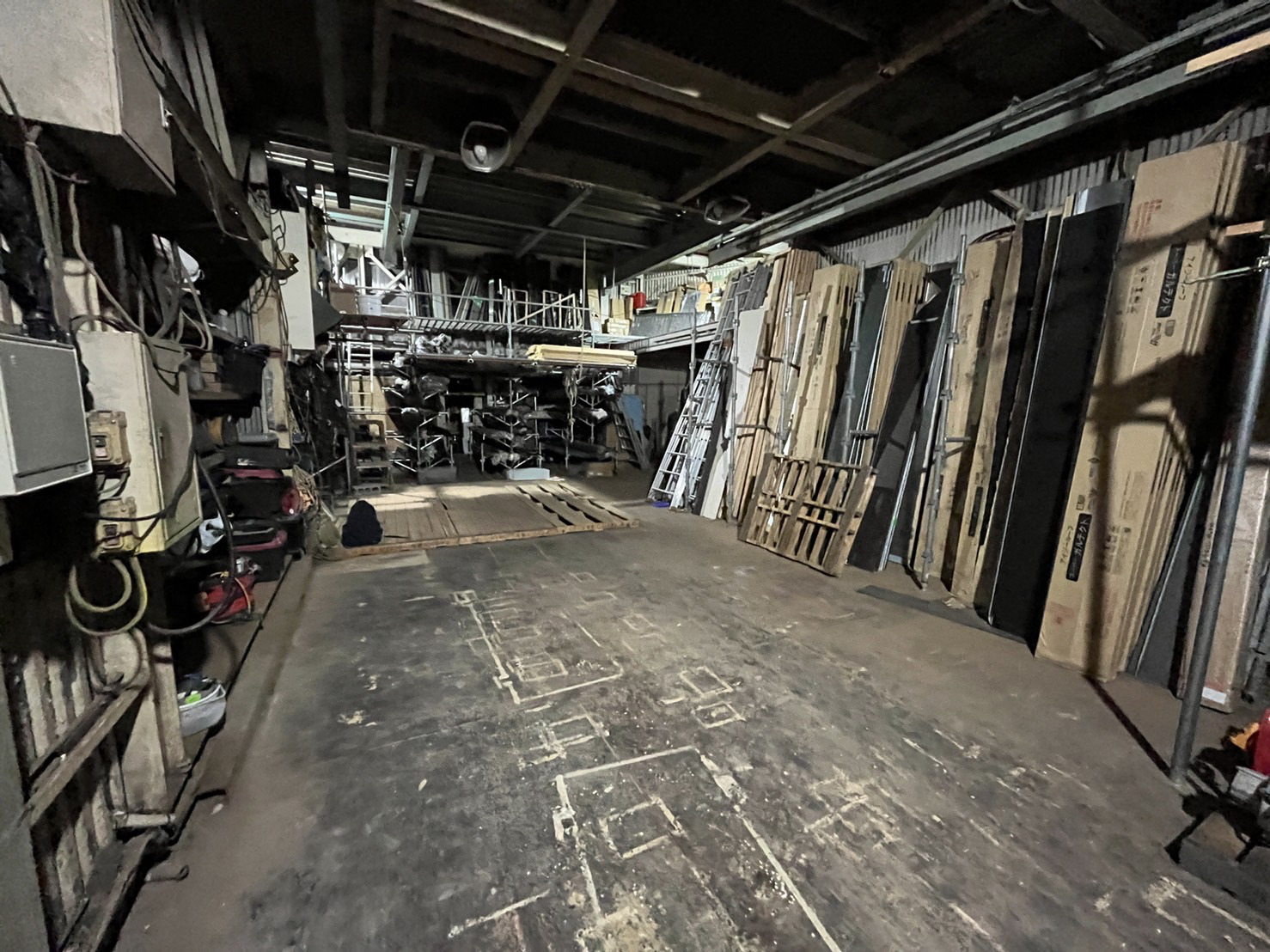 We store paints and substrate repair materials used for exterior renovations. By ordering a large quantity of materials at once, we can procure materials at a lower cost! Additionally, since we always have stock available, we can provide swift responses in emergencies!
In-house Waste Separation
 In large-scale renovations, various waste materials such as leftover paint, metal, and wood are generated. Kakeru Koumuten reduces waste disposal costs by sorting and recycling waste materials in-house.
Showroom Dedicated to Exterior Renovations

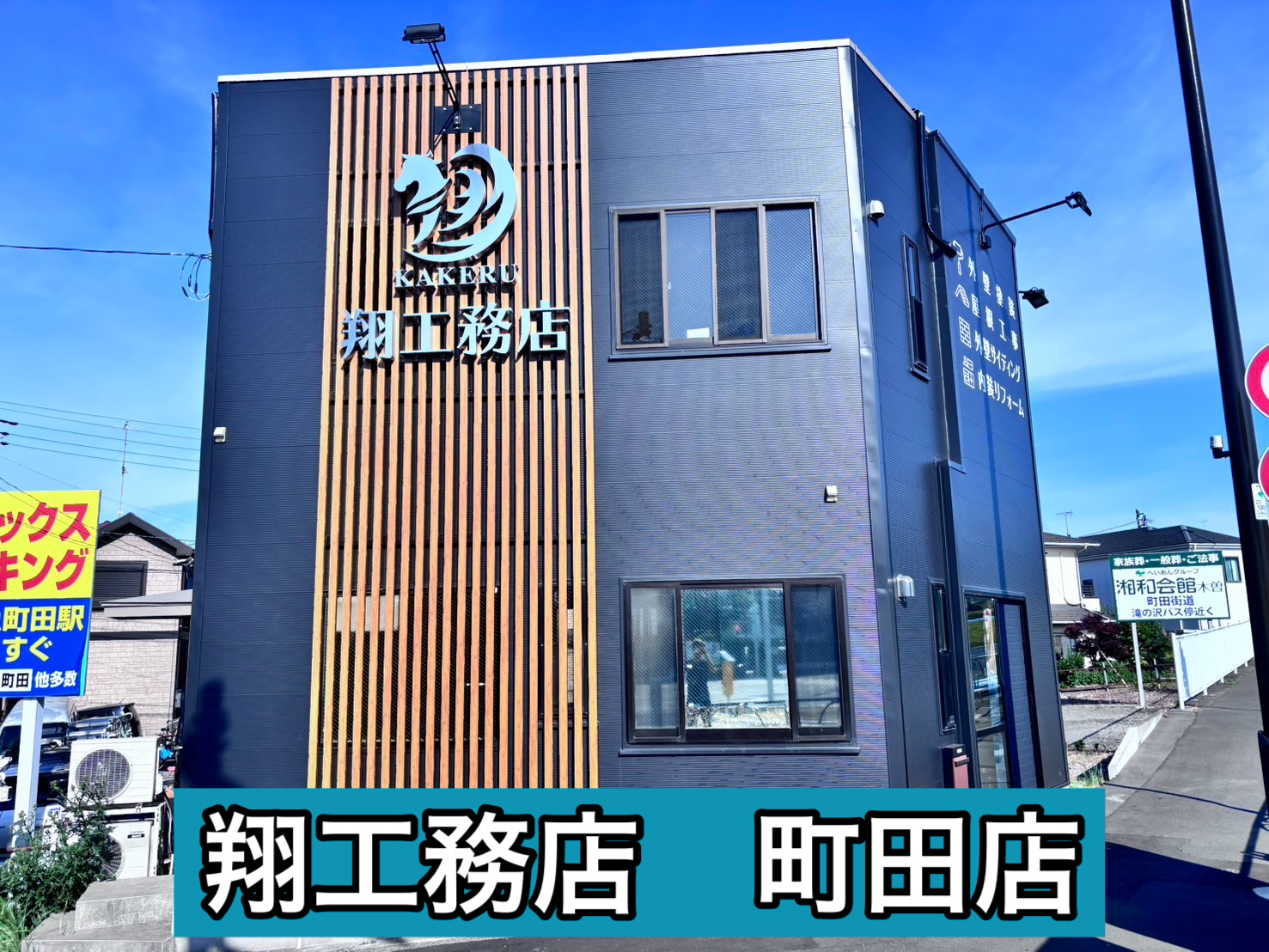
In the showroom, you can not only have meetings but also check actual samples and colors of exterior materials. Color simulations for exterior wall painting and heat resistance tests using a heat resistance testing machine are also available!
2. Cost Reduction through In-House Management and Construction
 One of Kakeru Koumuten’s major strengths is in-house management and construction.
By managing everything from inquiries to project completion in a consistent system by Kakeru Koumuten, we can keep costs down while providing high-quality large-scale repairs. Additionally, one representative will handle everything from the estimate to project completion. Since the representative does not change, communication can be smooth.
We can handle everything from temporary scaffolding installation to exterior wall painting, substrate repairs, waterproofing work, and tile repairs with complete in-house construction! Those with specialized knowledge and experience conduct inspections and actual construction for each process!
3. Various Permits and Skilled Workers
 We have obtained construction industry permits and permits for industrial waste collection and transportation! We also have nationally certified sheet metal and painting specialists on staff, and we are confident in our construction techniques. We can also handle large-scale roofing work for factories! We have qualified personnel for asbestos work supervisors and building material asbestos surveyors, so we can handle asbestos-containing roofing materials and conduct preliminary surveys as well.
4. Warranty and Aftercare
Most large-scale repair works, including “painting work,” “substrate repair work,” and “waterproofing work,” come with a warranty!
Aftercare is available every year, and we send out notification DM each year.
5. Flexible and Prompt Response

Our company is equipped to handle various troubles and situations related to apartments and condominiums.
We can also address exterior walls and rooftops that cannot be inspected from high places using drones! During rain leak investigations, we can use a thermal imaging camera to help identify the cause of leaks!
We will respond according to your wishes. We also accept emergency measures for sudden leaks! We will promptly respond to urgent requests or emergencies!
6. Staff Development
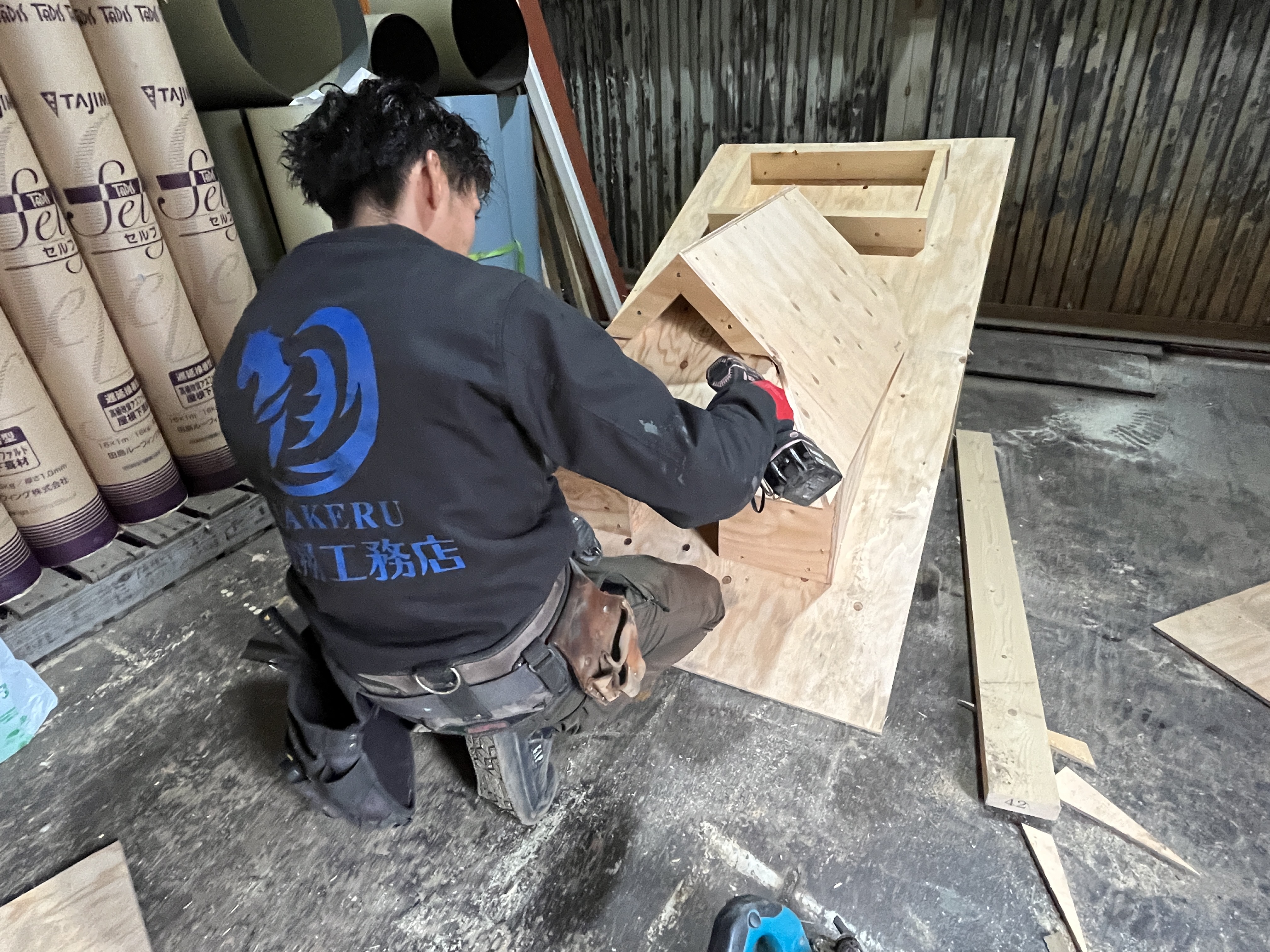
Our staff create various models for skill enhancement and conduct practical training. Since different sites require various processing and techniques, we regularly provide skill improvement education to ensure each staff member can respond effectively. We also educate on points to note and areas to check in each process of large-scale repair work.
7. Consideration for Residents and Neighbors
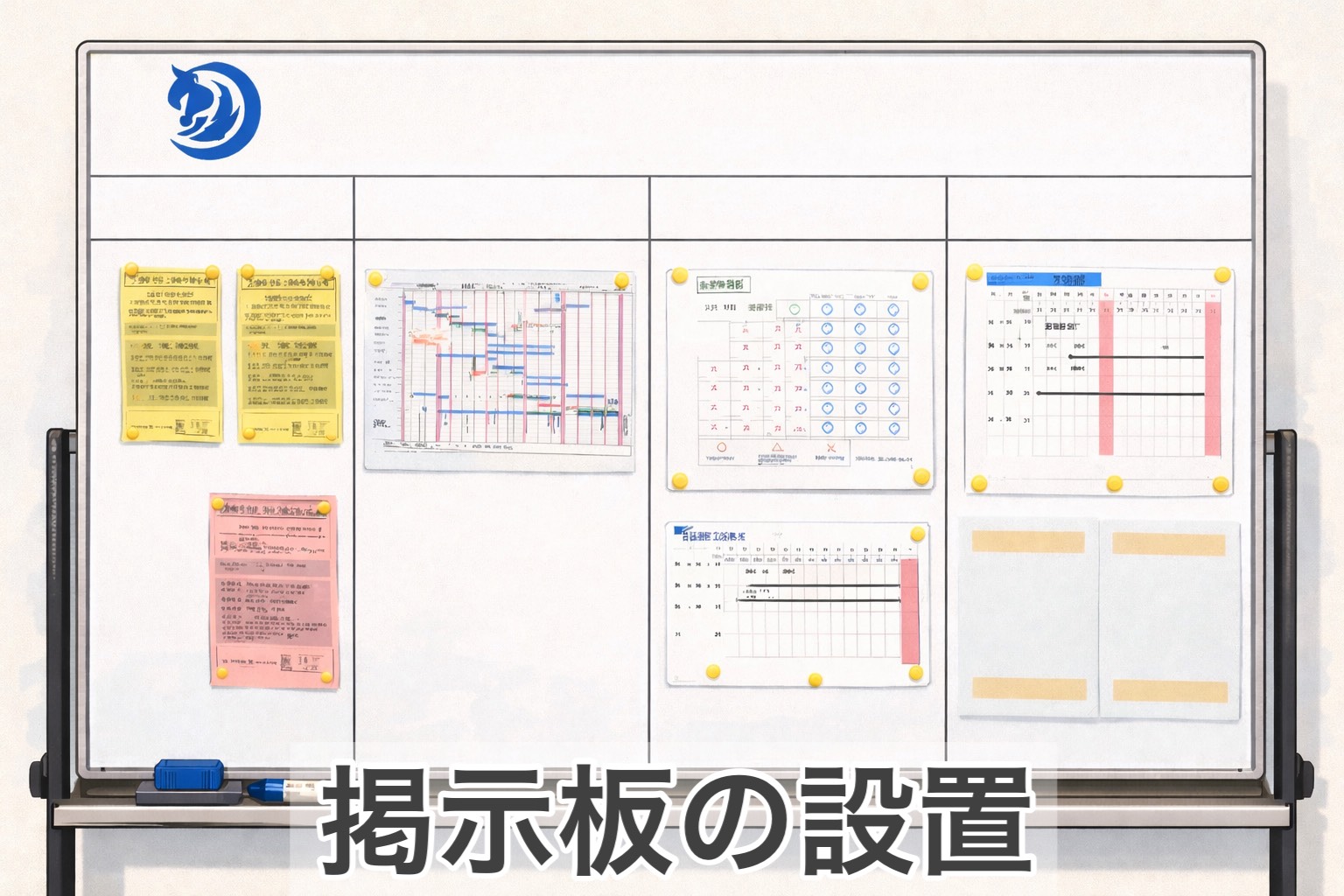
During large-scale renovation work, we will not only notify residents and greet nearby residents, but also install a bulletin board at the entrance to display the construction schedule and notices! Additionally, we will thoroughly educate visitors on proper manners to minimize any inconvenience to residents and neighbors.
8. Strict Quality Control
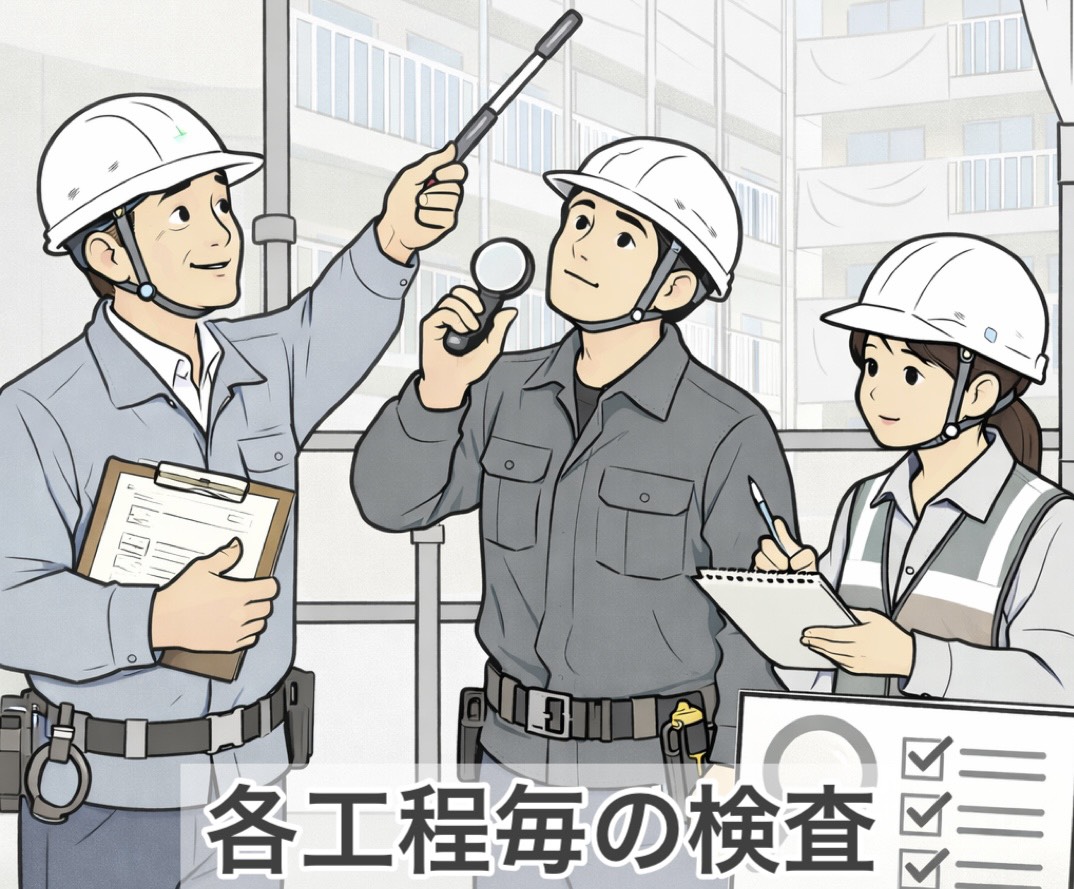
Each process will be inspected by a responsible person, and detailed construction photographs will be taken. We will use film thickness inspection machines and check sheets to ensure that there are no oversights in the inspections. During exterior wall painting and waterproofing work, we will check the number of used paint cans to confirm that the specified amount of paint is being used, and we will order paint directly from our company to prevent construction defects. Of course, we will also take photographs of the used paint and report them.
9. Exterior Wall Painting Color Simulation
9-1 Self Color Simulation
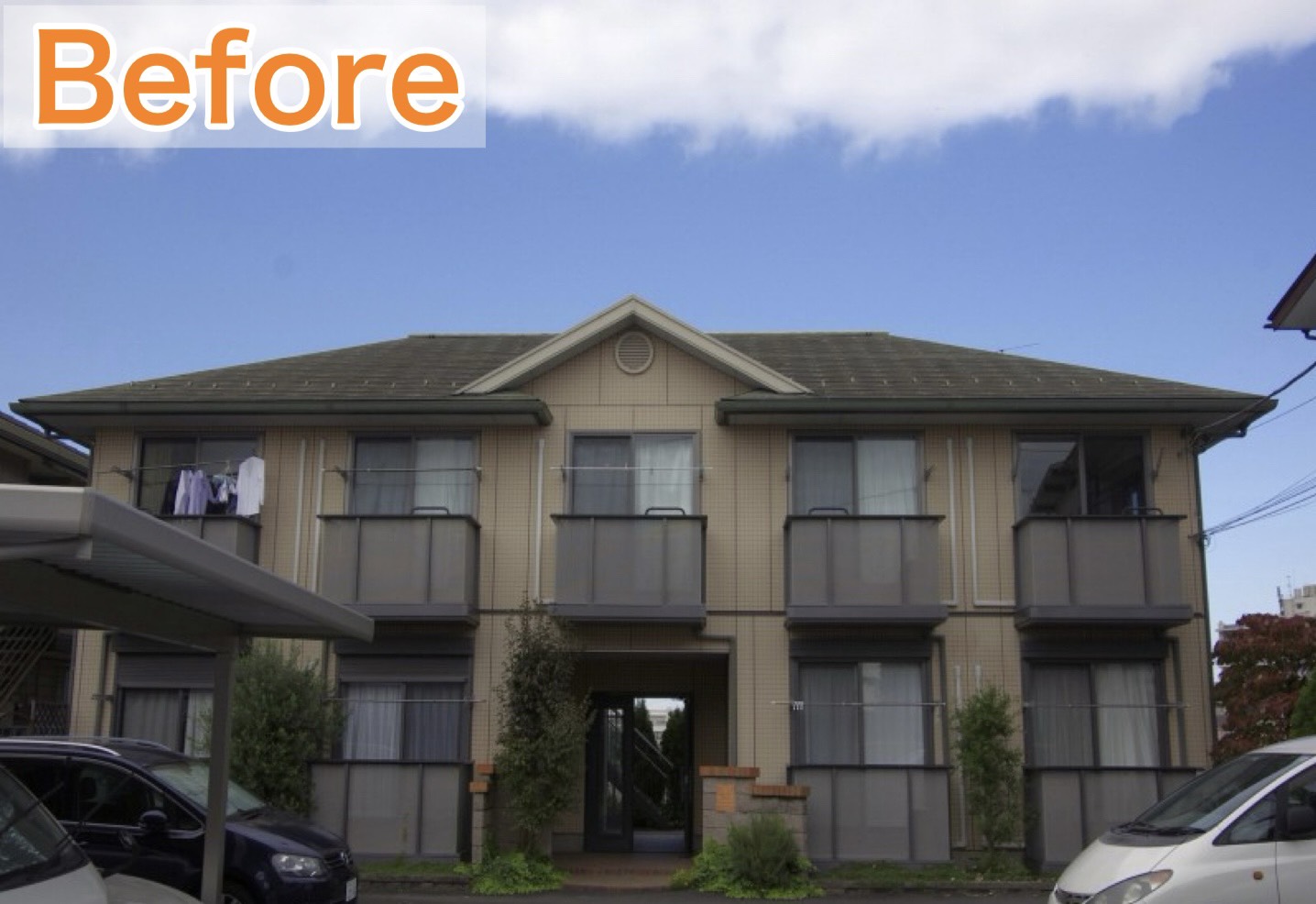
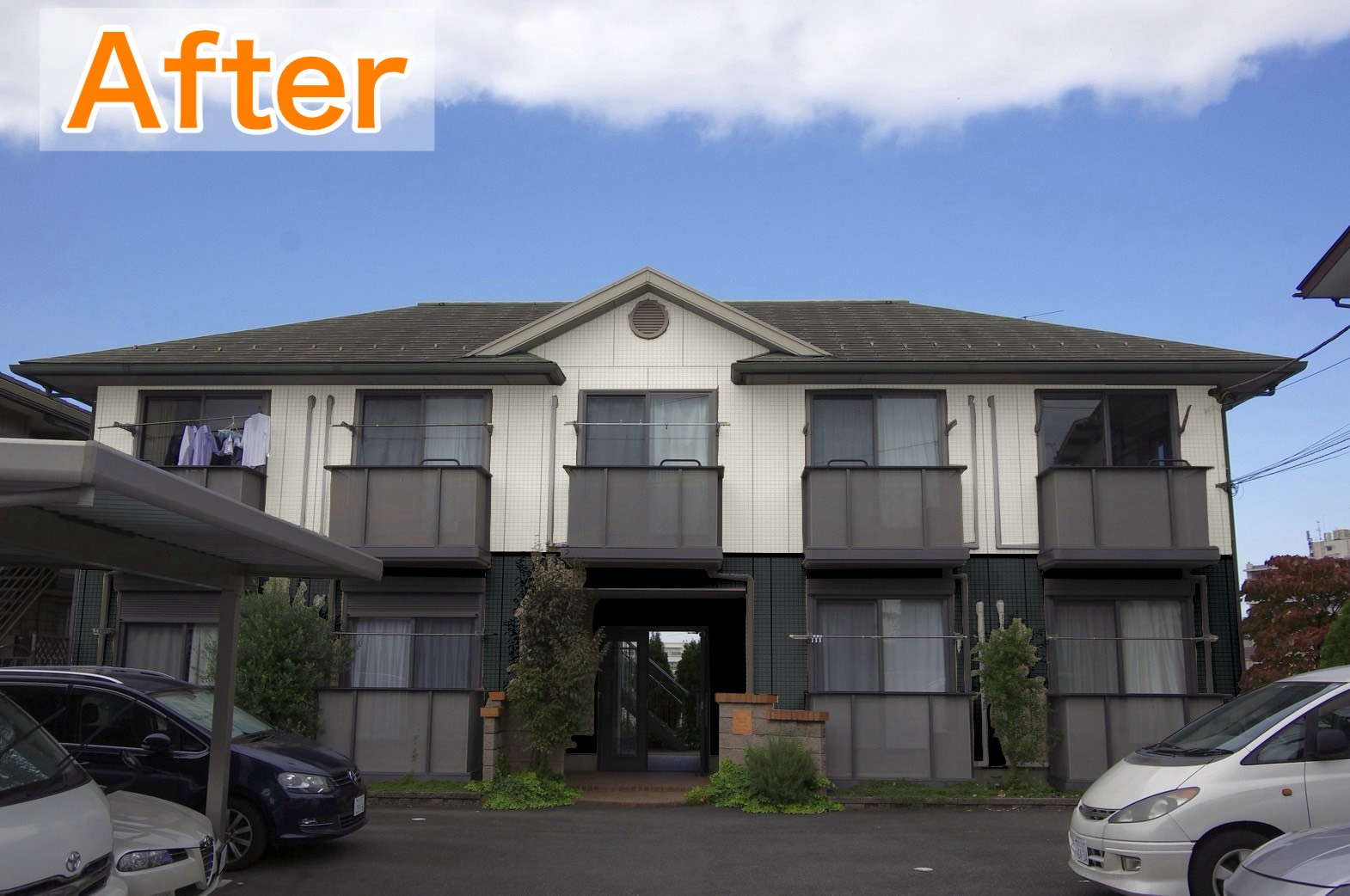
The simulations we create can be done using actual photos of your apartment or building!Simulations can also be performed on your smartphone or computer. By simulating and then applying a two-tone color or changing the image, we hope to enhance the stylish appearance and contribute to an increase in occupancy rates! Of course, we can also arrange for paint samples to confirm the actual colors.
* Tachikawa City has a landscape ordinance based on a landscape plan, and according to the notification guide (revised in April of Reiwa 7), repairs, renovations, and color changes that alter the appearance, as well as repainting of exterior walls, are subject to notification (repainting or repairs that do not change the appearance are generally not required to be notified, but if a building that does not conform to the landscape formation standards is fully repainted, notification is necessary). The scale of the subject varies by region and district, and according to the color standards, the total of emphasized colors and accent colors must be less than one-fifth of the visible area (Urban Planning Division, Urban Administration Section 042-523-2111, extensions 2367 and 2371). Additionally, in areas under the Tokyo Metropolitan Landscape Plan, notification based on the Tokyo Metropolitan Landscape Ordinance may be required depending on the overall scale of the building, and the city’s Q&A indicates that repainting with the same color is also subject to notification (normal maintenance activities such as tile repairs are excluded). Having a color simulation screen will help facilitate explanations to the general meeting, neighbors, owners, and residents.
9-2 Confirm the actual color with a trial paint!
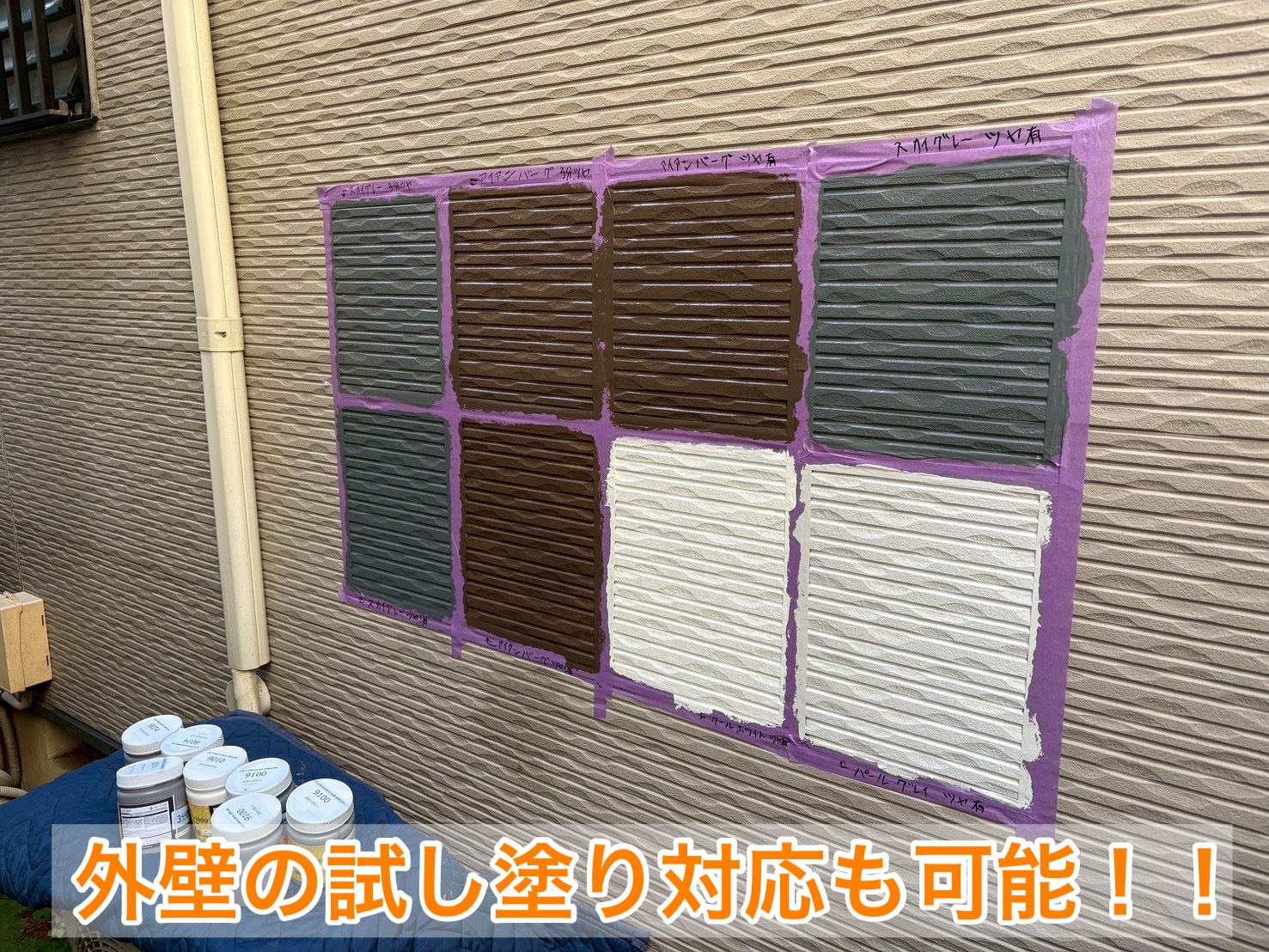 You can order samples of the paint you are considering and conduct trial painting on your exterior wall. By conducting a trial paint, you can confirm the actual color and gloss!
9-3 Exterior Renovation Simulation
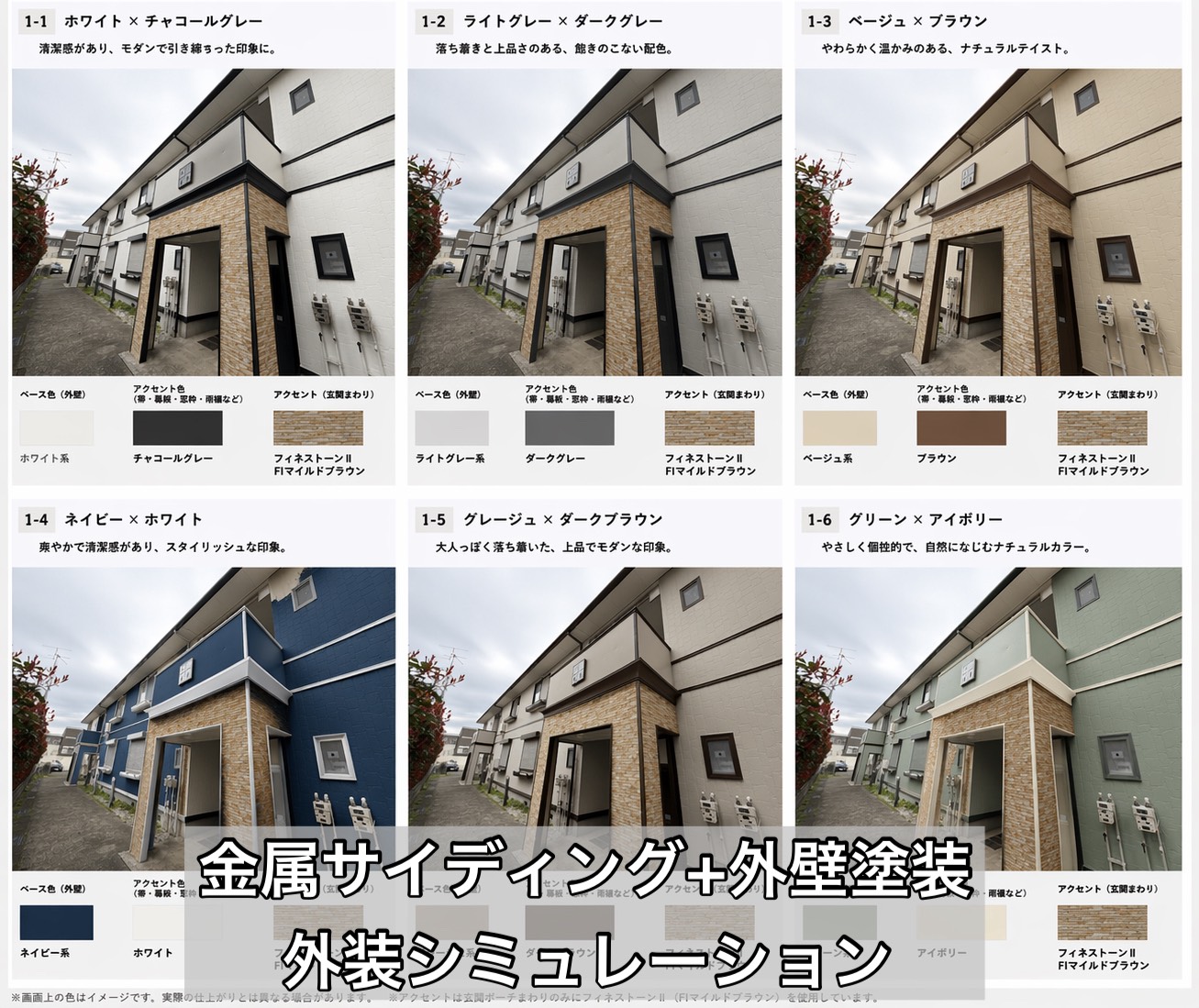
Exterior simulations for apartments and condominiums are also possible!
・Exterior wall color simulation (two-tone colors are also possible)
・Simulation of applying metal siding
・Simulation using accent materials such as cornices and louvers
・Simulation of roof painting and roof replacement work
With the exterior renovation simulation, you can minimize the risk of failure in image change! We hope that renovating the appearance of apartments and condominiums will help increase occupancy rates.
Cost Estimates for Large-Scale Repairs in Tachikawa City, Tokyo
The cost of large-scale repairs varies greatly depending on the size of the building, its deterioration condition, the scope of work, and the materials used. First, please refer to the national average based on public statistics, then to our company’s estimates based on construction performance by scale, and finally to unit price examples for each construction.
The national average for condominiums is 750,000 to 1,500,000 yen per unit
According to a survey conducted by the Ministry of Land, Infrastructure, Transport and Tourism, which compiled 818 construction case studies (FY 2021), approximately 70% of the costs for large-scale repairs are concentrated in the range of 750,000 to 1,500,000 yen per unit, with the most common price range being 1,000,000 to 1,250,000 yen. Please note that this survey’s amounts do not include consumption tax and common temporary costs, so the conditions differ from the current total construction costs including tax.
| Construction Cost per Unit | Percentage | Construction Cost per Unit | Percentage |
|---|---|---|---|
| Up to 750,000 yen | 15.1% | 1,250,000 to 1,500,000 yen | 17.4% |
| 750,000 to 1,000,000 yen | 24.7% | 1,500,000 to 2,000,000 yen | 9.1% |
| 1,000,000 to 1,250,000 yen | 27.0% (most common) | Over 2,000,000 yen | 2.8% |
Source: Ministry of Land, Infrastructure, Transport and Tourism “FY 2021 Survey on Large-Scale Repair Work for Condominiums” (200 companies, 818 cases) *Amounts do not include consumption tax and common temporary costs. Percentages may not total 100% due to rounding and non-responses.
Breakdown of Construction Costs (What the Money is Spent On)
| Category | Composition Ratio | Main Contents |
|---|---|---|
| Construction-related Work | 60.3% | About half for exterior wall work, about one-third for waterproofing. Substrate repairs, tiles, painting, waterproofing |
| Temporary Work | 22.8% | Scaffolding, mesh sheets, protective coverings, etc. (does not include common temporary costs) |
| Miscellaneous Expenses | 10.3% | Site management fees, general management fees, statutory welfare costs, etc. (9.5%), insurance premiums for large-scale repair defect insurance (0.8%) |
Source: Ministry of Land, Infrastructure, Transport and Tourism “FY 2021 Survey on Large-Scale Repair Work for Condominiums” (Second compilation of large-scale repair work. Overall average is construction-related 59.0%, temporary work 22.3%, miscellaneous expenses 9.9%). *The total may not equal 100% because it includes equipment-related work, exterior works, and others. This is an average value and is not a standard for judging the appropriateness of individual estimates.
Cost Estimates by Building Size (Scaffolding, Substrate Repair, Exterior Painting, Waterproofing, Sealing)
| Type and Size of Building | Cost Estimate | Estimated Construction Period |
|---|---|---|
| Wooden Apartment (2 stories, 6-10 units) | 2,000,000 – 4,000,000 JPY | 3 – 5 weeks |
| Steel Frame/RC Apartment (3 stories, 10-20 units) | 4,000,000 – 9,000,000 JPY | 1 – 2 months |
| Mixed-Use Building/Small Apartment (4-5 stories) | 5,000,000 – 15,000,000 JPY | 1.5 – 3 months |
| Medium-Sized Apartment (30-50 units) | 20,000,000 – 50,000,000 JPY | 3 – 5 months |
| Large Apartment (over 100 units) | Around 100,000,000 JPY or more | 6 months or more |
*The above estimates are based on Kakeru Koumuten’s construction records and may vary depending on the presence of roofing work, metal work, plumbing, etc. For apartments, please also consider the amount obtained by multiplying the national statistics above (750,000 – 1,500,000 JPY per unit) by the number of units as a reference.
Breakdown of Costs for Temporary Structures, Substrate Repair, Exterior Walls, and Waterproofing
The estimate for large-scale repairs is broadly divided into “temporary structures,” “substrate repair,” “sealing,” “exterior painting,” “waterproofing,” and “miscellaneous expenses.” Before comparing total amounts, please check what each item includes, how much, and at what cost.
| Item | What to Check in the Estimate |
|---|---|
| Building Prerequisites | Structure (wooden, steel frame, RC), number of floors, number of units, exterior wall area, waterproof area. Confirm whether the area is based on drawings or actual measurements. |
| Common Temporary Works & Scaffolding | Area and unit price of scaffolding, mesh sheets, protection, temporary toilets, etc. According to the Ministry of Land, Infrastructure, Transport and Tourism’s survey for the fiscal year 2021, temporary works such as scaffolding account for about 20% of construction costs (excluding common temporary costs). |
| Substrate Repair | Quantities and unit prices for repair methods such as cracks, lifting, and spalling. Since these items are not confirmed until scaffolding is set up, confirm whether it is based on estimated quantities or actual settlement, and the settlement method if quantities increase or decrease. |
| Sealing | Whether it is a replacement or additional application, length to be applied (m), material name. |
| Exterior Wall Painting | Painting area (㎡), manufacturer name, product name, grade of paint, number of coats, scope of ancillary parts. |
| Waterproofing | Area for each part such as rooftop, balcony, common corridor, construction method, material name, and whether drain renovations are included. |
| Inspection & Reporting | Inspections for each process, construction photos, and whether completion reports and warranty documents are included. |
| Miscellaneous Expenses | Contents and ratios of site management fees, general management fees, statutory welfare expenses, etc. According to the Ministry of Land, Infrastructure, Transport and Tourism’s survey for the fiscal year 2021, the average is about 10% of construction costs, but it varies depending on the size and conditions of the building, so there is no uniform standard. |
| Tax Classification | Whether the amount is tax-inclusive or tax-exclusive. Since companies display this differently, always align them before comparing total amounts. |
Unit Price Examples for Repair Work
| Repair Method | Materials Used | Cost |
|---|---|---|
| Tile Replacement | Existing Similar Tiles | per piece / 2,000 JPY〜4,000 JPY |
| Repair of Floating Tile and Mortar Areas | Epoxy Resin Injection | per square meter / 3,000 JPY〜5,000 JPY (Varies depending on the degree) |
| Tile Joint Mortar Repair | Mortar for Tile Joints | per square meter / 1,000 JPY〜2,000 JPY (Varies depending on the degree) |
| Concrete Spalling Repair | Rust Preventive for Rebar + Resin Mortar | per area / 1,000 JPY〜2,000 JPY (Varies depending on the degree) |
| Crack Repair | Filler or Polymer Cement | per meter / 100 JPY〜2,500 JPY (Varies depending on the degree) |
| Exterior Wall Painting (3 Coats) | Radical Control Silicone Paint | per square meter / 2,500 JPY〜3,500 JPY |
| Roof Waterproofing with Urethane (Ventilated Buffer Method) | High Strength Urethane | per square meter / 6,500 JPY〜9,500 JPY |
| Sealing Replacement | Modified Silicone | per meter / 900 JPY〜1,500 JPY |
| Temporary Scaffolding | In-house Owned Scaffolding Materials (Wedge Type) | per square meter / 700 JPY〜1,000 JPY |
*Costs and warranty periods vary based on shape, quantity, substrate condition, and type of materials. If you would like a detailed estimate, please feel free to contact us. Estimates are completely free.
Select Paint and Waterproofing Grades Based on “Years Until Next Repair”
“Good paint does not equal the right choice.” The best way to choose is to align when the next major repair will be with the lifespan of the materials to avoid waste.
| Grade | Estimated Lifespan | Suitable Cases |
|---|---|---|
| Silicone / Radical Control Type | 10-16 years | Buildings that are cycled every 12-15 years. A good choice with a balance of cost and performance. The lifespan varies by product, so choose a product specification that matches the cycle. |
| Fluorine | 16-20 years | Buildings that want to set the next repair after 15 years, high-rise or complex-shaped buildings where scaffolding costs are high. |
| Inorganic | 18-22 years | Buildings that want to suppress dirt adhesion. Effective for suppressing moss and algae on the north side or poorly lit areas. |
| Urethane Waterproofing (Rooftop) | 8-15 years | Complex-shaped rooftops, when wanting to renovate using the existing waterproof layer. Mid-term inspections and repairs, such as re-coating the top coat, are prerequisites. |
| PVC Sheet Waterproofing | 20-25 years | Rooftops with a large area and simple shape. Short construction time. |
| Asphalt Waterproofing | 15-20 years | Rooftops planned for a long cycle. The cost per instance will increase. |
* The estimated lifespan is a general guideline and may vary depending on sunlight, location, and substrate condition. Choosing paints with anti-algae and anti-mold properties will improve durability in shaded and humid areas.
Guidelines for Repair Reserve Funds and Options When Insufficient
The Ministry of Land, Infrastructure, Transport and Tourism guidelines indicate the estimated repair reserve fund on a monthly basis per exclusive area. An additional charge is required if there is a mechanical parking lot.
| Building Size (Less than 20 Floors) | Monthly Estimate (Average) | Range Covering Two-Thirds of Cases | Conversion for 70㎡ |
|---|---|---|---|
| Building Floor Area Less than 5,000㎡ | 335 JPY/㎡ | 235-430 JPY/㎡ | Approximately 16,500-30,100 JPY |
| 5,000-10,000㎡ | 252 JPY/㎡ | 170-320 JPY/㎡ | Approximately 11,900-22,400 JPY |
| 10,000-20,000㎡ | 271 JPY/㎡ | 200-330 JPY/㎡ | Approximately 14,000-23,100 JPY |
| Over 20,000㎡ | 255 JPY/㎡ | 190-325 JPY/㎡ | Approximately 13,300-22,750 JPY |
Source: Ministry of Land, Infrastructure, Transport and Tourism “Guidelines on Repair Reserve Funds for Condominiums” (Reiwa 6, June revision, PDF) / National average is 13,378 JPY per unit per month (Reiwa 5 Fiscal Year Comprehensive Survey of Condominiums)
In the Reiwa 5 Fiscal Year Comprehensive Survey of Condominiums, 36.6% of management associations responded that “the repair reserve fund is insufficient compared to the plan.” There are four main options when insufficient.
| Options | Considerations and Points of Caution |
|---|---|
| ① Adjusting the Construction Schedule | Based on deterioration diagnosis, postpone less urgent work to the next time. However, it is essential to distinguish between work that can be postponed and work that cannot, as delaying waterproofing and tile fall prevention measures can ultimately be more costly. |
| ② Reviewing the Scope and Specifications of Work | Reassessing paint grades, changing from full renovations to partial renovations, etc. Please consider this separately from “apparent cost reductions” that skip processes. |
| ③ Utilizing Subsidies and Tax Systems | Subsidies for energy-saving renovations from the national and Tokyo Metropolitan governments, as well as the management plan certification in Tachikawa City, and reductions in fixed property tax (see below). The reduction in fixed property tax is a system that lowers the tax amount for each unit owner, and does not directly increase the repair funds of the management association. |
| ④ Increasing Reserve Funds, Borrowing, and One-Time Payments | In addition to considering increasing the repair reserve fund at the general meeting, the Japan Housing Finance Agency’s condominium common area renovation loans require no collateral. Interest rates can be lowered by obtaining management plan certification. |
Subsidies, Tax Systems, and Loans to Check for Large-Scale Renovations in Tachikawa City, Tokyo
Based on the official page of Tachikawa City, there does not appear to be a municipal system that subsidizes the construction costs of large-scale renovations for condominiums. The city provides information on management plan certification, management status reporting, and free maintenance and management consultations. The available options can be broadly categorized into the following five types. The eligibility and acceptance status of these systems may change even during the fiscal year, so please be sure to confirm with our company or each contact point before contracting or starting work. (As of October 15, 2026)
| Type | Details |
|---|---|
| ① Support from Tachikawa City | Management plan certification system (application fee to the city: 4,100 JPY), management status reporting system, and information on free condominium consultations from the Tokyo Metropolitan Government. The contact point is the Housing Division, Housing Measures Section. |
| ② Tax Incentives | Reduction of property tax under the condominium longevity promotion tax system (national system). According to the city’s information, one unit up to 100㎡ is eligible for a one-third reduction. The application should be submitted to the Tax Division, Building Section. |
| ③ Management Plan Certification System | A certification system that serves as an entry point for tax incentives and interest rate reductions. Condominiums in Tachikawa City are handled by Tachikawa City (Housing Division, Housing Measures Section), and there are no unique city standards; they are the same as the national guideline standards. |
| ④ Purpose-specific Construction Subsidies | Energy-saving measures (windows, insulation, etc.). The existing housing insulation renovation subsidy from Tachikawa City has reached its budget limit for the fiscal year 2026 and is no longer accepting applications. Please check alongside national and Tokyo Metropolitan Government projects. |
| ⑤ Loans and Interest Subsidies | Renovation loans for common areas of condominiums from the Japan Housing Finance Agency, and interest subsidies from Tokyo Metropolitan Government (subsidy for condominium improvement work). |
We have organized the information provided by Tachikawa City for condominium management associations based on what can be confirmed on the city’s official page. None of these systems directly cover the costs of large-scale repair work.
| Management Status Notification System | Applicable to condominiums built before December 31, 1983, with six or more independent units for residential use. Notifications can be submitted through the Tokyo Metropolitan Government’s system or by mailing or bringing the notification form to the city’s housing department (the page was last updated on July 30, 2025). The number of applicable condominium buildings and the number of submitted notifications within the city are not listed on the page. |
|---|---|
| City’s Related Materials | On the city’s condominium management page, the “Tachikawa City Condominium Actual Condition Survey Report” (February 2023) and the “Tachikawa City Condominium Management Improvement Promotion Plan” are published. |
| Consultation Desk | The Comprehensive Consultation Desk for Condominiums at the Tokyo Disaster Prevention and Urban Development Center offers free consultations by condominium management specialists (03-6427-4900), along with specialized consultations by lawyers and first-class architects (free, by appointment only, applications through the city’s housing department). The city’s contact point is the Housing Policy Section of the Housing Department (042-523-2111, extension 2562). |
| Seismic Support | The subsidies for seismic measures listed on the city’s seismic page include seismic reinforcement for wooden houses and buildings along emergency transport routes. The city’s subsidy for seismic diagnosis and renovation of condominiums could not be confirmed on the page. Tokyo has a subsidy program for “Emergency Measures for Pilotis and Similar Structures” targeting condominiums with pilotis that pose a high risk of collapse under old seismic standards (please check with the Tokyo Metropolitan Government for eligibility). |
- Tachikawa City: Maintenance and Management of Condominiums (Official)
- Tachikawa City: Management Status Notification System (Official)
- Tachikawa City: Condominium Maintenance and Management Consultation (Official)
- Tachikawa City: Condominium Actual Condition Survey Report (Official)
- Tachikawa City: Seismic Measures (Official)
② Condominium Longevity Promotion Tax System (Reduction of Fixed Asset Tax)
If a condominium that meets certain requirements carries out large-scale repairs (such as exterior painting, floor waterproofing, and roof waterproofing as a single project) that contribute to longevity, the fixed asset tax for the building will be reduced in the following fiscal year (up to 100 square meters per unit; urban planning tax is not included). The reduction rate is determined by local ordinances. Since Tachikawa City is not one of the 23 wards of Tokyo, the fixed asset tax is a city tax. According to Tachikawa City’s official page (regarding the reduction system for fixed asset tax for condominiums that have undergone large-scale repairs contributing to longevity), it states that one-third of the fixed asset tax amount will be reduced, limited to 100 square meters per unit. The application should be made to the Taxation Division of the Citizens’ Affairs Department (042-523-2111, extensions 1221-1224). (In the 23 wards of Tokyo, the fixed asset tax is a metropolitan tax, and the reduction rate is one-half.)
| Main Requirements of the National System | For condominiums that are over 20 years old and have more than 10 units, the floor area of the residential exclusive part must be more than half of the total exclusive area / At least one instance of exterior painting, floor waterproofing, and roof waterproofing must have been completed in the past / Condominiums that have received certification of their management plan, which have raised the amount of the repair reserve fund (average amount over the entire planning period) from below the certification standard to above the standard after September 1, 2021, or management associations that have received administrative advice and guidance based on the Condominium Management Improvement Act to ensure that their long-term repair plans meet national standards. |
|---|---|
| Implementation Deadline of the National System | From April 1, 2023, to March 31, 2027 (the duration of the national system). |
| Tachikawa City Handling | According to the city’s page (updated June 18, 2026), the reduction applies only to the fiscal year following the year of completion of the work and is a one-time benefit. Applications must be submitted within three months after the renovation to the Tax Division, Building Section, with a reduction application form for each unit owner (if submitted collectively by the management association, only one set of certificates, etc., is required). For certified management plan condominiums, documents such as the management plan certification notice, proof of repair reserve fund increase, proof of past work, proof of large-scale repairs, and documents confirming the total number of units are required. For inquiries regarding management plan certification and documents related to the city’s advice and guidance, contact the Housing Division, Housing Policy Section (042-523-2111, extension 2562). |
| Points to Note | Obtaining management plan certification and reviewing the long-term repair plan takes time, so it is recommended to start preparations at least one year before the construction. The property tax reduction for seismic, barrier-free, and energy-saving renovations cannot be combined within the same fiscal year. The handling after April 2027 has not been confirmed on the official page. |
- Tachikawa City: Property Tax Reduction System for Condominiums that Conduct Large-Scale Repairs Contributing to Longevity (Official)
- Ministry of Land, Infrastructure, Transport and Tourism: Tax System Promoting Longevity of Condominiums (Official)
- Ministry of Land, Infrastructure, Transport and Tourism: Property Tax Reduction for Large-Scale Repairs of Condominiums (PDF)
- Ministry of Land, Infrastructure, Transport and Tourism: Is Your Condominium Being Regularly Maintained? (PDF)
③ Management Plan Certification System (Entry for Tax and Interest Rate Benefits)
By obtaining certification, it leads to fulfilling one of the requirements for interest rate preferential treatment for loans and bonds from the Japan Housing Finance Agency, as well as the long-term durability promotion tax system (certification alone does not guarantee tax reduction). For condominiums in Tachikawa City, Tachikawa City serves as the certification window. There are no unique municipal standards; it is considered to be the same as the standards set forth in the national guidelines for condominium management.
| Application Process | ① Apply for the “Management Plan Certification Procedure Support Service (Preliminary Confirmation)” at the Condominium Management Center and receive a preliminary confirmation from a condominium management consultant → ② If it meets the standards, a “Preliminary Confirmation Compliance Certificate” will be issued → ③ Apply for certification to the city through the management plan certification procedure support system → ④ Pay the fee with the payment notice received from the city → ⑤ After examination, if certified, a certification notification will be mailed. The certified management plan will be published on the Condominium Management Center’s viewing site unless otherwise requested. |
|---|---|
| Fees | The application fee for certification and renewal to the city is basic fee of 4,100 yen, and if there are multiple long-term repair plans, an additional 1,800 yen will be added for each subsequent plan. The cost for preliminary confirmation can be checked on the Condominium Management Center’s website. |
| Number of Certifications | There is no mention of the number of certifications on the city’s page. |
| Consultation Window | Tachikawa City, Citizens’ Department, Housing Division, Housing Policy Section 042-523-2111 (extension 2562) (The page was last updated on April 22, 2024) |
④ National Energy Conservation Support | Housing Energy Conservation 2026 Campaign
Changes for Fiscal Year 2026The “Child-Rearing Green Housing Support Project” for Fiscal Year 2025 has been abolished and reorganized into the successor “Mirai Eco Housing 2026 Project.” Additionally, the “Long-Term Excellent Housing Renovation Promotion Project” will end in Fiscal Year 7 and will not be implemented in Fiscal Year 8. Please be careful not to base your financial plans on outdated information.
Mirai Eco Housing 2026 Project
| Target | Renovations of existing homes built before December 31, 2016, regardless of whether they are single-family or multi-family residences. Management associations and management corporations can also become joint contractors (i.e., can be used for common area renovations). Rental properties are also eligible. |
|---|---|
| Required Work | Insulation renovations of openings, insulation renovations of the structure (floor, walls, ceiling), and installation of eco-friendly housing equipment are mandatory combinations. |
| Subsidy Limit | Based on the age of the building and the energy-saving performance achieved, 400,000 to 1,000,000 yen per unit (1,000,000 yen for homes built before 1991 that meet mandatory standards). |
| Period | Work that has started after signing a construction contract, from November 28, 2025, until no later than December 31, 2026, is eligible. The grant application is generally conducted by the registered contractor (construction contractor) after the completion of the work (the client cannot apply themselves). Reservations for grant applications must be made by November 16, 2026, at the latest, and grant applications must be submitted by December 31, 2026, at the latest (will end once the budget limit is reached). |
Advanced Window Renovation 2026 Project
| Target | Renovations to existing homes (single-family and multi-family) such as installing interior windows, replacing exterior windows, and glass replacement to high-performance insulation windows. For multi-family residences, subsidy rates are set based on “low-rise” and “mid-to-high-rise” classifications. |
|---|---|
| Bulk Application for Multi-Family Residences | For multi-family residences, there is a method of “bulk application” where all units can be applied for together. The application process is conducted by the registered contractor (window renovation contractor), and management associations cannot apply themselves, but this system is well-suited for window and entrance door renovations in conjunction with large-scale repairs. |
| Subsidy Limit | For residences, 1,000,000 yen per unit (changed from 2,000,000 yen for the fiscal year 2025). For non-residential buildings over 240 square meters, 10,000,000 yen per building. |
| Period | Work that has started after November 28, 2025, and no later than December 31, 2026, is eligible. Grant applications are made after the completion and handover of the work, with reservations due by November 16, 2026, at the latest, and grant applications due by December 31, 2026, at the latest (will end once the budget limit is reached). |
⑤ Tokyo’s Subsidies and Grants, and Tachikawa City’s Subsidy Information
| Tokyo Energy Conservation Renovation Promotion Project for Existing Homes (Fiscal Year 2026) | The renovation of high-performance windows, doors, insulation materials, and bathtubs is eligible, and the target participants include management associations of condominium buildings. For management associations with 50 or more renovated units, the subsidy amount will be 120% of the total unit price. The maximum subsidy for windows and doors is 2 million yen per unit, and for insulation materials, it is up to 1 million yen per unit, covering one-third of the expenses. Pre-registration started on May 29, 2026. Contracts and construction will take place after the pre-registration acceptance. It was not confirmed on the official page whether construction of common areas is eligible. Please check the official page and the contact number (03-6737-5300) for conditions regarding registered businesses and budget status. |
|---|---|
| Tachikawa City Existing Housing Insulation Renovation Subsidy (Fiscal Year 2026) | Renovations of windows and doors to insulation materials, as well as insulation renovations for exterior walls, ceilings, and floors, ordered from local businesses are eligible, with a subsidy of up to half of the eligible construction costs, capped at 50,000 yen. The target housing includes apartment buildings, and it is a condition that co-owners do not violate regulations, but it is not mentioned whether management associations can apply. The budget for fiscal year 2026 (2.5 million yen) has been exhausted, and applications are now closed. There is no information on the next year’s application schedule on the page. The contact is the Environmental Policy Division, Zero Carbon Promotion Section (042-523-2111, extensions 2243 and 2244). |
| Tachikawa City Asbestos Measures | The reporting of preliminary survey results for asbestos must be submitted electronically through the national “Asbestos Preliminary Survey Result Reporting System” as a general rule. The reporting contact for buildings with a total floor area of less than 2,000 square meters is the city’s Environmental Policy Division (extensions 2248 and 2249), while for buildings and structures of 2,000 square meters or more, it is the Tokyo Tama Environmental Office, Environmental Improvement Section. Reporting is required when the total contract amount for renovation work is 1 million yen or more (including tax). There is no information on municipal subsidies for surveys or removal work on the page. |
| Tokyo Emergency Measures Subsidy for Piloti Floors to Protect Lives | This program targets condominiums built under old seismic standards that have piloti floors with a high risk of collapse, and part of the reinforcement costs will be subsidized. The contact is the Tokyo Metropolitan Government, Housing Policy Headquarters, Private Housing Division, Condominium Section, Seismic Reinforcement Section (03-5320-4944). Please check the Tokyo page for detailed requirements and application status. |
| Tokyo Rental Housing Insulation and Renewable Energy Concentration Promotion Project (Fiscal Year 2026) | This program targets owners of existing rental housing leased under ordinary rental contracts, and construction must be carried out by registered businesses of Cool Net Tokyo. Pre-registration is from May 29, 2026, to March 31, 2027, and will end when the total application amount reaches the cap. The subsidy rate is two-thirds, with a maximum of 300,000 yen per unit for high-performance windows and 600,000 yen per unit for insulation renovations. No information was found confirming that management associations of condominium buildings are eligible, as this program is aimed at owners of rental apartments and rental condominiums. |
| Tokyo Subsidy for Renovation Costs of Special Nursing Homes (Fiscal Year 2026) | This is a Tokyo program that supports renovations of facilities for the elderly. It cannot be used for large-scale repairs of condominiums or apartments and is intended for those who own and operate facilities such as special nursing homes. Please check the explanatory video and official page of Tokyo for eligibility and conditions. |
* The Tokyo rental housing program is aimed at owners of rental apartments and rental condominiums, and no information was found confirming that management associations of condominium buildings are eligible. The application status may change, so please be sure to check the official page before applying.
- Tachikawa City: Existing Housing Insulation Renovation Subsidy (Official, Application Closed)
- Tachikawa City: Notification and Reporting for Demolition of Buildings Containing Asbestos (Official)
- Tokyo Metropolitan Government: Energy Conservation Renovation Promotion Project for Existing Housing (Official)
- Tokyo Metropolitan Government: Subsidy for Emergency Measures for Piloti Floors to Protect Lives (Official)
- Tokyo Metropolitan Government: Insulation and Renewable Energy Promotion Project for Rental Housing (Official)
- Tokyo Metropolitan Government: Announcement of the Start of the Insulation and Renewable Energy Promotion Project for Rental Housing (Official)
- Tokyo Metropolitan Government: Explanation Video on Subsidies for Renovation Costs of Special Nursing Homes
⑥ Financing System (Housing Finance Agency Mansion Sumairu Loan)
If the management association borrows funds for large-scale repairs, they can utilize the Housing Finance Agency’s “Mansion Common Area Renovation Loan (Mansion Sumairu Loan).”
| Eligible Work | Large-scale repairs, seismic retrofitting, flood prevention measures, energy conservation measures, balcony repairs, safety measures for elevators and parking lots, asbestos measures, costs for diagnosis and design by specialists |
|---|---|
| Collateral | No collateral required (Joint guarantee by the Mansion Management Center, etc.) |
| Repayment Period | Generally 1 to 10 years, 1 to 20 years for specific works, up to 35 years if seismic, flood, and energy conservation works are carried out after obtaining management plan certification |
| Interest Rate Reduction | ① Holding of Sumairu Bonds ② Obtaining Management Plan Certification ③ Implementation of seismic, flood, and energy conservation works, each reducing by 0.2% per year (maximum 0.6% per year) |
| Main Requirements | Improvement of management regulations, resolution at the general meeting, the delinquency rate of repair reserve funds must be within 10%. Applications are accepted year-round |
Source: Housing Finance Agency “Mansion Sumairu Loan” (Official)
Tokyo Metropolitan Apartment Improvement Construction Subsidy (Interest Subsidy)
| Content | This is a system where the Tokyo Metropolitan Government subsidizes the interest on the “Apartment Common Area Renovation Loan” from the Japan Housing Finance Agency. The difference from the agency’s interest rate, which is 1% lower, is subsidized (if the interest rate is less than 1%, it effectively becomes 0%), and the subsidy period is up to 20 years, which is the repayment period of the loan. |
|---|---|
| Eligibility | This applies to the management associations of fire-resistant condominiums in Tokyo that utilize the agency’s loans and debt guarantees from the Apartment Management Center, etc. Repairs and renovations of common areas are eligible (installation work for solar power generation equipment may also be eligible for loans; please check the conditions with the Japan Housing Finance Agency). Condominiums built before the earthquake resistance standards (before May 31, 1981) must undergo an earthquake resistance diagnosis, and condominiums that require reporting on management status must have completed the necessary reports and updates. |
| Limit | The limit is the smallest amount among the loan reservation amount, the construction cost eligible for the loan, the amount excluding subsidies from the construction cost, and 2 million yen per unit (6 million yen if accompanied by earthquake reinforcement) multiplied by the number of units. |
| Application for Reiwa Year 8 | The application is in two phases, with the first phase (May 13 – September 30) having ended. The second phase will be accepted from October 1, 2026, to February 19, 2027. Each phase has 2,500 units available on a first-come, first-served basis. After loan approval, applications and grant decisions must be received before the monetary loan contract. Contact: Tokyo Metropolitan Housing Policy Headquarters, Private Housing Department, Apartment Division 03-5320-7532 |
Cases Where Fire Insurance Can Be Used and Cases Where It Should Not Be Used
Damage caused by “accidental incidents” such as flying waterproof sheets, caps, and fences due to typhoons or strong winds, hail damage, and lightning strikes may be covered by fire insurance. It is important to separate and record damage caused by accidents from normal wear and tear during deterioration diagnosis.
On the other hand, normal wear and tear itself is not covered. There have been many troubles nationwide with companies soliciting that “repairs can be made without out-of-pocket expenses using insurance,” and the National Consumer Affairs Center has repeatedly issued warnings. False claims may be prosecuted as insurance fraud. Please confirm the eligibility for claims directly with your management association or owner with the insurance company or agent. Kakeru Koumuten Co., Ltd. does not provide such guidance.
Building Conditions and Repair Points in Tachikawa City, Tokyo
The population of Tachikawa City is approximately 185,000 (2023, city data). The Tachikawa Fault Zone runs north-south through the city center, and hazard maps for flooding from the Tama River and the Sunbori River, as well as for internal water and landslide disasters, have been developed. In February of Reiwa 5 (2023), the city published a condominium actual condition survey, revealing that among the 157 responses, 31.2% were built before 1983, and 52.2% were built before 1993. The city has a landscape plan based on the Landscape Act and a landscape ordinance, which may require notification for repainting exterior wall colors. The numbers below are only those verified from official documents.
(2023, city data)
(2023)
(2065)
(from 157 survey responses)
(from 157 survey responses)
Source: Tachikawa City “Current Situation of Tachikawa City (Population Trends)” (PDF)/Tachikawa City “Condominium Actual Condition Survey Report” (February of Reiwa 5, PDF) *The population figure is for 2023 (the base year for future estimates), and the city’s estimate predicts a peak of approximately 186,390 people in 2028. The percentage of construction years is based on the breakdown of the 157 responses.
Condominiums in Tachikawa City Show Distinct Construction Year Layers
The city’s actual condition survey (conducted from September to December of Reiwa 4. The target was 286 condominiums with 6 or more exclusive units, with 157 valid responses and a response rate of 54.9%) indicated that the construction years of the responding condominiums were 49 built before 1983 (during the old seismic standards period, accounting for 31.2%), 33 built between 1984 and 1993 (21.0%), 45 built between 1994 and 2003 (28.7%), 16 built between 2004 and 2013 (10.2%), and 14 built after 2014 (8.9%). The total from the 157 responses was 254 buildings and 10,578 units (an average of 67.4 units per building), with 154 responses (98.1%) indicating that a management association “exists.” Since several years have passed since the survey, please reinterpret the construction year layers to confirm the current construction years.
| Estimated Age of Construction (as of 2026) | Estimated Construction Period | Major Repairs in Next Renovation |
|---|---|---|
| Over 46 years old | Before Showa 55 | Repairs after the third time. Replacement of water supply and drainage pipes, exchange of iron parts and handrails, seismic diagnosis will be the main points. Buildings under the old seismic standards (before May 31, Showa 56) will also need to assess the necessity of a seismic diagnosis. |
| 36 to 45 years old | Showa 56 to Heisei 2 | Around the third repair. Complete renovation of waterproofing layers, equipment updates, and renovation of sashes and entrance doors are likely to be the focus. |
| 26 to 35 years old | Heisei 3 to 12 | Second to third repairs. Replacement of waterproofing layers and sealing, equipment updates will be the focus, and decisions will be made by comparing the previous specifications and the degree of deterioration. |
| 25 years old or younger | After Heisei 13 | First to second repairs. Exterior wall painting, sealing, and rooftop waterproofing will be the main focus. |
Source: Tachikawa City “Condominium Actual Survey Report” / Same report (PDF) *The age of construction is an estimate calculated from the cutoff year and does not indicate the degree of deterioration. The breakdown of responses in the actual survey does not represent the overall distribution in the city.
Four Factors Influencing Buildings and Construction in Tachikawa City
From public documents, we have organized four characteristics that lead to large-scale repairs. Tachikawa City has hazard maps for the Tachikawa fault zone and the Tama River and Zambori River floods and internal water, and the city’s landscape regulations require notification for exterior wall color changes. Additionally, there are city road occupancy permit standards for scaffolding, making diagnosis according to age and confirmation of scaffolding plans and notifications indispensable.
① Climate | Temperature Differences, Heat Waves, Heavy Rain
According to the Japan Meteorological Agency’s observations in Tokyo (not specific to Tachikawa City), the highest annual temperature (the highest value of the highest temperature of the day) from 2021 to 2025 was between 36.8 and 38.5°C, and the lowest annual temperature (the lowest value of the lowest temperature of the day) was between -3.5 and -1.0°C (the highest in 2025 was 38.5°C in August). The annual precipitation varied significantly, with the highest in 2021 at 2,052.5mm and the lowest in 2025 at 1,152.5mm. Due to the high temperatures in summer and the cold in winter, exterior walls, sealing, and waterproofing layers undergo repeated expansion and contraction every year. It is recommended to inspect the waterproofing layers, sealing, and drains before any issues arise.
② Terrain, Flooding, and Earthquakes | Tachikawa Fault Zone, Tama River, and Zanbori River
According to city documents, the Tachikawa Fault Zone is a fault that runs north-south through the center of the city, with a total length of approximately 20 to 30 km. In the national assessment of 2011 (Heisei 23), the earthquake magnitude is estimated to be around 7.4, with a probability of occurrence within the next 30 years estimated at 0.5 to 2%. Regarding flooding, the city’s disaster prevention map includes the external water hazard map for flooding of the Tama River and Zanbori River and the internal water hazard map (updated on December 6, Reiwa 6, in conjunction with the creation of the internal flooding assumption area map), as well as a landslide hazard map indicating landslide disaster warning areas. There is no storm surge hazard map created, as storm surge damage is not anticipated. Please check which assumptions apply to your property using the city’s hazard maps and on-site verification.
③ Types of Buildings and Notifications | Old Seismic Resistance Condominiums and Management Status Notifications
The city’s management status notification system targets condominiums with six or more independent units built before December 31, Showa 58 (1983). According to the city’s actual survey, out of 157 responses, 49 were from the old seismic resistance period (before 1983). The assistance indicated on the city’s seismic page is for wooden houses and buildings along emergency transport roads; there was no information available on city assistance for seismic diagnosis and renovation of condominiums. It is important to confirm the year of construction, previous work details, and whether a seismic diagnosis has been conducted for each management association to plan accordingly.
④ City Rules | Tachikawa City Landscape Ordinance and Color Standards
Tachikawa City has a landscape ordinance based on its landscape plan. The notification guide (revised in April, Reiwa 7) states that in addition to new construction and extensions of buildings, repairs, remodeling, and color changes that alter the appearance, as well as repainting of exterior walls, are also subject to notification (repainting or repairs that do not change the appearance are generally not required to be notified, but if a complete repainting of a building that does not conform to the landscape formation standards is planned, notification is necessary). The applicable scale varies by region and district; for example, in the Sunagawa area, it is defined as buildings over 15m in height or with a total floor area of over 1,000㎡, in the Itsukaichi Kaido area, over 10m in height or with a total floor area of over 500㎡, and in the Tamagawa Josui area, a total floor area of over 10㎡ for the facing property. The regional and district classifications of the property can be confirmed at the city’s service counter using the detailed classification map. The color standards categorize the basic color, emphasized color, and accent color of exterior walls, with the total of emphasized and accent colors being limited to one-fifth of the visible area. The contact point is the Urban Planning Division, Urban Administration Section (042-523-2111, extensions 2367 and 2371). Additionally, notification under the Tokyo Metropolitan Landscape Ordinance may be required, and the city’s Q&A indicates that repainting with the same color is also subject to notification (Green Landscape Section 03-5388-3265).
Source: Japan Meteorological Agency “Past Weather Data (Tokyo)” / Tachikawa City “About the Tachikawa Fault Zone” / Tachikawa City “Disaster Prevention Map, External Water, Internal Water, and Landslide Hazard Map” / Tachikawa City “Management Situation Notification System” / Tachikawa City “Condominium Actual Condition Survey Report” (PDF) / Tachikawa City “Seismic Resistance” / Tachikawa City “Landscape Ordinance Notification Guidelines” (PDF) / Tokyo Metropolitan Government “Landscape Ordinance Q&A” (PDF)
Key Points to Consider When Advancing Construction in Tachikawa City
| Issue | Current Situation in Tachikawa City and Kakeru Koumuten’s Response |
|---|---|
| Road Occupation and Scaffolding Extension | If scaffolding or temporary enclosures extend onto public roads, a road occupation permit is required under Article 32 of the Road Act. In Tachikawa City, the Urban Development Department, Road Division, Management Section (042-523-2111, extensions 2407, 2387, 2388) is the point of contact, and there is a dedicated guide on the city’s page for applications regarding scaffolding, temporary enclosures, and morning glories. According to the city’s road occupation permit standards, the extension of scaffolding and temporary enclosures must be less than 1 meter from the road edge and less than one-third of the effective width for roads with sidewalks, and less than 1 meter from the road edge and less than one-eighth of the road width for roads without sidewalks. The lower end of the cantilevered scaffolding must be at least 3 meters above the sidewalk and 4.5 meters above roads without sidewalks, while falling object prevention facilities (morning glories) must be at least 4 meters above sidewalks and 5 meters above roads without sidewalks. We will confirm the width of the front road and the delivery route on-site and incorporate the application schedule into the project timeline. |
| Landscape Ordinance Notification and Color | The city’s landscape ordinance may require notification for repainting exterior wall colors. The applicable scale varies by region and district, and the timing of notification is determined based on the application dates of other regulations. We will confirm the region and district of the site at the point of contact, and together with the color considerations, we will organize the necessity and timing of notification before starting construction. |
| Old Seismic Buildings and Seismic Diagnosis | Out of 157 responses, 49 were for buildings constructed before the old seismic standards (before 1983). We have not confirmed seismic assistance for the city’s condominium projects. For buildings under the old seismic standards (before May 31, 1981), we will organize the necessity of a seismic diagnosis at the planning stage of large-scale repairs and propose a combination of work that can be done during the period when scaffolding is present. |
| Window Insulation and Subsidies | The city’s existing housing insulation renovation subsidy for fiscal year Reiwa 8 has reached its budget limit and is no longer accepting applications. It is not stated on the page whether the management association can apply. If window renovations are incorporated into large-scale repairs, we will confirm each system before the contract, including the national Advanced Window Renovation 2026 and Tokyo’s projects, and plan accordingly based on the schedule of the general meeting. |
| Flood and Internal Water Assumptions and Drainage | The city’s hazard map anticipates flooding from the Tama River and the Zambori River, internal water, and landslides. We will organize the diagnosis of blockages in roof drains, gutters, and drainage pipes, as well as how water enters low floors and basements. |
Source: Tachikawa City “Road Occupation Permit Application (Scaffolding, Temporary Enclosure, Morning Glory)”/Tachikawa City “Road Occupation Permit Standards” (PDF)/Tachikawa City “Landscape Ordinance Notification Guide” (PDF)/Tachikawa City “Existing Housing Insulation Renovation Subsidy”/Tachikawa City “Disaster Prevention Map, Hazard Map”/Tachikawa City “Condominium Actual Condition Survey Report” (PDF)
*We accept consultations throughout Tachikawa City.
Deterioration Symptoms and Timing Requiring Major Repairs
Generally, major repairs are estimated to occur every 12 to 15 years. According to a survey by the Ministry of Land, Infrastructure, Transport and Tourism, the actual repair cycle is most commonly 13 years, with about 70% falling within the 12 to 15 year range, and the cycle tends to shorten with each occurrence. However, the actual determination should be based on the deterioration condition rather than just the number of years, so if you observe symptoms like those listed below, we recommend an early on-site inspection.
| Part | Dangerous Signs of Deterioration if Left Unattended | Main Measures |
|---|---|---|
| Exterior Wall (Painted Surface) | Chalking (white powder on hands), fading, cracks over 0.3mm, blistering or peeling of paint | Substrate repair + exterior wall painting |
| Exterior Wall (Tile Surface) | Tile lifting or falling off, chipping of joints, efflorescence, hollow sounds when tapped | Injection for lifting, replacement, clear waterproofing |
| Sealing | Cracks in joints, shrinkage, peeling, hardening | Re-sealing |
| Rooftop/Balcony | Bloating or breaking of waterproof layer, puddles, clogged drains, leaks to lower floors | Urethane waterproofing, sheet waterproofing, drain renovation |
| Metal Parts/Steel Stairs | Rust, peeling paint, corrosion of treads | Grinding + rust prevention + painting, component replacement |
| Roof | Lifting of ridge cap, cracking or warping of slate, moss, misalignment of tiles | Roof painting, overlay method, re-roofing |
| Concrete | Spalling (exposed rebar with rust stains), leaks from cracks | Spalling repair + resin mortar filling |
| Shared Corridor/Stair Floor | Lifting or peeling of long sheet flooring, exposed substrate | Replacement of long sheet flooring + substrate waterproofing |
Repair Cycle Guidelines by Part (Ministry of Land, Infrastructure, Transport and Tourism Guidelines)
| Part/Work | Estimated Cycle | Part/Work | Estimated Cycle |
|---|---|---|---|
| Exterior Wall Painting (Repainting) | 12-15 years | Re-sealing | 12-15 years |
| Exterior Wall Painting (Existing Removal + Painting) | 24-30 years | Metal Painting | 5-7 years |
| Rooftop Waterproofing (Repair) | 12-15 years | Water Supply Pipe (Rehabilitation/Replacement) | 19-23 years/30-40 years |
| Rooftop Waterproofing (Removal/New Installation) | 24-30 years | Drain Pipe (Rehabilitation/Replacement) | 19-23 years/30-40 years |
*The above are reference examples from the guidelines and are not uniform construction deadlines. Actual cycles will be set according to the building’s specifications, location conditions, and deterioration status.
Source: Ministry of Land, Infrastructure, Transport and Tourism “Long-term Repair Plan Creation Guidelines” (Revised June 2024, PDF) / Ministry of Land, Infrastructure, Transport and Tourism “FY2021 Survey on Large-scale Repair Work for Condominiums”
Examples of Large-Scale Renovation Work
This is an example of exterior renovation work on a mixed-use building undertaken by Kakeru Koumuten. The building had leaks occurring in several places, and we combined clear waterproofing for the tile exterior wall with rooftop waterproofing for the renovation.
Exterior Renovation Work for Mixed-Use Building (Tile Wall Waterproofing + Roof Waterproofing)
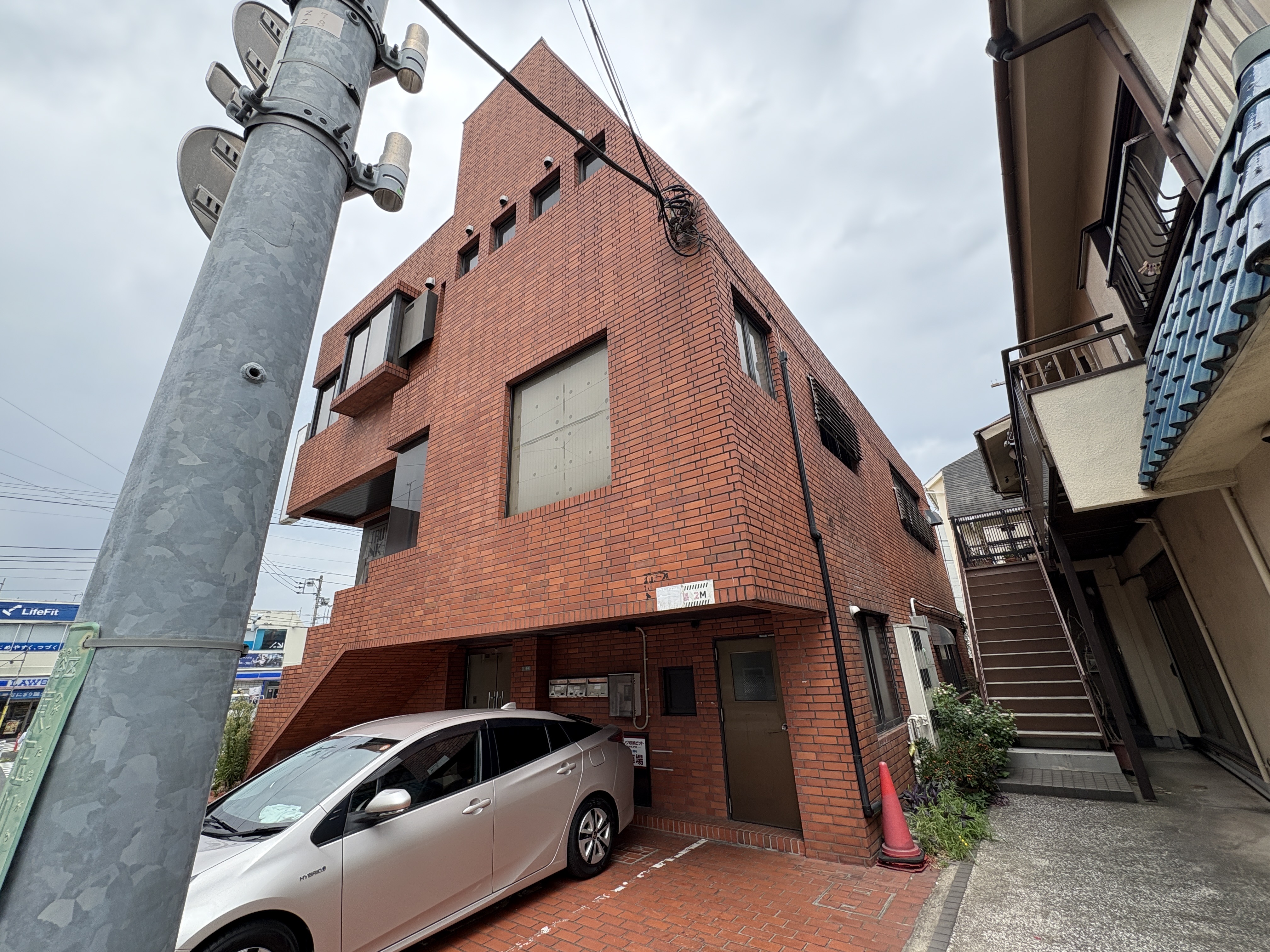
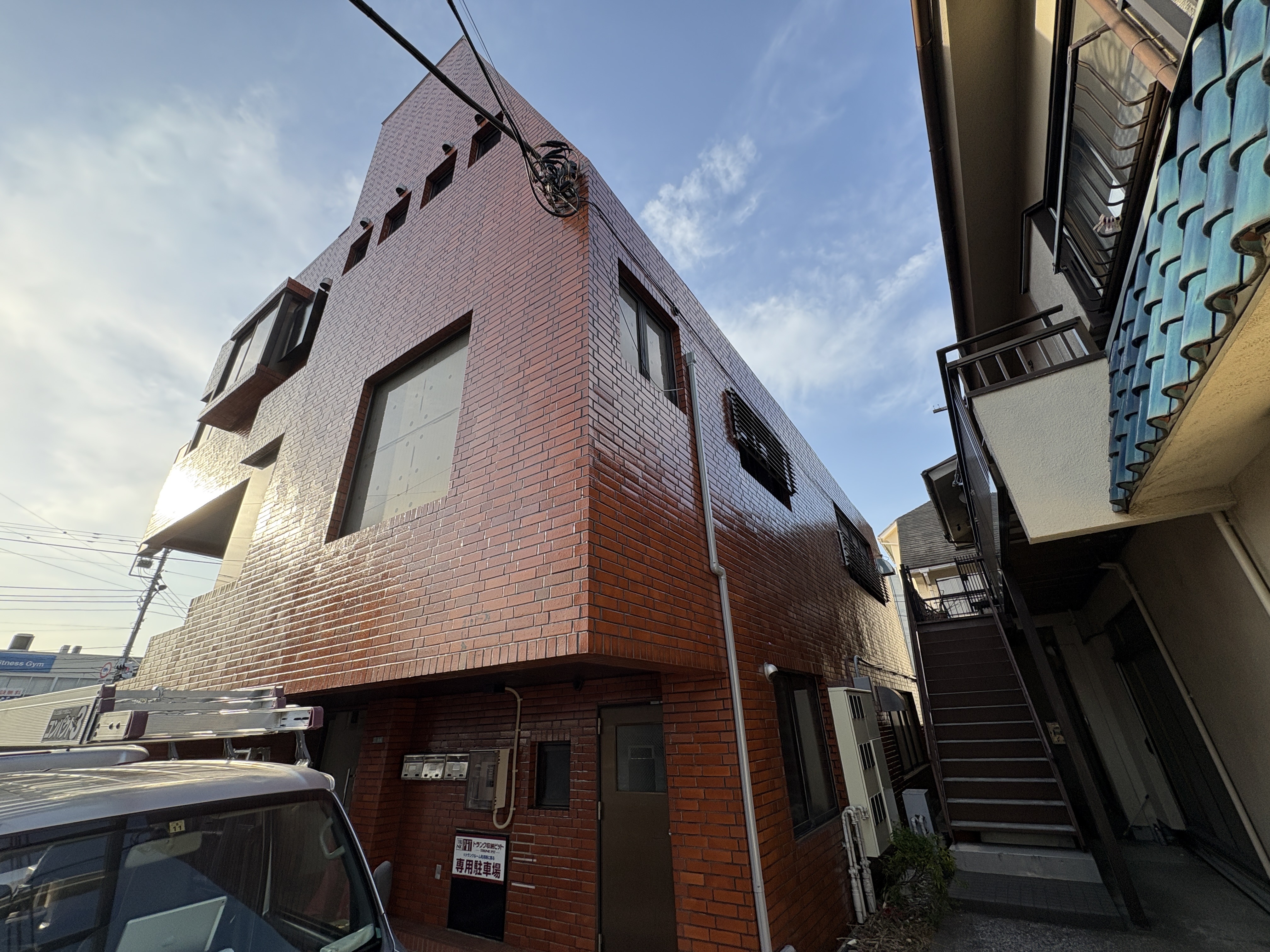
| Construction Details | Partial tile replacement for damaged tiles / Painting of ancillary parts (pipes, water drainage) / Roof waterproofing work (urethane waterproofing) / Exterior wall tile waterproofing (Seven S) / Sealing work around windows / Repair of exterior wall tile mortar joints / Removal of ivy |
|---|---|
| New Materials Used | Exterior wall tiles: Kunishiro tiles / Painting of ancillary parts: Radical silicone paint / Roof waterproofing: High-strength urethane (Sarasene A) / Exterior wall tile waterproofing: Seven S |
| Price Range | 4,000,000 to 4,100,000 yen |
| Construction Period | 45 days |
| Location | Not disclosed |
| Background to the Construction | Due to leaks occurring from several areas including the exterior walls and roof, we proposed waterproofing for the entire exterior wall. Seven S is a clear waterproofing material for tile walls, which is somewhat expensive but highly waterproof, making it recommended for cases where leaks are occurring from multiple areas of the exterior wall. |
Customer Feedback
Flow from On-Site Investigation to Completion of Construction
From the initial inquiry to the completion of the work and aftercare, a single representative will consistently handle your case. For management associations, a resolution at the general meeting is required, so it is advisable to start the process 1 to 1.5 years before the desired start date to proceed with ample time.
- Inquiry (Free) Please contact us via phone, form, or LINE. If you have estimates from other companies, just presenting those is fine.
- On-site Investigation & Building Diagnosis (Free) We will conduct an exterior wall inspection, check for cracks, sealing, and waterproofing layers, and if necessary, investigate the rooftop, high places, and leak areas using drones or thermography. For properties in Tachikawa City, we will also check the site conditions, trees, road width, necessity of road occupation, distance to neighboring buildings, flood assumptions on the city’s hazard map, delivery routes, and parking.
- Submission of Investigation Report & Estimate We will provide a deterioration diagnosis report with photos and an estimate detailing quantities, methods, and materials for each work item. Multiple plans can also be proposed.
- Plan Decision & Contract Confirm colors using color simulations, paint samples, and trial painting. For management associations, we will also assist in preparing materials for the general meeting. If there are notifications required under the Tokyo Metropolitan Landscape Ordinance or Tachikawa City’s landscape ordinance, we will explain the color considerations as well.
- Notification to Residents & Neighbors We will distribute construction notices, conduct greetings to neighbors, and set up a bulletin board at the entrance (with a schedule and laundry information). If temporary relocation of parking is necessary, adjustments will be made at this stage.
- Installation of Temporary Scaffolding & Various Works Our own scaffolding team will set up the scaffolding, followed by high-pressure washing → substrate repair → sealing → exterior wall painting & tile repair → waterproofing → metal parts & ancillary work in that order. A supervisor will inspect each process and take construction photos.
- Completion Inspection, Scaffolding Dismantling & Handover We will confirm the finish in the presence of the customer and provide construction photos, a report on the paint used, and a warranty certificate.
- Aftercare We will send annual DM notifications, allowing for yearly inspections. Simple repairs such as partial sealing are provided free of charge.
Resident Communication, Approval for Additional Work, Inspection Reports
Equally important as the construction itself is “when, what, and with what materials we report”. At Kakeru Koumuten, we provide materials and reports in the following four situations.
| Situation | Materials Provided / Actions Taken |
|---|---|
| Before Construction Building Diagnosis |
We will provide a deterioration diagnosis report with photos. This document summarizes the deteriorated areas and the basis for the proposed scope of work. |
| Before Construction to During Construction Notification to Residents & Neighbors |
We will distribute construction notices, conduct greetings to neighbors, and provide information on the schedule and laundry via the entrance bulletin board. |
| During Construction Approval for Additional Work |
Deterioration discovered after scaffolding is set up will be addressed by presenting photos and quantities/costs for approval before proceeding with the work. |
| During Construction to Completion Inspection Reports |
A supervisor will inspect each process and take construction photos. Upon completion, we will confirm the finish in the presence of the customer and provide construction photos, a report on the paint used, and a warranty certificate. |
* For management associations, it is smooth to decide in advance who will approve additional work (such as the chairman or the repair committee) and the amount that will require approval before signing the contract.
How will life be during construction? Impact on residents
Large-scale repairs are principally carried out while residents remain in their homes. However, there will be limitations on daily life while scaffolding is in place. Most troubles can be prevented simply by providing advance notice, so Kakeru Koumuten Co., Ltd. thoroughly explains and posts information before construction begins.
| What will be affected | What will actually happen / Our response |
|---|---|
| Laundry | On days of high-pressure washing, painting, and waterproofing, outdoor drying will not be possible. We will inform you via bulletin board and each unit’s mailbox about “which side will be worked on today” and will secure as many days as possible for drying. |
| Window opening and closing | In addition to washing and painting days, there may be times when windows cannot be opened during the preparation, drying, and waterproofing processes. We will provide information for each process, so please check the postings and notifications. We will schedule the work to avoid continuous closures. |
| Balcony | During floor waterproofing and handrail painting, we ask for temporary relocation of personal items, plants, and air conditioning outdoor units. The timing will be notified in advance for each unit. |
| Noise and Odor | The period of substrate repair (chipping and drilling) will produce the most noise. Work hours are generally from 8 AM to 5 PM, and we will accommodate requests such as refraining from work on Sundays and holidays. Low-odor paint options are also available. |
| Security and Privacy | Scaffolding can become a potential entry point. We can take measures such as blocking sightlines with mesh sheets and installing locks and sensor lights on the scaffolding’s access stairs at night. We also thoroughly educate visitors on proper etiquette. |
| Parking | Vehicles on the side where scaffolding will be erected will need to be temporarily relocated. Since securing a new parking spot may take time, we will begin securing a new location 2 to 3 months before construction starts. |
| Pets, Small Children, and Working from Home | If you have sensitivities to noise, please inform us in advance, and we may be able to adjust work dates accordingly. Please do not hesitate to let us know. |
| Rented Rooms | We can assist owners in creating notification documents for residents. If you are concerned about the impact of construction on occupancy rates, we can also propose a color simulation for an image change. |
How to Choose a Large-Scale Repair Contractor and Ordering Method
There are many large-scale repair contractors serving Tachikawa City, Tokyo, and you may be unsure which one to choose. When requesting renovations for apartments, condominiums, or buildings, please check the following four points.
● Have extensive experience in large-scale repairs
● Confirm the presence of warranties and aftercare services
● Obtain estimates from multiple contractors (at least 3 companies)
● Verify if they are self-managed
Have extensive experience in large-scale repairs
Large-scale repair contractors often have websites that showcase their exterior renovation achievements. If they provide detailed explanations of repair contents with photos, it gives you peace of mind as a reference when you actually request work.
Using ratings from Google and review sites can be effective when comparing large-scale repair contractors!Be cautious if there are many negative reviews. If there are few reviews, also check the construction track record, content of explanations, and management system.
Large-scale repair work involves not only the construction itself but also the potential for troubles with residents and nearby neighbors. Therefore, it is necessary to report the progress of the work and information about laundry on bulletin boards to prevent issues before they arise. Kakeru Koumuten Co., Ltd. specializes in exterior work, and we receive many requests for exterior renovations of apartments and condominiums.
Check for warranties and aftercare services
When choosing a large-scale repair company, make sure to check for warranties. If any issues such as leaks occur after the work is completed, having a leak warranty from the contractor ensures that repairs can be made at no cost, providing peace of mind! Companies that offer warranty periods are often confident in their work, making this a key criterion for selecting a contractor.
Warranty periods vary by contractor and type of work, but typically range from 1 to 10 years. Emergency repairs or partial fixes often do not come with leak warranties. Some contractors also offer aftercare services separate from warranties, so be sure to check if warranties and aftercare services are available.
At Kakeru Koumuten Co., Ltd., we send out annual direct mail for aftercare maintenance, allowing for yearly inspections. We also provide simple repairs such as partial sealing at no charge.
Obtain estimates from multiple contractors (at least 3 companies)
When requesting large-scale repairs, be sure to obtain estimates from multiple contractors. It is important to get estimates from at least 3 companies and compare their quotes and reports! Even for the same type of work, costs can vary between contractors, and warranties and aftercare services may differ. Additionally, obtaining multiple estimates makes price negotiations easier.
When comparing estimates, consider not only the cost but also the “items in the estimate,” “methods and materials for substrate repair and exterior painting,” and “confirmation of the process.” Make detailed comparisons to make informed decisions! If the quality of auxiliary materials is low or if steps are skipped, costs can be reduced, so avoid making decisions based solely on price. Especially since substrate repair work can be difficult to assess from appearance alone, ensure that the repair methods are appropriate for the condition of the substrate!
Check these points on the estimate (checklist)
| Confirmation Items | Points to Consider |
|---|---|
| Is there an excessive use of “one set” notation? | Are the quantities and unit prices clearly stated? With “Exterior Wall Repair One Set,” comparisons and verifications cannot be made. |
| Do the quantities match the actual measurements? | Are there quantities recorded that are far from the drawings or actual measurements? This is the area where inflation is most likely to occur. |
| Proportion of miscellaneous expenses | Details and proportions of site management costs, general management costs, statutory welfare costs, etc. According to the Ministry of Land, Infrastructure, Transport and Tourism’s survey for the fiscal year 2021, the average is about 10% of the construction cost (excluding common temporary costs), but it varies depending on the size and conditions of the building, so there is no uniform standard. |
| Are the names of materials written? | Are the manufacturer names, product names, grades, and number of coats for paints and waterproofing materials specified? |
| Treatment of quantities for substrate repairs | This is an item that cannot be accurately measured until scaffolding is set up. Is it stated whether it is “estimated quantity” or “actual quantity settlement,” and are there agreements for increases or decreases? This is the most important aspect. |
| Warranty and after-inspection | Warranty period for each construction, frequency of inspections, and scope of free support. |
| Company backing | Types of construction industry licenses, track record of similar scale and structure, presence of qualified personnel. |
Confirm if it is self-managed
Large-scale repair works involve various tasks such as “substrate repair work,” “exterior wall painting,” “waterproofing work,” and “pipe replacement,” and the plan content will change based on the actual deterioration condition and customer preferences.
If a contractor completely outsources to subcontractors, they may lack knowledge and experience, leading to proposals for repairs in irrelevant areas or meaningless work. If you investigate and then request a subcontractor, it may incur additional time and costs. By having knowledge and experience and managing in-house, responsible construction can be achieved at a lower cost.
Additionally, contractors who outsource may also be slow to respond if any troubles occur during construction. It is safer to avoid having a company that has not actually met with the customer manage the construction. Kakeru Koumuten performs everything from temporary scaffolding installation to exterior wall painting and waterproofing work in-house, managed by knowledgeable and experienced personnel!
There are three ordering methods. The choice affects the approach.
Especially for management associations, it is necessary to decide “how to request” before “which company to rely on.” The main ordering methods are the following three.
| Method | Procedure | Advantages | Disadvantages |
|---|---|---|---|
| Responsible Construction Method | The construction company handles investigation, design, construction, and management all at once | No additional fees for design consulting (investigation and design costs may be included in the construction costs) / Single point of contact reduces the burden on the management association / Responsibility is clear / Can shorten the period until ordering | Specifications can easily be left to the construction company, making it difficult to compare side by side / Third-party checks are hard to implement, requiring the management association to verify price, specifications, and construction status |
| Design Supervision Method | A design office or consultant conducts investigation and design, while a different company handles construction | Allows comparison of construction companies under the same conditions / Independent supervision during construction | Consulting fees are required separately / Attention needed for risks of conflicts of interest and collusion / Can lead to longer periods |
| Management Company Prime Contract Method | The management company acts as the prime contractor, with subcontractors performing the construction | Easy coordination with daily management / Minimal effort required from the management association | Can become expensive due to intermediate margins / Competition principles may not be effective |
Collusion and Inappropriate Consulting Issues in Large-Scale Renovations and Self-Defense Measures
Latest 2026 In the large-scale renovation industry, inappropriate orders linked between design consultants and construction companies have long been a concern. The Ministry of Land, Infrastructure, Transport and Tourism issued warnings and notifications to management associations in January 2017 and April 2023, and on September 28, 2026, the Japan Fair Trade Commission announced that it had issued exclusion orders to 38 companies and a total of 1.63788 billion yen in payment orders to 37 companies regarding large-scale renovation work commissioned by condominium management associations in the Kanto region to design consulting firms (two design consulting firms were also subject to exclusion orders).
※Based on the announcement from the Japan Fair Trade Commission (September 28, 2026).
Three Typical Methods
① Dummy Estimates
Prior to receiving orders, companies are predetermined, and other companies only provide high estimates as a formality, creating a “fixed race.” This gives the management association the appearance of having “properly obtained competitive estimates.”
② Collusion with Design Supervisors
Consultants contract at extremely low design supervision fees while receiving kickbacks from the high construction costs of partnered contractors. Beware of design supervision fees that are too low as a warning sign.
③ Back Margin
A certain percentage of the contract amount is kicked back, which is then added to the construction costs as an expense. As a result, the management association ends up paying extra.
Self-Defense Measures for Management Associations
- Obtain independent estimates from multiple companies
- Consult with neutral third parties such as condominium management professionals or architects
- Document the contractor selection process in minutes to ensure transparency
- Confirm the reasons for unusually low consulting fees
- Include a penalty clause in the contract for cases of collusion
- Avoid concentrating information with a single consultant and verify specifications independently
Frequently Asked Questions about Large-Scale Repairs in Tachikawa City, Tokyo
- How much does large-scale repair in Tachikawa City, Tokyo cost?
- For condominiums, according to the Ministry of Land, Infrastructure, Transport and Tourism’s survey for the fiscal year 2021, about 70% of cases fall between 750,000 to 1,500,000 yen (excluding consumption tax and common temporary construction costs), with the most common range being 1,000,000 to 1,250,000 yen. Based on our company’s construction records, the cost for a two-story wooden apartment ranges from 2,000,000 to 4,000,000 yen, for a three-story steel or RC apartment from 4,000,000 to 9,000,000 yen, and for small condominiums or mixed-use buildings from 5,000,000 to 15,000,000 yen. The cost varies depending on the condition of the substrate and whether waterproofing or roofing work is needed, so we provide free on-site estimates.
- How often should large-scale repairs be conducted?
- Generally, a cycle of 12 to 15 years is recommended, and the actual cycle is most commonly 13 years according to the Ministry of Land, Infrastructure, Transport and Tourism’s survey, with about 70% falling within the 12 to 15-year range. However, the decision should be based on the condition of deterioration rather than just the number of years. If deterioration of sealing, tile lifting, or breaks in the waterproof layer are observed, it is advisable to carry out repairs without waiting for the cycle, as this can ultimately reduce costs. In the Tachikawa City condominium survey (February 2023), among 157 responses, 31.2% were built before 1983, and 52.2% were built before 1993 (this does not represent the overall distribution in the city). Generally, buildings aged 26 to 35 years enter their second or third round of repairs, focusing on replacing waterproof layers and sealing, as well as updating facilities. For buildings over 36 years old, updating water supply and drainage pipes is necessary, and for buildings constructed under the old seismic standards (before May 31, 1981), consideration of seismic diagnosis is also required. Each building’s situation varies, so we assess based on on-site surveys and long-term repair plans.
- How long does the construction period take? Can residents stay during the work?
- For apartments, the duration is typically 3 weeks to 2 months, for small condominiums or buildings 1.5 to 3 months, and for condominiums with over 50 units about 4 to 6 months. Residents can remain in their homes during the construction. However, while scaffolding is in place, there may be restrictions on drying laundry outside and opening windows, so we take thorough measures to minimize the impact on daily life, including distributing advance notices, providing information on the schedule and laundry through bulletin boards, and strictly adhering to working hours.
- How long should I expect from the start of planning to the completion of construction?
- For management associations, the process from establishing a repair committee, building diagnosis, selecting contractors, to general meeting resolutions typically takes 1 to 1.5 years, followed by 3 to 6 months for construction. Overall, it is advisable to plan for about 2 years to proceed comfortably. If using subsidies or tax incentives, obtaining management plan certification (resolutions at general meetings, pre-confirmation, certification application) also takes time, so please factor that into your timeline.
- Are there any subsidies available for large-scale repairs in Tachikawa City, Tokyo?
- As of October 15, 2026, based on the official page of Tachikawa City, there do not appear to be any municipal programs that subsidize the construction costs or deterioration diagnosis costs for large-scale repairs of condominiums (please confirm with the city’s Housing Division, Housing Policy Section). The city provides information on the condominium management plan certification system (the basic application fee to the city is 4,100 yen), the management status reporting system, and free consultations for condominiums. The reduction of fixed property tax (Condominium Longevity Promotion Tax System) is a national program, applicable to construction completed by March 31, 2027. The official city page states that one-third of the fixed property tax amount is reduced, limited to 100 square meters per unit, and the application destination is the Tax Division, Building Section (042-523-2111, extensions 1221-1224). Consider also the Housing Finance Agency’s loans and Tokyo’s “Condominium Improvement Construction Subsidy” (interest subsidies; the second phase for fiscal year 2026 is accepting applications until February 19, 2027). The city’s “Existing Housing Insulation Renovation Subsidy” (for window, door, and insulation renovations; up to half of the eligible construction costs, with a maximum of 50,000 yen) has reached its budget limit for fiscal year 2026 and is no longer accepting applications. Additionally, for construction that includes windows and insulation, there may be eligibility for national programs such as “Advanced Window Renovation 2026,” “Future Eco Housing 2026,” and Tokyo’s energy-saving renovation promotion project for existing homes. The timing of applications and applicants varies by program, so please check the eligibility conditions and application procedures for each program before contracting or starting construction.
- I heard that fixed property tax can be reduced through large-scale repairs; is that true?
- 外壁の色は自由に決められます。お客様のご希望に応じて、さまざまな色やデザインから選択できます。色見本を用意しており、実際の施工前に確認することができますので、安心してお選びいただけます。色の選定は建物の印象を大きく左右しますので、じっくりとご検討ください。Tachikawa City has a landscape ordinance based on the landscape plan, and the notification guide (revised in April of Reiwa 7) states that repairs, renovations, and color changes that alter the exterior appearance, as well as repainting of exterior walls, are subject to notification (repainting or repairs that do not change the appearance are generally not required, but if a building that does not conform to the landscape formation standards is fully repainted, notification is necessary). The scale of applicability varies by region and district, so please confirm the zoning of your property with the Urban Planning Division, Urban Administration Section (042-523-2111, extensions 2367 and 2371). The color standards categorize the basic color, emphasis color, and accent color of the exterior walls, with the total of emphasis and accent colors being limited to one-fifth of the visible area. Additionally, in areas governed by the Tokyo Metropolitan Landscape Plan, notification based on the Tokyo Metropolitan Landscape Ordinance may be required depending on the overall scale of the building, and the city’s Q&A indicates that repainting in the same color is also subject to notification (normal maintenance activities such as tile repairs are excluded. Green Space Landscape Section 03-5388-3265). Whether notification is necessary depends on the location of the building and the scope of the work, so please confirm in advance. We will also investigate this during our survey. Sharing a color simulation of the completed image can facilitate discussions at meetings and with neighbors.
- Why is only the north side of the exterior wall covered in moss and algae?
- This is because areas with poor sunlight and trapped moisture are prone to the growth of algae, moss, and mold. In addition to the north side, areas that do not receive sunlight due to neighboring buildings or trees are also likely to be affected. By thoroughly removing them with high-pressure washing and selecting paint with anti-algae and anti-mold properties, recurrence can be minimized. We also recommend checking for blockages in roof drains and gutters caused by fallen leaves and mud at the same time, as these can lead to puddles on the roof or leaks.
- Should I choose the responsibility construction method or the design supervision method?
- For buildings with fewer units, the burden of consulting fees tends to be heavier, so we believe that the responsibility construction method is often more suitable for small to medium-sized buildings. On the other hand, for large buildings with many units, the design supervision method allows a third party to standardize specifications, making it easier to compare under the same conditions. While the design supervision method allows for comparison of construction companies under the same conditions since a third party creates the specifications, it incurs separate consulting fees and requires caution regarding conflicts of interest and collusion risks. Even with the responsibility construction method, verifying price, specifications, and construction status is essential. Kakeru Koumuten Co., Ltd. provides estimates detailing quantities, methods, and materials for each construction item, allowing for comparison on the same playing field with other companies.
- How can I detect collusion in large-scale repairs?
- There are three typical methods. 1) Pre-selecting the contractor and having other companies submit only formal high estimates, known as “dummy estimates.” 2) A consultant contracts at an extremely low design supervision fee and receives kickbacks from partner companies, leading to collusion. 3) Adding a portion of the contract amount as a back margin to the construction costs. Countermeasures include obtaining independent estimates, consulting with a neutral third party, documenting the selection process in meeting minutes, and including penalty clauses in contracts. On September 28, 2026, the Fair Trade Commission announced exclusion orders and payment orders for large-scale repair work.
- How many companies should I get estimates from?
- We recommend at least three companies. If there are too many, it becomes difficult to compare, and if there are too few, competition does not occur. What’s important is not the number of companies but “creating the same playing field before comparing.” By creating a common specification sheet and quantity table and requesting under the same conditions, and requiring detailed breakdowns instead of “lump sum” notation, the differences in amounts can be clearly identified as differences in scope or unit price.
- What is the difference if you own your own scaffolding?
- Temporary construction accounts for about 20% of the total cost of large-scale repair work (according to the Ministry of Land, Infrastructure, Transport and Tourism’s fiscal year 2021 survey). By not outsourcing scaffolding work, it is easier to control costs in this area, and our in-house scaffolding team can flexibly respond to sudden changes in the schedule or additional work. Kakeru Koumuten Co., Ltd. owns scaffolding materials for approximately 100 detached houses and plans according to the site, even in areas with elevation differences or narrow front roads.
- I’m in the middle of getting estimates, but can I just have a look at the estimate?
- Of course, that is possible. If you bring in estimates from other companies, we will check for free whether the items, quantities, methods, and materials are appropriate and provide you with an estimate under the same conditions. We welcome competitive estimates.
- Can I request just emergency repairs for leaks?
- Yes. As a preliminary step before large-scale repairs, we also accept requests for emergency repairs or partial repairs for leaks. We will identify the cause using thermal imaging or drones and propose the minimum necessary repairs.
- Can you handle roofing materials and exterior wall materials that contain asbestos?
- Yes, we can. We have qualified personnel, including asbestos work supervisors and investigators of buildings containing asbestos materials, who can conduct the legally required preliminary surveys and handle the cover method or removal of asbestos-containing roofing materials. As of October 15, 2026, there were no municipal subsidies for asbestos investigation or removal work found on the official page of Tachikawa City. The report of the preliminary survey results for asbestos is generally submitted electronically through the national system, with the reporting window for buildings under 2,000㎡ being the city’s Environmental Policy Division, and for buildings over 2,000㎡, it is the Environmental Improvement Division of the Tokyo Tama Environmental Office. Please confirm this during the planning stage of the construction.
- What happens if large-scale repairs are not done?
- There are risks such as personal accidents due to falling exterior wall tiles, structural deterioration due to corrosion of rebar, water leaks, and a decrease in asset value. Furthermore, for buildings subject to regular reporting under Article 12 of the Building Standards Act, investigations through full tapping and other methods are required under certain conditions, such as when more than 10 years have passed since completion or exterior wall renovations for tiled or mortar-finished walls. Regular reporting for buildings in Tachikawa City is handled by the Tachikawa City Building Guidance Division, Inspection Section. Conditions such as applicable uses and scales, as well as the number of floors or floor area for apartment buildings, can be confirmed on the city’s regular reporting system page or at the city’s office. Complex buildings including stores, restaurants, hospitals, and hotels may also be subject to reporting depending on their use and scale, so individual confirmation is necessary. Even if not subject to statutory inspections, regular checks and maintenance are essential, so please consult us if you are unsure.
- How much does large-scale repair for an apartment (about 10 units) cost?
- For a wooden two-story building with 6 to 10 units, it is estimated to be between 2,000,000 and 4,000,000 yen, and for a three-story steel or RC building with 10 to 20 units, it is estimated to be between 4,000,000 and 9,000,000 yen based on our company’s past performance (including scaffolding, substrate repairs, exterior wall painting, sealing, and waterproofing). It is common for apartments to undergo repairs every 10 to 15 years. For owners, there is an increasing trend to change the appearance through color simulations during repairs to improve occupancy rates.
If you are looking for a large-scale repair contractor in Tachikawa City, contact Kakeru Koumuten
Our company handles exterior wall renovations and large-scale repairs for condominiums and apartments in Tachikawa City, covering all of Kanagawa Prefecture and Tokyo. We are happy to assist not only with large-scale repair work but also with partial repairs and water leak repairs. “I want it to last long with one renovation” “I want to keep costs down as much as possible” “I want to improve insulation performance because the indoors are hot” We will propose the best solutions for your specific requests and future repair plans.
From temporary scaffolding work to roofing and exterior wall painting, all work is performed by our own team. We are confident that we will not be outdone by others in terms of cost, quality, and efficiency, so we welcome comparative estimates!
On-site surveys, estimates, and color simulations are all free
Please feel free to consult us via the inquiry form, phone, or LINE.
It’s also fine to just present estimates from other companies.
Areas Covered for Large-Scale Repair Work
Kakeru Koumuten accepts requests across all of Kanagawa Prefecture and Tokyo.
Akebono-cho / Izumi-cho / Ichiban-cho / Kashiwa-cho / Kamisuna-cho / Saiwaicho / Sakae-cho / Shibazaki-cho / Sunagawa-cho / Takamatsu-cho / Nishisuna-cho / Hagoromo-cho / Fujimi-cho / Midori-cho / Wakaba-cho
・When should large-scale renovations be carried out? Explanation of the optimal timing and risks of postponement!
・Estimates are essential when conducting large-scale renovations! Key comparison points and precautions!
・5 common troubles in large-scale renovations of condominiums! Thorough explanation of causes and prevention measures!
・What is waterproofing work in large-scale renovations? Thorough explanation of roles, signs of deterioration, and precautions!
・Insufficient funds for large-scale renovations… Explanation of how to deal with funding shortages and preparations you can do right now!
・What is substrate repair, which is important in large-scale renovations? Thorough explanation of necessary reasons, signs of deterioration, and types of work!
・What is sealing work in large-scale renovations? Introduction to roles, methods, and tips for avoiding mistakes!
・What is tile repair, which is important in large-scale renovations? Explanation of signs of deterioration, types of work, and cost estimates!
・What is exterior wall painting, which is important in large-scale renovations? Thorough explanation of necessity, signs of deterioration, and cost estimates!
・For exterior renovations in Tachikawa City, Tokyo, trust Kakeru Koumuten!
・For roof renovations in Tachikawa City, Tokyo, trust Kakeru Koumuten!
・For exterior wall painting in Tachikawa City, Tokyo, trust Kakeru Koumuten!
We also welcome inquiries via LINE◎

We are also updating our Instagram regularly◎ Please follow us!

contact Kakeru Koumuten Co., Ltd.
Kakeru Koumuten is a young company whose team is, on average, in their late twenties, but our skills are second to none.
Our greatest strength is that we handle scaffolding, roofing and painting entirely in-house. In an industry where these tasks are usually divided among contractors, our complete service simplifies project management and helps keep costs down. Above all, if a problem arises, we respond promptly.
We proudly describe ourselves as the youngest and most helpful renovation company in Kanagawa!