What is a Crack? We Provide Useful Information on Risks of Leaving It Unattended and Repair Methods!

Hello everyone! This is Kakeru Koumuten Co., Ltd.!

In this article, we will introduce what cracks are!
This page was created by our amateur office worker, Sekiguchi, while consulting with our painting craftsmen!
If you hear a hoarse voice when you call Kakeru Koumuten, that’s me!
*I hardly drink alcohol.
What is a Crack?
Some of you may be wondering what is meant by cracks.
A crack means “a fissure”. If you have found a crack on the exterior wall of your home and are wondering if it’s okay to leave it alone, please read this and if you have any concerns, consult us.
We will introduce the risks and causes that arise from neglecting it!
If You Discover a Crack

Many people may discover a crack on their home’s exterior wall and still leave it unattended. Some might think, is it too much to call a contractor for a small crack?
Depending on the width and depth of the crack, neglecting it can lead to a decrease in the strength and durability of your home! We will discuss these points.
Main Causes of Cracks
①Aging Deterioration
The paint on the exterior walls of your home may gradually deteriorate and develop cracks due to being exposed to ultraviolet rays for an extended period.
When the paint film reaches its durability lifespan, it loses its waterproofing ability, causing exterior materials like siding to absorb rainwater. As the exterior materials absorb and release moisture, they move, leading to cracks…
The lifespan of the paint film varies depending on the rank of the paint used (acrylic, urethane, silicone, inorganic, etc.)!
When painting the exterior, it is recommended to use paint that is at least silicone rank for excellent cost performance!
By the way, our popular paints are Premium Silicone and Premium Inorganic from SK Kaken!
The joints (sealing/calking) that seal the seams of siding and tiles can deteriorate due to ultraviolet rays, leading to cracks. In this case, it is not the siding boards themselves that are deteriorating and causing cracks, but rather the deterioration of the caulking used at the joints.
The typical lifespan of general sealing materials is about 10 years, but there are also sealing materials like “Auton Exceed” that boast a durability of 30 years!
②Properties of Wall Materials
Cracks can also occur due to the properties of the wall materials. When the exterior wall dries, a finishing coat is applied over the mortar. However, if the surface paint dries before the mortar has dried, drying cracks may occur.
③Shaking from Trains or Earthquakes
Cracks can occur when forces are applied to the building due to shaking from trains or earthquakes, causing the exterior materials like mortar, concrete, and tiles to crack under stress.
Additionally, if the caulking used to seal the joints of siding boards or tiles cannot withstand the shaking from an earthquake, it may also lead to cracks.
④Poor Construction
If mortar is applied again to an area that has already dried, it may not bond well and could result in cracks.
Using materials that do not bond well, such as vinyl chloride and mortar, may also lead to cracks.
Main Types of Cracks
There are various factors that can cause cracks to occur, but the important thing is not to leave high-risk ones unattended. Cracks can be broadly classified into two categories.
These are “hair cracks” and “structural cracks.”
The high-risk cracks are referred to as “structural cracks.” Let us introduce these types of cracks.
Hair Cracks
Hair cracks refer to small cracks that are about the size of a hair.
Generally, they are those measuring less than 0.3 mm, and since they pose a low immediate danger, they are considered not to require repair. However, it is important to note that some may worsen and grow larger over time.
Structural Cracks
Structural cracks refer to larger cracks that may have a significant impact on the structure.
Typically, these are cracks that exceed 0.3 mm, and they require appropriate repairs due to their potential high risk.
If you find a hair crack, it is necessary to be cautious, but there is no need to rush as you monitor its progress.
On the other hand, if you find a crack that you suspect might be a structural crack, do not hesitate to contact Kakeru Koumuten!
Crack Risk Levels
The risk level of a crack varies depending on its width.
As a matter of course, larger cracks increase the level of danger.
Crack Risk Levels
| Crack Width | Risk Level |
|---|---|
| 0.3 mm or less | No urgent repairs needed, but it’s better to repair if appearance is a concern〇 |
| 0.3 mm to 1 mm |
Attention needed○ We recommend repairs before the crack gets larger〇 |
| 1 mm or more |
Serious issues with the wall◎ There may be deterioration inside the wall and within the house. Inspection and repairs are necessary! |
Risks of Leaving Cracks Unattended
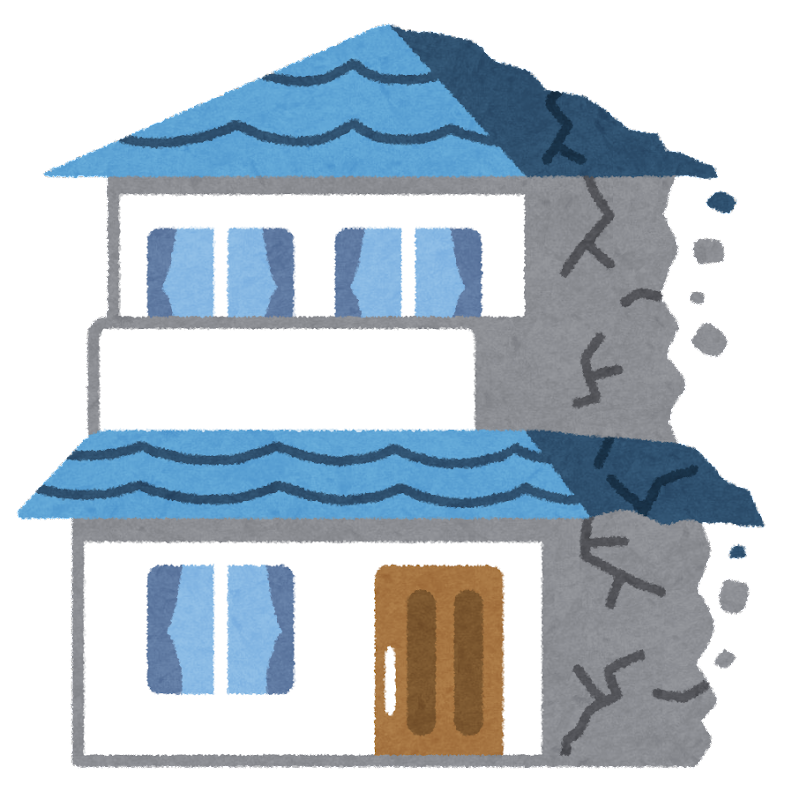

If cracks appear in the exterior wall and are left unattended, there is a risk that rainwater will seep in through the cracked areas, weakening the structural integrity of your home.
When structural materials are exposed to rainwater for an extended period, the following types of deterioration can occur:
・Increased moisture inside the exterior wall attracts termites.
・The interior of the exterior wall may corrode, reducing the overall strength of the building.
・Reduced strength increases the risk of collapse during an earthquake.
・Water leaks can cause stains on indoor walls and ceilings.
・There is a possibility of exterior wall materials falling off.
First and foremost, you must be cautious of rusting rebar caused by rainwater entering the concrete through cracks. Even cracks less than 0.3 mm wide, which do not significantly affect the structure, can allow rainwater to seep in, so vigilance is necessary.
Moreover, if serious cracks are left unattended, the foundation’s strength may decrease, potentially leading to ground subsidence.
It’s advisable to conduct maintenance or have a professional inspect the situation before problems arise!
After completing
Be Cautious of Cross Cracks
While ordinary cracks are dangerous, the most concerning ones are intersecting cracks. Basic diagonal cracks may be mild, but if cross cracks develop, there is a higher likelihood of affecting the building itself. These cracks are often seen during major earthquakes, but if cross cracks are present without an earthquake occurring, it is dangerous!
Mild cracks can generally be addressed with seismic reinforcement, but if you find cross cracks, please contact us!
Estimates are free of charge!!
Crack Repair Methods
Seal Method
The seal method is generally optimal for cracks ranging from 0.2 mm to 0.3 mm in width. This method involves applying resin to the cracked area for repair.
It can also be done as a DIY project, making it a recommended repair method for those looking to save costs.
If you dislike the appearance of the repair area standing out, we can paint it using the same paint as the exterior wall!
Resin Injection Method
The resin method is suitable for cracks wider than 0.3 mm. This type of work is more complex and is not recommended as a DIY project.
Since there is time for the sealing material and resin to dry, at least 2 to 3 days of work will be necessary![/jin-iconbox01]
Cut Sealing Filling Method
The cut sealing filling method is used for cracks that are 1.0mm or wider.
Since this repair method requires technical skills, it is advisable to hire a contractor!
Many people think that DIY will be cheaper than hiring a contractor, but when looking at the long-term maintenance of your home, hiring a contractor often results in lower costs in the future.
When requesting Kakeru Koumuten, using subsidies or fire insurance can often lead to lower costs than the market average!
We also have articles about subsidies, so please take a look!
Conclusion
How was that? Just knowing how to distinguish between hairline cracks and structural cracks can give you an idea of the deterioration of your home.
If you think maintenance is necessary, please contact Kakeru Koumuten!
We prioritize our customers and are confident in our work!
Kakeru Koumuten does not charge any fees until our customers are satisfied with the work!
If there are any concerns after the work is done, or if you feel that you are not satisfied, we will respond promptly, so please feel free to consult with us!
Consultations via LINE are also very welcome◎

We are also updating our Instagram regularly◎Please follow us!◎

No matter how small the project is, we are happy to assist you!
Kakeru Koumuten appreciates your support!

contact Kakeru Koumuten Co., Ltd.
Kakeru Koumuten is a young company whose team is, on average, in their late twenties, but our skills are second to none.
Our greatest strength is that we handle scaffolding, roofing and painting entirely in-house. In an industry where these tasks are usually divided among contractors, our complete service simplifies project management and helps keep costs down. Above all, if a problem arises, we respond promptly.
We proudly describe ourselves as the youngest and most helpful renovation company in Kanagawa!