When Should Large-Scale Repairs Be Implemented? An Explanation of the Optimal Timing and Risks of Delaying!

When owning, managing, or operating condominiums, apartments, or factories, one unavoidable aspect is the
major repair work.
Many of you reading this article may have the question,
“When should major repairs be conducted?”
Since major repairs can be relatively expensive,
many people may want to postpone them as much as possible. However,
if you delay, the deterioration of the building may progress, leading to irreparable situations.
In this article, we will explain in detail the
appropriate timing for major repairs and the risks of postponement,
as well as the benefits of conducting them early.
What are Major Repairs?
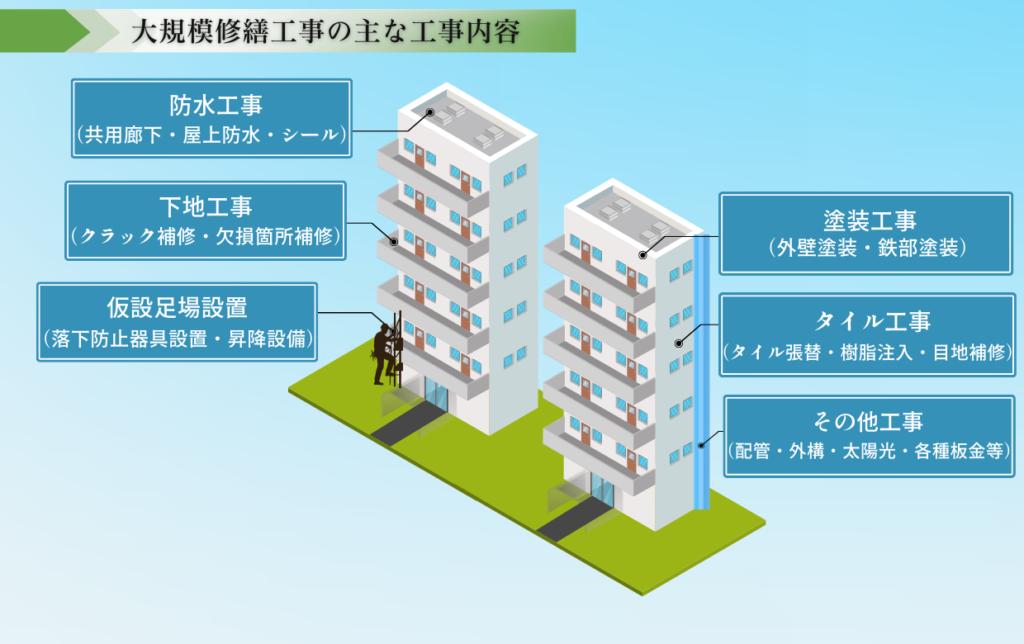
Major repairs refer to
planned repairs and renovations of the building’s exterior walls, roofs, common areas, and facilities.
Unlike routine partial repairs, the goal is to restore and maintain the overall performance and durability of the building.
Especially for condominiums and apartments, these repairs are essential to ensure the safety and comfort of residents.
In the case of factories, leaks and equipment deterioration directly lead to decreased productivity, making the importance of major repairs very high.
When Should Major Repairs Be Conducted?

The timing of major repairs is a crucial point that affects the lifespan and asset value of the building.
Simply thinking “We should do it because a certain number of years have passed” can lead to excessive work or, conversely, it may be too late.
Therefore, it is important to combine general guidelines with the results of a “deterioration diagnosis” that indicates the actual condition of the building.
Here, we will explain two perspectives that you should keep in mind as criteria for judgment.
General Guidelines
For major repairs of condominiums and apartments, it is generally considered appropriate to conduct them once every 12 to 15 years.
This is because the lifespan of exterior wall painting, roof waterproofing, and sealing materials coincides with this period.
After that, generally conducting repairs every 12 years will help maintain the overall performance of the building more steadily.
However, the rate of deterioration can vary significantly depending on location, construction quality, and daily management conditions, so it should be regarded as a guideline.
Timing for Deterioration Diagnosis
Regardless of the age of the building, if you notice cracks in the exterior walls, peeling paint, or signs of leaks, it is recommended to conduct a deterioration diagnosis.
By receiving a diagnosis from a professional contractor, you can check for deterioration of the underlying structure and the condition of the waterproof layer, which may not be easily visible.
As a result,
you can objectively determine whether immediate repairs are necessary or if you can wait a few years.
By conducting an early diagnosis, you can often resolve issues with minor repairs, ultimately helping to reduce repair costs, so please consider it.
What are the risks of postponing large-scale repairs?

Large-scale repairs can be costly, leading some people to think, “It should be fine for now,” and postpone them.
However, if you miss the timing for repairs, various negative impacts may arise for the building itself and in terms of management, so caution is necessary.
Even if there appear to be no problems on the surface, deterioration may be progressing internally, so repairs must be conducted at the appropriate time.
Here, we will introduce some typical risks that arise from postponing large-scale repairs.
Progression of Building Deterioration
If large-scale repairs are postponed, rainwater can enter through cracks in the exterior walls and deterioration of the waterproof layer, making internal deterioration more likely.
In the early stages, issues that could have been addressed with partial repairs may develop into serious problems such as corrosion of rebar or concrete spalling if left unattended.
As a result, the scope of repairs will expand, and the work will become more extensive.
Neglecting early intervention can ultimately shorten the lifespan of the building, so it is important to carry out repairs at the appropriate time.
Decreased Asset Value and Increased Tenant Dissatisfaction
Buildings with noticeable exterior deterioration or issues in common areas are likely to see a decrease in asset value.
Especially in condominiums and apartments, they may become less attractive to potential tenants, leading to an increase in vacancy rates.
Additionally, for existing tenants, leaks and a decline in aesthetics are significant sources of dissatisfaction.
In some cases, there may be an increase in complaints and departures, which can negatively impact management burdens and profitability.
Increased Burden of Repair Reserve Funds
If deterioration progresses due to postponing repairs, the initially anticipated repair reserve funds may not cover the construction costs.
In that case, a one-time collection or additional burden may be necessary, placing a significant burden on the owners.
Expenses that could have been avoided with planned repairs can suddenly arise due to postponement, which is not uncommon.
For these financial risks, it is essential to make timely decisions.
Benefits of Conducting Large-Scale Repairs Early

Large-scale repairs are often thought to be something that should be done after problems arise, but implementing them early can provide many benefits.
The typical benefits are as follows:
・Increased likelihood of only needing minor repairs
・Leads to improved tenant satisfaction and reliability
Let’s take a closer look at each of these.
1. Increased likelihood of only needing minor repairs
When large-scale repairs are conducted at an early stage of deterioration, the repairs to the exterior walls and waterproofing layers are likely to be minimal.
If cracks or paint deterioration are in the initial stages, there are often cases where only partial repairs or surface treatments can be addressed.
As a result, shorter construction periods and cost reductions can be expected.
In this way, addressing issues before large-scale substrate repairs are necessary directly contributes to long-term cost savings.
2. Leads to improved tenant satisfaction and reliability
Buildings that undergo planned large-scale repairs maintain a beautiful appearance and high safety standards.
In condominiums and apartments, this provides tenants with a sense of security and creates an impression of well-managed properties.
As a result, it positively impacts long-term tenancy and vacancy measures.
In factories and commercial buildings, the increased reliability from clients and employees is a significant benefit.
Specific Factors for Determining the Feasibility of Large-Scale Repairs

The feasibility of conducting large-scale repairs should not be judged solely based on intuition or the age of the building.
To implement repairs at the appropriate timing, it is essential to comprehensively check multiple factors such as the condition of the building, future plans, and financial status.
Especially for buildings like condominiums, apartments, and factories, making incorrect judgments can have significant impacts on management.
Here, we will introduce the important points for determining the feasibility of large-scale repairs.
✔️Condition of the exterior and facilities
The condition of the exterior and facilities is the most straightforward indicator for determining the necessity of large-scale repairs.
If there are signs such as cracks in the exterior walls, tiles lifting, or peeling paint, it is highly likely that deterioration has already progressed.
Additionally, if there are issues with shared facilities such as water supply and drainage systems or electrical equipment, caution is required.
Neglecting these symptoms could lead to sudden failures or accidents, so early judgment is necessary.
✔️Status of long-term repair plans and reserve funds
The feasibility of conducting large-scale repairs is closely related to the status of long-term repair plans and reserve funds.
If savings are progressing as planned, it becomes realistic to implement repairs at the scheduled time.
On the other hand, if the reserve funds are insufficient, it often becomes necessary to review the scope of work or adjust the timing.
To carry out large-scale repairs at the appropriate time, it is important to understand the current financial situation and create a feasible plan.
✔️Utilizing Expert Diagnosis and Third-Party Evaluation
When you are unsure about the feasibility of large-scale repairs, it is recommended to utilize deterioration diagnosis by specialists or third-party evaluations.
By incorporating an objective perspective rather than relying solely on the judgment of the management company or construction company, the necessity and priority of large-scale repairs become clearer.
Additionally, the likelihood of avoiding unnecessary work increases, making it a win-win situation.
By considering the results of specialized diagnoses, you can make decisions that you feel confident about, so please consider this option.
Construction Plan and Process for Large-Scale Repairs
To smoothly advance large-scale repairs, it is essential to accurately understand the overall construction plan and process.
If construction begins without adequate preparation, the likelihood of resident disputes and additional costs increases.
Therefore, it is important to organize what needs to be done at each stage, from pre-preparation to responses during construction.
Here, we will explain the basic flow and points of caution for large-scale repairs, divided into the preparation stage and the actual construction period.
Preparation Stage
In the preparation stage for large-scale repairs, there are many important steps, from considering the scope of repairs to selecting a construction company.
First, based on the results of the building diagnosis and the long-term repair plan, start by organizing the items to be repaired and their priorities.
Next, if necessary, establish a repair committee and hold discussions within the management association to share the direction.
When selecting a construction company, it is important to obtain estimates from multiple companies and compare not only the costs but also their track records, proposals, and directions.
By smoothly progressing with such preparations, the system for starting construction will be established.
Actual Construction Period and Points of Caution
During the construction period, it is necessary to check whether the work is progressing as planned while also being considerate of the residents.
In large-scale repairs, scaffolding, exterior wall work, and waterproofing work are carried out sequentially, which can lead to noise, odors, and restrictions on common areas.
Therefore, it is important to inform residents of the construction schedule in advance and establish a contact point for inquiries.
Additionally, conducting quality checks by the construction supervisor is essential to prevent substandard work and deviations from specifications.
After the construction is completed, it is important to conduct a final inspection and correction confirmation to ensure that the handover occurs without any issues.
Points of Caution for Subsequent Large-Scale Repairs
For large-scale repairs after the second time, it is necessary to consider from a different perspective than the first time.
This is because the aging deterioration since the time of construction has progressed further, and in many cases, superficial repairs alone are insufficient.
Here, we will introduce some key points to pay special attention to during the second large-scale repair.
✔️Removal and Installation of Rooftop Waterproofing
In large-scale repairs after the second time, the handling of rooftop waterproofing is extremely important.
Even if the waterproof layer has been renovated once, it may have deteriorated more than expected due to long-term exposure to UV rays and wind.
In some cases, it may be possible to address the issue by simply replacing the top coat, but if the waterproof layer has reached the end of its lifespan, consider installing a new one.
✔️Replacement of Hardware
Handrails, door hardware, and pipe support hardware are representative parts that should be considered for replacement during repairs after the second time.
These hardware components are subjected to daily loads and have a tendency to rust and corrode easily.
Even if there are no significant visible abnormalities, internal deterioration may be progressing, and neglecting such conditions increases the risk of accidents such as falling or breaking.
To avoid unexpected troubles, consider replacement rather than just repainting, taking into account safety and durability.
✔️Replacement of Mechanical Parking Systems
Mechanical parking systems require particularly careful judgment during large-scale repairs after the second time.
Generally, the useful life is considered to be about 20 to 25 years, and even if partial repairs can extend its life, the frequency of breakdowns tends to increase, leading to higher maintenance costs.
To prevent future troubles and dissatisfaction among users, it is important to consider removal, new installation, or leveling, and make choices that fit the actual usage of the building.
For large-scale repairs of condominiums, apartments, and factories, trust “Kakeru Koumuten Co., Ltd.”!

When it comes to large-scale repairs of buildings such as condominiums, apartments, and factories, it is essential to choose a construction company that can propose optimal work while understanding the characteristics of each building.
Kakeru Koumuten Co., Ltd. has a wide range of repair achievements from residential complexes to factory facilities,
・Exterior wall painting
・Waterproofing work
・Roof work
and can handle these consistently.
Additionally, we provide thorough support from on-site surveys to estimates and construction and aftercare, so you can trust us until the end.
On-site surveys, deterioration diagnosis, and estimates are free!!!
We offer flexible proposals tailored to the condition of your building and your budget, so if you are considering large-scale repairs, please feel free to consult with us.
Summary
Large-scale repairs are essential for maintaining the safety and asset value of a building.
By carefully progressing through each stage, from decision-making to planning and handling during the construction period, we can minimize the risk of troubles.
In particular, selecting a construction company is a significant factor that influences the quality of repairs, so it is important to thoroughly check their track record and responsiveness.
That said, there are multiple contractors that handle large-scale repairs, which can make it difficult to decide where to seek advice.
In such cases, please feel free to consult with Kakeru Koumuten Co., Ltd.
・Aftercare by Kakeru Koumuten Co., Ltd.
・Construction Menu and Price List by Kakeru Koumuten Co., Ltd.
・Staff Blog and Announcements by Kakeru Koumuten Co., Ltd.
・Explaining the Importance of Comparing Estimates!
・What are the Cost Estimates for Large-Scale Renovations? A Thorough Explanation of Breakdown and Cost-Saving Tips!
・Estimates are Essential for Large-Scale Renovations! Introducing Comparison Points and Precautions!
・5 Common Troubles in Large-Scale Renovations for Condominiums! A Thorough Explanation of Causes and Prevention Measures!
・What is Waterproofing Work in Large-Scale Renovations? A Thorough Explanation of Roles, Signs of Deterioration, and Precautions!
・What to Do When Funds are Insufficient for Large-Scale Renovations… An Explanation of Countermeasures and Preparations You Can Start Now!
・What is Surface Repair in Large-Scale Renovations? A Thorough Explanation of Necessary Reasons, Signs of Deterioration, and Types of Work!
・What is Sealing Work in Large-Scale Renovations? Introducing Roles, Methods, and Tips to Avoid Failures!
・What is Tile Repair in Large-Scale Renovations? An Explanation of Signs of Deterioration, Types of Work, and Cost Estimates!
・What is the important exterior wall painting in large-scale repairs? A thorough explanation of necessity, signs of deterioration, and cost trends!
We welcome consultations via LINE◎

We are also updating our Instagram regularly◎ Please follow us!

contact Kakeru Koumuten Co., Ltd.
Kakeru Koumuten is a young company whose team is, on average, in their late twenties, but our skills are second to none.
Our greatest strength is that we handle scaffolding, roofing and painting entirely in-house. In an industry where these tasks are usually divided among contractors, our complete service simplifies project management and helps keep costs down. Above all, if a problem arises, we respond promptly.
We proudly describe ourselves as the youngest and most helpful renovation company in Kanagawa!