Waterproofing Work | Explanation of FRP Waterproofing!

Welcome to Kakeru Koumuten Co., Ltd., the exterior renovation specialist in Yokohama!
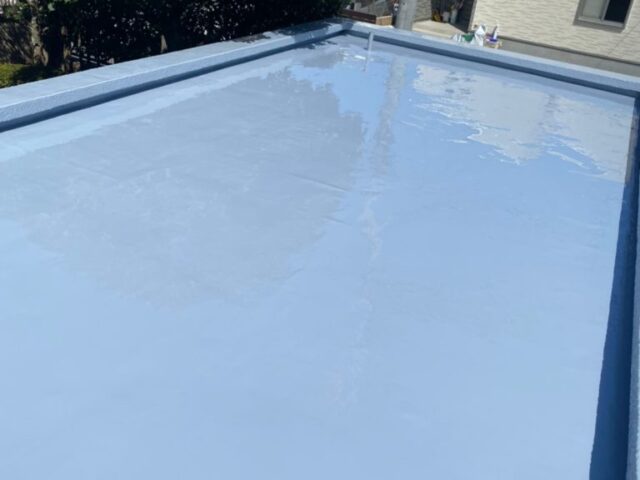
At Kakeru Koumuten, we also handle a lot of FRP waterproofing projects.
In this article, we will explain FRP waterproofing in as much detail as possible!
“Suitable and Unsuitable Installation Locations for FRP Waterproofing”
“Maintenance Methods for FRP Waterproofing and Key Points for Estimation Confirmation”
You can find information on the above three points and more about FRP waterproofing!
We hope this will be helpful for those considering maintenance or renovation of FRP waterproofing, so please take a look.
What is FRP Waterproofing?

FRP waterproofing is an abbreviation for “Fiber Reinforced Plastics,” and it has the characteristic of being excellent in waterproofing and strength among plastics.
The method of soaking glass mat with epoxy resin to create a waterproof layer and applying a top coat is called FRP waterproofing.
To simply explain FRP waterproofing, it consists of the following structure!
・Glass mat
・Polyester resin
・Top coat
FRP waterproofing is widely used for waterproofing outdoor spaces. It is utilized not only for balconies and terraces but also for rooftops and bathrooms.
Advantages and Disadvantages of FRP Waterproofing
Next, let’s take a closer look at the advantages and disadvantages of performing FRP waterproofing.
Advantages of FRP Waterproofing
First, let’s explain the advantages of FRP waterproofing.
High Waterproofing Performance

First of all, since the material used for FRP waterproofing is reinforced plastic, it has excellent waterproofing properties compared to other methods.
Thanks to the characteristics of FRP, FRP waterproofing work can prevent leaks on rooftops and balconies, thereby protecting the building.
Additionally, as some may know, FRP is used in applications that require high waterproofing, such as bathtubs and space rockets, making it a material that can be considered quite excellent in terms of its “ability to resist water.”
Impact Resistant

In addition to its high waterproofing properties, FRP also has the characteristic of being impact resistant. The surface of FRP is hard, making it strong against external impacts and pressure. Due to its hardness, it can maintain its waterproofing effectiveness over a long period.
The floor surface treated with FRP waterproofing is effective against heavy objects and friction, making it an ideal method for those who want to maintain durability for a long time.
Reduces Burden on Buildings
The FRP waterproof layer weighs about 4 kilograms per square meter.
Thus, being a relatively lightweight material, it can reduce the burden on the building.
Similar to urethane, FRP uses a considerably lightweight material, making it an excellent choice even when considering the burden on the building.
Therefore, it is suitable for waterproofing work on older buildings or wooden houses that are weak against weight.
Short Construction Period

FRP waterproofing work can be completed in as little as one day, making the construction time very short.
The reason is that while the topcoat resin needs to dry, it dries in a few hours, making it a recommended option for those looking to finish quickly.
Moreover, compared to urethane waterproofing, which is also a coating type waterproofing, FRP waterproofing has the advantage of curing much faster!
No Joints
FRP waterproofing is also known as membrane waterproofing, where “membrane” means “film,” used in the context of coating waterproofing.
Unlike sheet waterproofing, which can vary based on the skill of the worker and may create joints, FRP waterproofing can form a waterproof layer in complex shapes without any joints.
Versatile Applications
FRP waterproofing work is applicable not only to rooftops and balconies but also to various uses such as pools, tanks, and ships.
Therefore, it can be widely utilized according to the structure and purpose of the building or facility.
Disadvantages of FRP Waterproofing
Next, let’s take a closer look at the disadvantages of FRP waterproofing.
High Cost
FRP waterproofing work is relatively expensive. The cost of materials and the labor involved can reflect in the overall expenses, making it higher compared to other waterproofing methods.
Difficult to Repair and Maintain
If cracks or damage occur in the FRP waterproof layer, it can be challenging to repair or maintain. Depending on the material and construction method, it may be difficult to repair just a part, necessitating a complete replacement.
Durability Limitations
FRP waterproofing layers are known for their durability, but they are also vulnerable to ultraviolet rays, which can lead to deterioration and cracking after a certain number of years. Therefore, regular maintenance and repairs are necessary.
When considering FRP waterproofing work, it is important to compare the advantages and disadvantages while taking these drawbacks into account and make an appropriate decision.
Timing for FRP Waterproofing Maintenance and Signs of Deterioration
The maintenance of FRP waterproofing is fundamentally based on reapplying the top coat every 5 to 7 years. Additionally, if the following signs of deterioration appear, prompt action is required.
Signs of Deterioration
・The top coat appears whitish and powdery (chalking)
・Discoloration, loss of luster, and noticeable cracks
・Wear and exposure of the waterproof layer in high foot traffic areas
・Signs of waterproof failure such as rain stains, blisters, and lifting
・Rain leaks occurring from cracks
There are various signs of deterioration like these.
If regular maintenance is neglected, it may lead to rain leaks, so please be cautious.
Methods for FRP Waterproofing Maintenance
FRP waterproofing can be broadly categorized into two types of maintenance methods.
Reapplication of the Top Coat
The durability of FRP waterproofing is said to be around 10 to 15 years, but this can be maintained through regular maintenance.
Basically, the top coat deteriorates in about 5 to 7 years, so we recommend reapplying the top coat!
In addition to the timing mentioned above, if you notice fading, the appearance of white powder (chalking), small cracks, or peeling, we recommend repainting the top coat. If left unattended, the risk of rain leaks increases, so prompt action is necessary.
Reinstallation of FRP Waterproofing
If rain leaks have already occurred or if there are cracks in the FRP waterproofing layer, simply repainting the top coat will not resolve the issue.
In such cases, it is necessary to either reinstall FRP waterproofing over the existing waterproof layer or remove the waterproof layer and then reinstall FRP waterproofing.
There are 1PLY and 2PLY methods for reinstallation of FRP waterproofing, which involve construction using glass mats.
The 1PLY method involves applying a single layer of glass mat, while the 2PLY method involves applying two layers!
What Items to Check in an Estimate for FRP Waterproofing?

We will explain the items to check in the estimate for FRP waterproofing work!
Since it varies depending on the method and materials used, please feel free to consult us if you have any questions!
FRP Waterproofing Work [1PLY Method]
Preparation
We will perform preparation using polymer masks and masking tape.
Make sure to check if the materials to be used are detailed in the documentation.
New Base Treatment
As part of the base adjustment, if there are any irregularities in the existing base, we will perform a scraping operation. Additionally, we will conduct an acetone wipe.
Let’s confirm that this item is clearly documented.
If it is not documented, there may be additional costs involved.
Primer Application
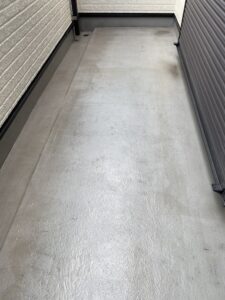 Similar to urethane waterproofing, we will apply a primer specifically for FRP waterproofing to enhance the adhesion between the base and the new waterproof layer.
This is an important item for increasing the adhesion between the existing base and the new waterproof layer.
Let’s confirm in advance what materials will be used.
New Glass Mat Installation
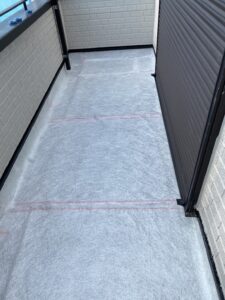 After applying the primer, we will lay down the glass mat.
Polyester Resin Application
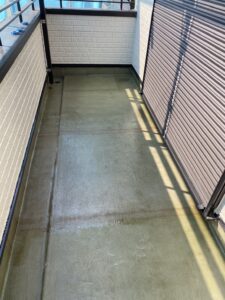 We will use FRP-specific polyester resin to cure the waterproof layer.
The process will vary depending on whether you are using the 1PLY method or the 2PLY method.
Let’s confirm whether the materials are clearly specified!
Surface Preparation
Before applying the top coat, let’s check if surface preparation has been carried out.
If this item has not been performed, there is a possibility of poor adhesion leading to immediate peeling, so let’s confirm if it will be done in advance.
Top Coat Application
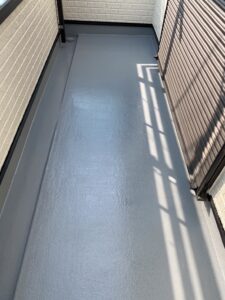 This is a subsequent item. To protect the waterproof layer, we will apply a top coat specifically for FRP as a protective agent. Since FRP is fundamentally a material that is weak against ultraviolet rays, we recommend applying a top coat!
About Suitable Bases and Primers for FRP Waterproofing
The type and condition of the base, as well as the construction location, will determine the appropriate undercoat materials and waterproofing materials.
Here, we will explain the optimal materials for each type of base and construction location.
Concrete (New)
Undercoat Material → Polyester-based Primer
The undercoat material should be thoroughly dried before application.
Concrete (Existing/Deteriorated)
→ Epoxy-based Primer
This epoxy-based primer is an effective undercoat material for rust prevention, absorption prevention, and improving adhesion.
Metal
→ Metal-specific Primer
When applying FRP waterproofing to a metal substrate, a primer specifically designed for metal is required. Using a standard primer may lead to poor adhesion and an increased risk of rust.
Existing FRP Waterproofing Layer
→ Primer for FRP
After roughening the surface of the existing waterproofing layer, the primer enhances adhesion. Depending on the condition of the substrate, removal may be necessary. Some topcoats can be applied without a primer.
Suitable and Unsuitable Locations for FRP Waterproofing
Locations Suitable for FRP Waterproofing
1. Verandas and Balconies
FRP waterproofing is most commonly used on residential verandas and balconies!
These areas are frequently walked on and are significantly affected by rainwater. With FRP waterproofing, the surface becomes hard and durable, making it resistant to wear and degradation, allowing for long-term use with peace of mind.
2. Roof Balconies (Area less than 15㎡)
FRP waterproofing is also effective on flat roofs (roofs common in small to medium-sized buildings)!
It is suitable for areas that are not too large, providing a reliable waterproof layer without adding weight to the building. Additionally, it has high resistance to UV rays and rain, resulting in less maintenance effort!
Locations Unsuitable for FRP Waterproofing
Large Rooftops
Due to significant expansion and contraction from temperature changes, rigid materials like FRP can lead to cracking.
Buildings with Significant Movement
The FRP waterproofing layer may not be able to adapt to movements caused by earthquakes or wood expansion, leading to risks of poor adhesion, lifting, and cracking. FRP waterproofing is not recommended for buildings with movement.
FRP Waterproofing Methods
There are mainly two methods for FRP waterproofing, 1PLY Method and 2PLY Method.
The difference between 1PLY and 2PLY in FRP waterproofing lies in the thickness and durability of the layers. 1PLY uses one layer each of glass mat and resin, making it lightweight and quick to install, suitable mainly for residential balconies, while 2PLY consists of two layers, increasing thickness and improving wear resistance and waterproofing, making it suitable for common corridors and rooftops where durability is required due to high foot traffic.
Recommended FRP Waterproofing Materials
Here, we introduce recommended waterproofing materials used in FRP waterproofing work!
Tough Seal / Nippon Special Paint
The Tough Seal series from Nippon Special Paint is a high-performance topcoat/waterproofing material specifically designed for FRP waterproofing, with the representative model Tough Seal #50 being a trusted material ideal for balconies and rooftops.
Tough Seal forms a strong yet lightweight coating, featuring rapid curing, weather resistance, wear resistance, and thermal insulation, making it a product that supports the reliability and aesthetic maintenance of all external parts over the long term.
Possible Subsidies for FRP Waterproofing
When using a heat-insulating topcoat in FRP waterproofing, there is a possibility of being eligible for subsidies such as energy-saving grants from various municipalities.
[Katsushika-ku, Tokyo] Katsushika Eco Subsidy
Eligible Construction Work
High Reflective Coating:Painting work using high reflective paint on roofs and exterior walls.
Private Residences
Subsidy Amount
For work on only the roof or exterior wall: 50,000 yen per unit.
For work on both the roof and exterior wall: 100,000 yen per unit.
Multi-Family Dwellings & Businesses
Subsidy Amount
One-fourth of eligible expenses or construction area (㎡) × 1,000 yen
whichever is smaller
Maximum Amount
Multi-family Dwellings: 1,000,000 yen
Businesses: 400,000 yen
Requirements
The solar reflectance in the near-infrared region of the paint used must be 65% or higher.
For more details, please refer to Katsushika Eco Subsidy|Katsushika Ward Official Site
【Chuo-ku, Tokyo】Fiscal Year 7 Subsidy Program for Residential and Multi-Family Dwellings for Natural Energy and Energy-Saving Equipment Installation Costs
Subsidy Amount
350,000 yen to 100,000 yen
Subsidy Rate
Partial subsidy for the installation costs of eligible equipment (equipment, materials, and installation work costs)
20% of the costs
Eligible Materials
High Reflective Paint:Using paint with high solar reflectance to reduce the cooling load of buildings
Eligible Applicants
Individuals residing in Chuo-ku
Management associations of condominium buildings in Chuo-ku
For more details, please visit here.
Long-term Excellent Housing Renovation Promotion Project
The “Long-term Excellent Housing Renovation Promotion Project” implemented by the Ministry of Land, Infrastructure, Transport and Tourism supports renovations aimed at improving the durability, energy efficiency, and deterioration countermeasures of buildings.
This may include subsidies that can be utilized for urethane waterproofing work.
-
Maximum Subsidy Amount: Up to 1.6 million yen (basic 800,000 yen + additional maximum 800,000 yen)
-
Eligible Works: Deterioration countermeasures including waterproofing work, energy-saving renovations, and support for multi-generational living, etc.
For more details, please check the official website.
Summary
Costs for FRP waterproofing can vary among contractors, so it is advisable to obtain estimates from multiple companies and select the contractor accordingly.
Kakeru Koumuten Co., Ltd. has extensive experience in FRP waterproofing, and we welcome competitive estimates!
We can handle everything from temporary scaffolding to FRP waterproofing work with our own team, so if you are considering renovations or repairs for FRP waterproofing, please feel free to consult with us!
Free estimates and consultations are also very welcome, so please feel free to contact us!
For more helpful information on other exterior renovations, click here!
We welcome consultations via LINE as well◎

We are also updating our Instagram regularly◎ Please follow us◎

contact Kakeru Koumuten Co., Ltd.
Kakeru Koumuten is a young company whose team is, on average, in their late twenties, but our skills are second to none.
Our greatest strength is that we handle scaffolding, roofing and painting entirely in-house. In an industry where these tasks are usually divided among contractors, our complete service simplifies project management and helps keep costs down. Above all, if a problem arises, we respond promptly.
We proudly describe ourselves as the youngest and most helpful renovation company in Kanagawa!